


Blog / Mark Jacobson Toyota Service

ToyotaCare vs ToyotaCare Plus vs Extended Warranty: What Durham Owners Should Know

ToyotaCare vs ToyotaCare Plus vs Extended Warranty: What Durham Owners Should Know

Toyota Ownership Guide • Durham, NC

Maintenance Plan or Repair Protection? Know What Your Toyota Coverage Actually Does

ToyotaCare, ToyotaCare Plus and a Toyota Vehicle Service Agreement can all be part of the ownership conversation, but they cover different expenses and should not be treated as interchangeable products.

ToyotaCare, ToyotaCare Plus and what shoppers often call a Toyota extended warranty serve different purposes. ToyotaCare is the no-cost scheduled-maintenance program included with eligible new Toyota vehicles. ToyotaCare Plus is an optional prepaid maintenance plan that can continue eligible scheduled services beyond the initial ToyotaCare period. A Toyota Vehicle Service Agreement, often described conversationally as an extended warranty, is optional protection for certain covered repair costs under the agreement. ToyotaCare Plus is not an extended repair warranty.

That distinction matters because maintenance and repairs solve different ownership problems. An oil change, tire rotation or scheduled inspection is maintenance. A covered component that fails unexpectedly is a repair issue. Paying for a maintenance plan does not automatically mean future mechanical repairs are covered, and buying a Vehicle Service Agreement does not mean routine scheduled maintenance is included.

There is another reason Durham Toyota owners should look closely at the details in 2026: ToyotaCare terms now differ by model year. A 2026 Toyota and a 2027 Toyota can begin ownership with different standard ToyotaCare structures. Before comparing plans, identify your vehicle's model year, date of first use and current mileage, then read the specific agreement that applies to that vehicle.

The Simplest Way to Understand the Difference

ToyotaCare and ToyotaCare Plus are centered on scheduled maintenance. A Toyota Vehicle Service Agreement is centered on eligible covered repairs. The factory warranty is another separate layer. Start by identifying whether you are trying to plan routine service costs or protect against certain future repair costs, then evaluate the product designed for that purpose.

ToyotaCare vs ToyotaCare Plus vs Extended Warranty

The names can sound as though they represent increasing levels of the same coverage. They do not. ToyotaCare starts the ownership experience with eligible scheduled maintenance and roadside assistance. ToyotaCare Plus is an optional prepaid maintenance product for owners who want to continue eligible scheduled services under a plan. A Toyota Vehicle Service Agreement focuses instead on eligible repairs to covered components, subject to its terms, exclusions, limitations and any applicable deductible.

ProductMain PurposeScheduled MaintenanceEligible Covered RepairsHow You Get It
ToyotaCareInitial factory-scheduled maintenance plus roadside assistance for eligible new ToyotasYes, according to the applicable maintenance schedule and program termsNo. It is not a repair warranty or VSA.Included at no additional cost with eligible new Toyota vehicles
ToyotaCare PlusContinue eligible prepaid scheduled maintenanceYes, according to the selected plan and vehicle maintenance guideNo. It does not replace a repair VSA.Optional purchase, subject to eligibility
Toyota Vehicle Service AgreementProtection for certain eligible repair costsNot a routine maintenance planYes, for covered components subject to agreement termsOptional purchase, subject to eligibility and availability
Factory WarrantyManufacturer warranty protection for applicable covered defects/componentsNot a prepaid maintenance planCoverage depends on the warranty and component involvedComes with the new vehicle under Toyota's applicable warranty terms

This four-layer view is more useful than asking which plan has the most benefits. The products are aimed at different expenses. A driver may care about predictable service visits, unexpected repair exposure, or both. That is why an owner can conceptually have maintenance coverage and repair protection at the same time without the two products being duplicates.

What Does ToyotaCare Cover?

ToyotaCare is Toyota's no-cost maintenance program for eligible new Toyota vehicles. It is designed around normal factory-scheduled maintenance during the applicable program period. Services follow the vehicle's Warranty and Maintenance Guide, which is important because not every Toyota uses the same maintenance schedule or requires identical service at the same mileage.

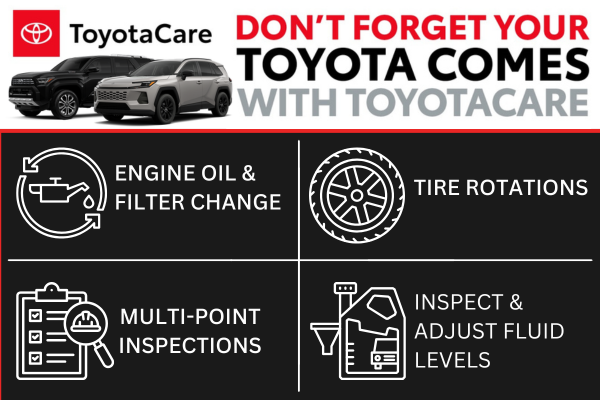
Depending on the vehicle and maintenance interval, ToyotaCare can include items such as engine oil and oil-filter changes when due, tire rotations, multi-point inspections and fluid-level inspections or adjustments. Toyota-trained technicians perform the eligible services using the maintenance schedule for the specific vehicle.

ToyotaCare also includes roadside assistance for an applicable period. Roadside services can include assistance for situations such as a flat tire, battery jump-start, lockout, emergency fuel delivery, towing or winching, subject to program limitations. Roadside assistance should not be confused with repair coverage either. A tow may help get a vehicle to the dealership, but that does not automatically mean the cause of the breakdown is covered by ToyotaCare.

What ToyotaCare Does Not Mean

ToyotaCare is not a promise that every maintenance item, wear item or repair during ownership is free. The exact scheduled services depend on the vehicle's maintenance guide, and program exceptions exist for certain models and powertrains.

For example, tires, brake friction materials, wiper blades and other items can wear with use. Whether a particular item or repair is covered depends on the applicable maintenance plan, warranty, service agreement or other protection product, not simply on the fact that the Toyota originally came with ToyotaCare.

The safest approach is to separate the question into two parts: “Is this service scheduled maintenance included under my current plan?” and “If this is a repair, is it covered by an applicable warranty or service agreement?” Those are not the same question.

ToyotaCare Changed for 2027 Model-Year Vehicles

For 2027-model-year and newer Toyota vehicles, Toyota's current standard ToyotaCare structure differs from many 2026-and-earlier vehicles. Toyota currently states that ToyotaCare covers normal factory-scheduled maintenance for 1 year or 10,000 miles, whichever comes first, while 2026-model-year and earlier vehicles are an exception that retain the 2-year/25,000-mile ToyotaCare structure. Other model-specific exceptions also exist, so owners should identify the model year and vehicle before assuming the historical 2-year/25,000-mile figure applies.

Vehicle GroupCurrent ToyotaCare Maintenance StructureWhy Owners Should Check
Most MY2027 and newer eligible Toyota vehicles1 year or 10,000 miles, whichever comes firstThis is different from the historical ToyotaCare structure many owners remember.
MY2026 and earlier eligible Toyota vehicles2 years or 25,000 miles, whichever comes firstToyota currently lists these model years as an exception to the newer structure.
Selected models or electrified vehiclesProgram terms can differCheck the specific ToyotaCare disclosure and Warranty and Maintenance Guide.

Roadside-assistance terms also have their own rules and model-specific exceptions. That is another reason not to describe all ToyotaCare benefits with one universal time-and-mileage statement.

This change is particularly relevant in late 2026 because a dealership can have shoppers researching both 2026 and 2027 vehicles at the same time. Two customers buying new Toyotas during the same month may see different ToyotaCare maintenance periods because the vehicles belong to different model years.

If you already own a Toyota, the model year and original date of first use matter more than today's calendar date. Your coverage follows the program applicable to the vehicle rather than automatically changing because Toyota introduced a newer structure for later model years.

What Does ToyotaCare Plus Cover?

ToyotaCare Plus is an optional prepaid maintenance plan. Its purpose is to help eligible owners continue scheduled Toyota maintenance beyond the initial no-cost ToyotaCare period or otherwise add eligible future maintenance services under the plan structure that applies to the vehicle.

Current Toyota Financial information lists services that may include engine oil and oil-filter changes, tire rotations, multi-point inspections and other maintenance specified by the vehicle's maintenance guide. For MY2027-and-newer plans, Toyota Financial also lists eligible cabin and engine air-filter changes where applicable. Roadside-assistance benefits are also included under current ToyotaCare Plus program terms, subject to the plan's restrictions.

ToyotaCare Plus Eligibility for MY2026 and Earlier

For vehicles model year 2026 and older, Toyota Financial currently says eligible vehicles generally need to have been eligible for the no-cost 2-year/25,000-mile ToyotaCare program, be within 37 months of the date of first use and have 31,000 miles or fewer.

Current plan choices for that group can range from 3 years or 35,000 miles through 5 years or 75,000 miles, depending on the plan and vehicle. Importantly, Toyota Financial measures this coverage from the date of first use. A 5-year plan should not be interpreted as five additional years beginning only after ToyotaCare ends.

ToyotaCare Plus for MY2027 and Newer

The newer structure is different. Toyota Financial currently lists eligibility for MY2027-and-newer ToyotaCare Plus plans when the vehicle has fewer than 16,000 miles, was ToyotaCare eligible and does not already have another prepaid maintenance plan.

Depending on the selected plan, current options range from 2 years with up to 3 services through 6 years with up to 13 services. Toyota Financial states that coverage begins at the point of sale or once ToyotaCare expires, depending on the circumstances, and ends when the plan's maximum time or number of services is reached.

Check the Model Year Before Comparing ToyotaCare Plus

A ToyotaCare Plus description written for a 2026 vehicle may not accurately describe eligibility, plan length or service-count structure for a 2027 vehicle. Use the agreement and current Toyota Financial information for the specific model year instead of relying on an older ToyotaCare Plus explanation.

ToyotaCare Plus Does Not Replace an Extended Warranty

This is the point most worth remembering. ToyotaCare Plus helps plan eligible scheduled maintenance. It is not designed as broad repair protection for a failed transmission, electronics module, air-conditioning component or other mechanical system simply because the repair occurs while the maintenance plan is active.

Likewise, a Vehicle Service Agreement is not a substitute for your maintenance schedule. If the agreement covers an eligible mechanical repair, that does not eliminate the need to change oil, rotate tires, inspect components or perform other maintenance identified in the Warranty and Maintenance Guide.

Maintenance history can also matter when diagnosing problems or evaluating coverage. Following the manufacturer's maintenance requirements helps document that the vehicle was serviced appropriately, but maintenance itself should still be treated separately from contractual repair coverage.

What Is a Toyota Vehicle Service Agreement?

A Toyota Vehicle Service Agreement, or VSA, is the Toyota Financial product most closely related to what consumers commonly mean when they say “extended warranty.” Technically, it is a service agreement rather than the original factory warranty. It provides coverage for eligible repair costs to specified components according to the protection level and terms selected.

For qualifying new Toyota vehicles, Toyota Financial currently offers levels including Platinum Protection, Gold Protection and Powertrain Protection, plus separate products for certain battery-electric vehicles. The covered component list becomes broader or narrower depending on the protection level, so the plan name alone is not enough to determine whether a specific repair is covered.

Current Toyota Financial rules say new Toyota vehicles can generally be eligible to purchase a new-vehicle VSA up to 3 years or 36,000 total vehicle miles, whichever comes first. Eligibility does not mean every plan is identical or available in every situation. State availability, vehicle type, purchase date and program rules can affect the agreement.

For Platinum Protection, Toyota Financial currently lists term choices that can range from 3 years/50,000 total vehicle miles to as long as 10 years/125,000 total vehicle miles. Other protection levels can have different maximum terms. Coverage periods are measured according to the agreement, and deductibles, exclusions and limitations can apply.

What Should You Look for in the VSA Agreement?

Do not evaluate repair protection only by the maximum number of years printed in a brochure. Look at what components are included, what is excluded, how the deductible works, where covered repairs can be performed, when the term starts, the mileage limit and what happens if the vehicle is sold or the agreement is canceled.

Toyota Financial also states that its VSAs are optional and are not required to obtain credit. That is important whenever a protection product is discussed during vehicle financing. A shopper should understand the vehicle price, financing terms and optional protection products as separate parts of the transaction.

Mark Jacobson Toyota maintains an Extended Warranty Options page where Durham shoppers can review available protection categories and discuss current eligibility.

ToyotaCare Plus vs Extended Warranty: Which Expense Are You Planning For?

Choose based on the expense you are trying to plan for. If your goal is to prepay eligible factory-scheduled maintenance, a maintenance product such as ToyotaCare Plus is the relevant category. If your concern is the cost of certain unexpected mechanical or electrical repairs after applicable warranty coverage, a Vehicle Service Agreement is the relevant category. One product does not automatically substitute for the other, and some owners may consider both because they address different costs.

Your Main ConcernProduct to UnderstandReason
Oil changes and scheduled serviceToyotaCare / ToyotaCare PlusThese products center on eligible scheduled maintenance.
Planning maintenance costs beyond ToyotaCareToyotaCare PlusIt is an optional prepaid maintenance plan for qualifying vehicles.
Unexpected eligible component repairFactory warranty or VSA, depending on timing and coverageRepair coverage is different from scheduled maintenance.
Longer-term repair-cost protectionToyota Vehicle Service AgreementVSAs cover eligible components according to the selected agreement.
Roadside assistanceReview the current ToyotaCare, ToyotaCare Plus or VSA termsRoadside benefits can exist in multiple products, but duration and limitations differ.

It is also reasonable to choose neither optional product if you prefer to pay maintenance and repairs as they occur. These are voluntary protection products, not mandatory components of owning or financing a Toyota. The useful question is whether a particular plan's services, eligibility and cost fit the way you expect to own and maintain the vehicle.

What About the Toyota Factory Warranty?

The factory warranty should be treated as its own layer. A new Toyota includes manufacturer warranty coverage under Toyota's warranty terms, with different coverage periods potentially applying to different systems or components. Your Warranty and Maintenance Guide is the controlling source for the specific vehicle.

A Vehicle Service Agreement can provide eligible repair protection beyond or alongside applicable warranty periods according to the VSA contract, but it does not rewrite the factory warranty. Similarly, ToyotaCare does not extend the factory warranty simply because scheduled maintenance is being performed at the dealership.

If a problem occurs while your vehicle is still within an applicable factory warranty period, the service department can determine whether the issue is covered by that warranty, another applicable campaign or agreement, or is the owner's responsibility. You do not need to decide which coverage applies by guessing based on the repair cost.

What About Toyota Service Care?

Toyota Service Care is another prepaid maintenance product, but it is aimed at a different stage of ownership. Toyota Financial describes it as maintenance coverage available through the service drive for vehicles that are no longer covered by ToyotaCare and do not have another active prepaid maintenance plan.

Current Toyota Financial information says Toyota Service Care has no vehicle age or mileage maximum under its general eligibility rules, provided ToyotaCare has expired and there is no other active prepaid maintenance plan. Services can include oil and filter changes, tire rotations and multi-point inspections, along with roadside assistance under the applicable terms.

Mark Jacobson Toyota also has a dedicated Toyota Service Care page for owners who want to explore maintenance options after the original ToyotaCare stage.

That means Toyota Service Care should not be confused with a VSA either. Like ToyotaCare Plus, it belongs primarily in the maintenance-planning bucket rather than the repair-protection bucket.

What About Toyoguard Platinum?

Durham is in the Southeast Toyota region, so some buyers may also encounter the name Toyoguard Platinum. Toyoguard is a separate Southeast Toyota program and should not be assumed to be another name for ToyotaCare Plus or a Vehicle Service Agreement.

If your purchase paperwork mentions Toyoguard, review the actual benefits attached to that vehicle rather than merging them mentally with ToyotaCare. We cover that regional distinction separately in our ToyotaCare vs Toyoguard Platinum guide for Durham, Raleigh and Cary owners.

Which Toyota Protection Fits Your Ownership Plan?

Start with how long you expect to keep the Toyota. A driver who normally trades vehicles after a few years may view long-term repair protection differently from an owner planning to keep a Toyota well beyond the original warranty period. At the same time, both drivers still have scheduled maintenance responsibilities while they own the vehicle.

Next, think about how you prefer to handle expenses. Some owners like the predictability of prepaying eligible maintenance rather than paying at each visit. Others prefer keeping that money available and paying service costs when they occur. Neither approach automatically guarantees lower total ownership cost.

For repair protection, consider your tolerance for an unexpected covered repair bill, the components included in the agreement, the deductible, the ownership period and the price of the VSA. A longer term can sound attractive, but only if its start date, mileage limit and coverage list match how long and how far you expect to drive.

Can You Have ToyotaCare Plus and a VSA at the Same Time?

Conceptually, yes, because the products address different categories of expense. ToyotaCare Plus can cover eligible scheduled maintenance under its agreement while a VSA can provide protection for eligible covered repairs under a separate agreement. Actual eligibility and plan availability still need to be confirmed for the specific vehicle.

The presence of one plan should not be used as proof that the other is unnecessary. Nor should buying both automatically be described as the best value. The decision depends on what each agreement covers, what it costs and whether those benefits fit your ownership plan.

Questions to Ask Before Buying a Toyota Protection Product

Before agreeing to any optional maintenance or repair product, ask for the plan name and written agreement. Product names can sound similar, but the contract makes clear what you are actually purchasing.

  • Is this a maintenance plan or repair-protection agreement?
  • What exact services or components are covered?
  • What is specifically excluded?
  • When does the coverage period begin?
  • Does the term run from today's purchase date or the vehicle's original date of first use?
  • What mileage or service-count limit ends the plan?
  • Is there a deductible for covered repairs?
  • Where can maintenance or repairs be performed?
  • What roadside-assistance benefits are included and for how long?
  • Is the agreement transferable if I sell the Toyota?
  • What are the cancellation terms?
  • Is this Toyota-backed, Southeast Toyota-related or administered by another provider?
  • Is the product optional?

If you cannot tell from the paperwork whether you are buying maintenance or repair protection, ask for that distinction to be explained before signing. That one question prevents a large portion of the confusion surrounding ToyotaCare Plus and extended warranties.

Key Takeaways for Durham Toyota Owners

  • ToyotaCare is the initial no-cost scheduled-maintenance program for eligible new Toyota vehicles, with roadside assistance under applicable program terms.
  • ToyotaCare Plus is an optional prepaid maintenance plan, not an extended repair warranty.
  • MY2027-and-newer ToyotaCare generally uses a 1-year/10,000-mile maintenance structure, while MY2026-and-earlier vehicles are currently listed as a 2-year/25,000-mile exception.
  • ToyotaCare Plus eligibility and plan structure also differ by model-year group, so older plan descriptions should not automatically be applied to a 2027 vehicle.
  • A Toyota Vehicle Service Agreement is optional repair protection for eligible covered components and can have exclusions, deductibles and other contract-specific limitations.
  • Toyota Service Care is another prepaid maintenance option aimed at owners beyond the ToyotaCare stage, not a repair warranty.
  • Optional protection products should be evaluated separately from the vehicle purchase and financing terms.

ToyotaCare, ToyotaCare Plus and Extended Warranty FAQ

Is ToyotaCare Plus an extended warranty?

No. ToyotaCare Plus is a prepaid maintenance plan. It can cover eligible scheduled maintenance such as oil and filter changes when applicable, tire rotations, inspections and other services specified by the vehicle maintenance guide. A Toyota Vehicle Service Agreement is the product designed to provide protection for certain eligible repair costs under its contract.

Does ToyotaCare cover repairs?

ToyotaCare is primarily a scheduled-maintenance and roadside-assistance program. It should not be treated as general repair coverage. A repair may instead fall under an applicable Toyota factory warranty, recall or service campaign, Vehicle Service Agreement or another protection product depending on the specific problem and vehicle.

Is ToyotaCare different for 2027 Toyota models?

Yes. Toyota's current program information states that most eligible 2027-model-year and newer vehicles receive ToyotaCare scheduled maintenance for 1 year or 10,000 miles, whichever comes first. Toyota currently lists 2026-model-year and earlier vehicles as an exception with the previous 2-year/25,000-mile structure. Additional model-specific exceptions can apply.

When does ToyotaCare Plus coverage start?

It depends on the model-year group and plan. For MY2026-and-earlier ToyotaCare Plus plans, Toyota Financial states that coverage is measured from the vehicle's date of first use. For MY2027-and-newer plans, current Toyota Financial information says coverage begins at the point of sale or once ToyotaCare expires, depending on the circumstances. Review the specific agreement before purchasing.

Can I buy a Toyota Vehicle Service Agreement after buying the vehicle?

Potentially, yes. Toyota Financial currently states that qualifying new Toyota vehicles can generally be eligible for a new-vehicle VSA up to 3 years or 36,000 total vehicle miles, whichever comes first. Eligibility, available plans and state-specific terms can vary, so confirm the current options for your vehicle before relying on that window.

Review the Plan Before You Decide

ToyotaCare, ToyotaCare Plus and Vehicle Service Agreements can each be useful in the right ownership situation, but they solve different problems. The best starting point is the actual vehicle: its model year, current mileage, maintenance schedule, existing warranty coverage and how long you expect to keep it.

Mark Jacobson Toyota can help Durham owners review current maintenance and protection options, confirm eligibility and explain how the applicable agreement works before a decision is made.

Explore Protection Options Visit Our Service Center

Related Toyota Insights & Ownership Guides


Posted in:

Related Posts

toyota tire rotation

Tire Rotations and Alignment: The Definitive Guide to Spring Vehicle Health

The physical reality of driving a modern vehicle in Durham involves a complex interplay between rubber, asphalt, and weight distribution. Tire rotation is far more than a simple chore; it is a critical engineering necessity dictated by the laws of physics. In a standard vehicle, particularly front-wheel-drive models like the Toyota Camry, the front tires are burdened with a disproportionate amount of labor. They must support the heavy weight of the engine and transmission, manage the friction required for steering, and absorb nearly eighty percent of the kinetic energy during braking. This creates a thermal and mechanical environment where the front tires degrade at a much higher rate than the rear counterparts. Without regular intervention, this imbalance leads to a rapid decline in tread depth, eventually compromising the structural integrity of the tire and the safety of the occupants. The Science of Tire Longevity and Strategic Rotation Patterns When we perform a tire rotation at Mark Jacobson Toyota, we are effectively resetting the wear clock for each tire. By systematically moving the front tires to the rear and the rear tires to the front often using the "Forward Cross" or "Rearward Cross" patterns depending on your specific drivetrain we ensure that no single tire is subjected to localized stress for too long. This process allows the rubber compounds to wear down at a uniform rate across the entire set. Uniform tread wear is the cornerstone of vehicle stability; it ensures that all four corners of your car provide equal grip during cornering and identical water evacuation capabilities during Durham’s sudden spring thunderstorms. Furthermore, maintaining a matched set of tires preserves the delicate balance of your suspension system, preventing secondary wear on wheel bearings and struts. By adhering to a strict 5,000-mile rotation interval, you are not merely extending the life of the rubber; you are protecting the complex mechanical symphony that keeps your vehicle moving efficiently. This proactive approach saves thousands of dollars over the life of the vehicle, as it prevents the premature purchase of new tires and maximizes the return on your initial investment. In the long run, consistent rotation ensures that when it finally comes time to replace your tires, you can replace all four at once, which is the only way to maintain the manufacturer's intended handling characteristics and safety ratings for your specific Toyota model. Drivetrain Dynamics and Positional Wear Characteristics The specific way your vehicle delivers power to the road whether through Front-Wheel Drive (FWD), Rear-Wheel Drive (RWD), or All-Wheel Drive (AWD) drastically alters the wear characteristics of your tires. In FWD vehicles, the front tires are the "workhorses," handling propulsion, steering, and the majority of braking forces, leading to rapid shoulder wear. Conversely, in RWD vehicles, the rear tires often see more center-tread wear due to the forces of acceleration. AWD systems present a unique challenge; because all four wheels are powered, the tires must be almost identical in tread depth to prevent strain on the center differential. A difference of even a few millimeters can cause the computer systems to misinterpret wheel speed, potentially leading to expensive drivetrain damage. Therefore, rotation is not just about the tires themselves, but about protecting the expensive transmission and differential components. By understanding these dynamics, our technicians can apply the most effective rotation pattern for your specific Toyota. This technical precision ensures that your vehicle remains balanced, preventing the "feathering" or "cupping" that often occurs when tires are left in the same position for too long, ultimately providing a smoother and much quieter ride on the North Carolina highways. The Technical Nuances of Wheel Alignment and Suspension Geometry While tire rotation addresses the wear on the rubber, wheel alignment focuses on the intricate geometry of the vehicle’s suspension system. Alignment is the process of adjusting the angles of the wheels so they are perfectly parallel to each other and perpendicular to the ground. This is achieved by fine-tuning three primary measurements: camber, caster, and toe. Camber refers to the inward or outward tilt of the tire when viewed from the front; improper camber causes the tire to lean, wearing out one edge prematurely. Caster is the angle of the steering axis when viewed from the side, which is essential for steering stability and the "self-centering" feel of the wheel. Toe is the most critical setting for tire life; it describes whether the fronts of the tires are pointing toward or away from each other. Even a fraction of a degree of "toe-in" or "toe-out" is equivalent to dragging your tires sideways across the pavement for every mile you drive. In the Durham area, the transition from winter to spring is particularly treacherous for alignment. The expansion and contraction of the asphalt on roads like I-40 and University Drive create deep potholes that can easily jar a vehicle’s suspension out of its factory specifications. When your alignment is compromised, your car has to fight against itself. You may notice a persistent "pull" to one side, or you might find that your steering wheel is no longer centered when driving straight. This misalignment creates a significant amount of "rolling resistance," meaning your engine must work harder and burn more fuel just to maintain speed. At Mark Jacobson Toyota, we use state-of-the-art laser alignment technology to measure these angles with microscopic precision. Our certified technicians don’t just look at the tires; they inspect the entire suspension ecosystem, including ball joints, tie rods, and bushings. If these components are worn or damaged by winter road debris, even a perfect alignment won’t hold. By restoring your vehicle to its original factory settings, we ensure that your Toyota tracks straight, handles predictably in emergency maneuvers, and maintains the highest possible level of fuel efficiency, all while protecting your tires from the devastating effects of uneven wear. Calibrating the Future: Alignment and ADAS Integration Modern Toyota vehicles are equipped with Toyota Safety Sense (TSS), a sophisticated suite of Advanced Driver Assistance Systems (ADAS) that includes Lane Departure Alert and Dynamic Radar Cruise Control. These systems rely on cameras and sensors that are calibrated based on the vehicle’s "thrust angle" the direction the rear wheels are pointing. If a technician performs a mechanical alignment but fails to perform a "Zero Point Calibration" of the electronic sensors, the safety systems may become confused. The car might "think" it is drifting out of a lane when it is actually traveling straight, leading to intrusive steering corrections or even system failure. At Mark Jacobson Toyota, we understand that a modern alignment is a dual process involving both mechanical wrenches and digital software. We ensure that your car’s digital brain is perfectly synchronized with its physical wheels. This holistic approach is something that many independent "quick-lube" shops simply cannot offer because they lack the proprietary Toyota diagnostic tools. By choosing dealership service, you are guaranteeing that your vehicle’s safety technology works exactly as the engineers intended, providing you with peace of mind every time you merge onto the busy Durham-Chapel Hill Boulevard. Beyond the Tread: Fuel Efficiency and Environmental Stewardship The relationship between tire maintenance and environmental impact is often underestimated by the average driver. However, the physics of "rolling resistance" plays a massive role in your vehicle's carbon footprint and your monthly fuel budget. When tires are improperly aligned or unevenly worn, they do not roll across the pavement smoothly; instead, they experience increased friction. This friction acts as a constant drag on the vehicle, requiring the internal combustion engine or electric motor to exert significantly more energy to overcome the resistance. Studies have shown that a vehicle with poor alignment can suffer a decrease in fuel economy by as much as ten percent. Over the course of a year, for a commuter in the Durham area, this equates to hundreds of dollars in wasted fuel and a substantial increase in CO2 emissions. Proper tire rotation and alignment are, therefore, essential components of "green" driving, ensuring that your Toyota operates at its peak aerodynamic and mechanical efficiency. Furthermore, the environmental cost of premature tire disposal is staggering. Tires are notoriously difficult to recycle and often end up in landfills where they can take centuries to decompose. By extending the life of your tires through regular maintenance at Mark Jacobson Toyota, you are directly reducing the demand for new rubber production and decreasing the volume of waste generated by your vehicle. A set of tires that lasts for 60,000 miles instead of 30,000 miles represents a fifty-percent reduction in your automotive waste footprint. Additionally, well-maintained tires contribute to a quieter urban environment. Tires with uneven wear patterns, such as "cupping" or "feathering," generate significantly more road noise, contributing to noise pollution in our local neighborhoods. By investing in a spring alignment and rotation, you are not just performing a mechanical service; you are engaging in responsible vehicle ownership that benefits the local Durham ecosystem. Our service center is committed to this philosophy of efficiency, using precision tools to ensure that every drop of fuel is used to move you forward rather than overcoming the friction of a misaligned suspension. This intersection of economic savings and environmental protection makes tire maintenance one of the most impactful decisions a vehicle owner can make. Distinguishing Between Wheel Balance and Alignment It is a common misconception among drivers that wheel balancing and wheel alignment are the same service, but they address entirely different issues. Balancing refers to the compensation for weight imbalances within the tire and wheel assembly itself. Even high-quality tires have tiny manufacturing imperfections that make one side heavier than the other. At high speeds, these heavy spots create centrifugal force, causing the wheel to wobble or bounce. This is typically felt as a vibration in the steering wheel or seat at speeds between 55 and 70 miles per hour. During a tire rotation at Mark Jacobson Toyota, we often recommend a balance check. We use specialized machines to identify these heavy spots and apply small lead-free weights to the rim to ensure a perfectly smooth rotation. While alignment ensures the wheels are pointing in the right direction, balancing ensures they spin without vibrating. Neglecting balance can lead to "cupped" wear patterns that permanently ruin the tire's ride quality. By performing both services together, we provide a comprehensive solution that eliminates vibrations and prevents the premature destruction of your suspension components, ensuring your drive through the Research Triangle remains serene and controlled. Spring Restoration: Healing Your Vehicle After Winter Road Hazards The transition from winter to spring in North Carolina brings a hidden set of challenges for your vehicle's undercarriage. While our winters may not be as snowy as those in the north, the fluctuating temperatures and frequent rain-freeze cycles are devastating to road surfaces. Salt and brine used during occasional freezes can seep into the rubber bushings and metal joints of your suspension, leading to corrosion and stiffness. More importantly, the "pothole season" that follows winter is the primary enemy of your vehicle's alignment. Hitting a single deep pothole at speed on a road like NC-54 can instantly bend a tie rod or knock a strut out of its mounting position. This damage is often invisible to the naked eye but manifests quickly as uneven tire wear or a wandering steering feel. Spring is the optimal time for a professional intervention to "heal" the vehicle from these seasonal traumas and prepare it for the high-temperature demands of the upcoming summer. At Mark Jacobson Toyota, our spring car care service goes far beyond a simple tire swap. When your car is on the alignment rack, our technicians perform a comprehensive "shakedown" of the suspension. We check the integrity of the CV boots, which protect the drive axles from dirt and moisture, and we inspect the shock absorbers for signs of leaking fluid. A vehicle with worn shocks will allow the tires to bounce excessively, leading to a wear pattern known as "scalloping," which ruins the tire and increases stopping distances. By catching these issues in the spring, we prevent them from escalating into major mechanical failures during your summer road trips. Furthermore, we take this opportunity to inspect the brake lines and rotors, which are often exposed to the same harsh winter elements as the suspension. This holistic approach ensures that your Toyota is not just driving straight, but is structurally sound and safe for your family. The peace of mind that comes from a professional multi-point inspection is invaluable, especially when navigating the high-speed traffic and unpredictable weather of the Durham-Chapel Hill area. The Role of Pressure and TPMS in Vehicle Stability A critical but often overlooked aspect of tire maintenance is the management of the Tire Pressure Monitoring System (TPMS) and maintaining the correct PSI. Tire pressure is not static; it fluctuates with the outside temperature roughly one pound per square inch (PSI) for every ten-degree change. As Durham warms up in the spring, your tire pressure can rise, potentially leading to over-inflation, which causes the center of the tread to wear out prematurely and reduces traction. Conversely, under-inflation causes the sidewalls to flex excessively, generating heat that can lead to a catastrophic blowout. During your alignment service at Mark Jacobson Toyota, we manually set your pressures to the exact manufacturer specifications listed on your door placard. We also test your TPMS sensors to ensure they are communicating correctly with the vehicle's computer. If you have recently replaced a sensor or rotated your tires, the system may need to be "relearned" so it accurately identifies which tire is low. This attention to detail ensures that your dashboard warning lights stay off and that your tires provide the optimal "footprint" on the road, maximizing both safety and comfort. Additional Insights on Regional Maintenance The unique geography of Durham, situated between the coast and the mountains, means your tires face a variety of stresses from high-speed highway commuting to stop-and-go city traffic. This diversity of driving conditions makes frequent inspections even more vital than in more uniform climates. A vehicle driven primarily on I-40 will experience different wear patterns than one used for short trips around Duke University. Furthermore, the resale value of your Toyota is directly tied to its maintenance history. A vehicle with documented, regular alignments and rotations at a certified dealership like Mark Jacobson Toyota commands a higher price on the secondary market. It proves to potential buyers that the vehicle was cared for by professionals who understood the specific needs of the brand, ensuring the long-term health of the drivetrain. Finally, the quality of service at a dedicated dealership cannot be overstated. We use genuine Toyota parts and factory-calibrated equipment that "talks" to your car’s specific software. While a generic shop might offer a cheaper "quick" alignment, they often lack the data to handle the complexities of modern steering systems. Investing in professional service today prevents the need for expensive repairs and tire replacements tomorrow. Visit Mark Jacobson Toyota Today Don't let the remnants of winter road damage compromise your driving experience this season. Our team of Toyota-certified technicians at Mark Jacobson Toyota is ready to provide the precision care your vehicle deserves. Whether you need a simple tire rotation to even out your tread wear or a full four-wheel laser alignment to restore your steering to factory perfection, we are here to help. Our state-of-the-art facility on the Durham-Chapel Hill Blvd offers a comfortable lounge, transparent pricing, and the expertise only a dealership can provide. Visit us today at 14516 Durham-Chapel Hill Blvd or schedule your appointment online in just a few clicks to ensure your Toyota is safe, efficient, and ready for the road ahead.

Toyota Remote Connect & Digital Key: Durham Setup

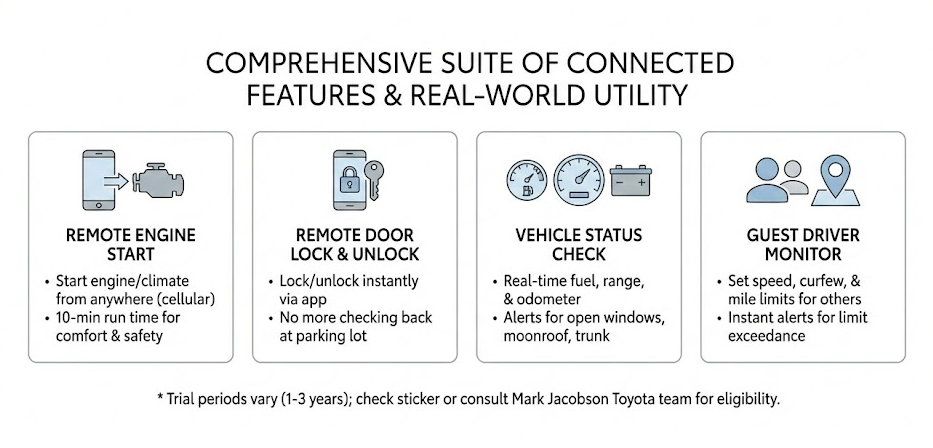
In our digitally connected world, we expect our devices to talk to each other seamlessly, and your vehicle should be no exception. For Toyota owners in Durham, the Toyota Remote Connect service transforms your smartphone into a powerful command center for your car, bridging the gap between your home and your driveway. Imagine waking up on a freezing January morning in Chapel Hill and starting your car from your warm kitchen to defrost the windshield before you even put on your coat. Or perhaps you are sitting in a meeting at RTP and panic, suddenly wondering if you locked your doors. With Remote Connect, these conveniences and anxieties are managed at your fingertips. This guide explains exactly what this technology can do, the specific steps to set it up without frustration, and how to maximize its features to enhance your ownership experience. Comprehensive Suite of Connected Features and Real-World Utility Toyota Remote Connect is a sophisticated suite of services accessible via the Toyota app that utilizes a Data Communication Module (DCM) built directly into the vehicle's telematics system. The most popular feature is the Remote Engine Start. Unlike a traditional key fob remote start that has a limited range of a few hundred feet, the app-based system uses cellular signals, meaning you can start your engine and your climate control system from virtually anywhere whether you are checking out at the grocery store or just landing at RDU airport. The system runs the engine for precisely 10 minutes before automatically shutting off to conserve fuel and ensure safety, ensuring your cabin is comfortable when you finally arrive. Beyond basic ignition controls, the Remote Door Lock and Unlock feature serves as a digital lifesaver for busy professionals in the Triangle; no more trekking back to a distant parking lot to verify if you secured your vehicle. You can simply tap the app to lock it instantly from your office desk. Furthermore, the Vehicle Status check provides a comprehensive real-time health report, allowing you to view your fuel level, remaining driving range, and odometer reading. Crucially, it sends push notifications if windows, the moonroof, or the trunk were left open after you walked away. For families and those who utilize valet services in downtown Durham, the Guest Driver Monitor is a standout safety tool. This allows you to set strict digital boundaries for other drivers, such as teenagers or service attendants. You can configure precise limits on maximum speed, curfew times, and total miles driven. If the vehicle exceeds these pre-set parameters for example, if a valet takes the car outside a designated geofenced radius or a teen exceeds 75 mph the primary owner receives an instant alert. Most new Toyotas come with a trial period for Remote Connect, typically ranging from one year to three years depending on whether the vehicle is equipped with Audio Plus or Premium Audio packages. It is vital to check your window sticker or consult with our specialized technology team at Mark Jacobson Toyota to confirm your specific trial duration and eligibility, as this ensures you never lose access to these critical conveniences during your first years of ownership. Specialized Remote Services for Electric and Hybrid Vehicles For owners of electrified models like the RAV4 Prime, Prius Prime, or the all-electric bZ4X, Remote Connect offers an even more robust set of tools specifically designed for energy management. These features allow you to monitor your current battery percentage and estimated EV-only driving range in real-time, which is essential for planning commutes across the Triangle. You can remotely start or stop a charging session, which is particularly useful if you want to take advantage of off-peak electricity rates provided by local utility companies. Furthermore, the app allows you to set a detailed charging schedule so the vehicle is always topped off right before your morning departure. Perhaps the most beneficial feature for EV owners is the Remote Climate Prep. Unlike standard gas vehicles, you can activate the heater or air conditioning while the car is still plugged into your home charger. This uses grid power instead of battery power to reach the desired temperature, effectively preserving your maximum driving range for the road. This specialized integration ensures that your transition to electric driving is as efficient and high-tech as possible, providing a level of control that traditional vehicles simply cannot match. Master the Activation Handshake and Seamless App Integration Activating Remote Connect is a straightforward process, but it requires a specific, secure sequence of steps to prevent unauthorized access to your vehicle and ensure your data remains private. First, you must download the official "Toyota" app from either the Apple App Store or Google Play Store. Once installed, open the app and click "Register" to create a new account, or sign in if you already have an existing Toyota profile. To link your vehicle, you will need your 17-character Vehicle Identification Number (VIN), which is conveniently located on your vehicle registration card or the driver’s side dashboard near the bottom of the windshield. After the vehicle is successfully added to your virtual "Garage" within the app, a tile will appear labeled "Activate Services" or "Connected Services." Clicking this initiates the enrollment process where you will review and accept the terms of service and privacy data disclosures. The most critical step, and the one that frequently confuses new users, is the physical authorization "handshake" between the phone and the car. After completing the enrollment on your phone, the app will generate a unique 6-digit authorization code. You must then take this code into your vehicle, start the engine to ensure the multimedia system is fully powered, and navigate to the "Apps" icon on your vehicle's touchscreen bezel. Within this menu, find the "Remote Connect" or "Authorization" section. Enter the 6-digit code from your smartphone into the car's screen and press submit. This vital physical step verifies that only someone with actual possession of the vehicle can link it to a mobile device, acting as a robust defense against remote digital theft. Once the code is authorized, the app dashboard will refresh though this may take up to five minutes to display the remote command buttons for Start, Stop, Lock, and Unlock. It is important to note that for a Remote Start command to execute successfully, the vehicle must be in "Park," all doors must be fully closed and locked, and the hood must be latched. By following this precise sequence, you ensure that your vehicle's telematics system is properly synced with Toyota's secure cloud servers for reliable long-term performance. Digital Key Capability and the Future of Mobile Access On select newer models such as the latest generation Toyota Crown, Prius, and bZ4X, the Remote Connect suite is expanded by the "Digital Key" capability, which represents the next evolution in vehicle access. It is important to distinguish this from the standard cellular-based Remote Connect features; while Remote Connect works over long distances via 4G LTE, the Digital Key utilizes Bluetooth Low Energy (BLE) to communicate with your car when you are in close proximity. This technology allows your smartphone to function as a literal replacement for your physical key fob. As you approach the vehicle with your phone in your pocket or bag, the doors can automatically unlock, and you can start the engine and drive away without ever touching a piece of hardware. This feature is managed through the same Toyota app but requires a separate one-time setup to "pair" the phone's secure element with the car's computer. One of the most innovative aspects of this technology is the ability to "share" your digital key with up to seven family members or friends. You can send a digital invite via text message, granting them temporary or permanent access to drive your vehicle. This is perfect for scenarios where a family member needs to borrow the car while you are traveling, or if you accidentally leave your keys inside the house. Safety Logic, Signal Constraints, and Navigation Shortcuts Toyota prioritizes the safety of both the driver and the vehicle's surroundings above all else, which results in certain operational logic that new owners should understand to avoid confusion. The most frequent inquiry we receive at Mark Jacobson Toyota is regarding why the engine shuts off as soon as a door is opened after a remote start. This is not a technical glitch; it is an intentional anti-theft safeguard. By shutting down the engine the moment the door is unlocked and opened, the system ensures that an unauthorized individual cannot jump into your running vehicle and drive away while you are still walking toward it. To continue your journey, you must simply enter the car, press the brake pedal, and hit the "Start" button to officially restart the vehicle with the key or phone present. Additionally, users should be aware of the environmental factors that affect performance. Because the system relies on a 4G LTE cellular network, typically provided by AT&T, signal strength is paramount. While coverage across Durham, Chapel Hill, and the Research Triangle is exceptionally strong, physical barriers like deep underground concrete parking garages such as those found at major hospitals or university campuses can block the signal to the vehicle's DCM. If the car cannot "hear" the signal from the cloud, the command will fail. To mitigate the frustration of losing your car in these large parking structures or at expansive lots like those at Southpoint Mall or RDU Airport, the app includes a "Vehicle Finder" feature. This tool uses the car's onboard GPS to drop a precise pin on a Google-based map within your app. It even provides walking directions back to your car, which is an invaluable asset when you’ve forgotten your parking row or section after a long day of travel or shopping. Wearable Integration and the Convenience of Smartwatches For the tech-savvy driver who is always on the move, Toyota Remote Connect offers seamless integration with popular wearable devices, including the Apple Watch and various Android Wear OS smartwatches. This integration allows you to perform the most common remote tasks directly from your wrist, providing a level of convenience that feels almost futuristic. By opening the Toyota app on your watch, you can quickly lock or unlock your doors, start the engine, or check your fuel level without ever having to dig your smartphone out of your pocket or purse. This is particularly helpful when your hands are full of groceries or when you are dressed for a run and carrying minimal gear. The watch app provides haptic feedback to confirm when a command has been successfully sent and received by the vehicle, giving you peace of mind while you are on the go. Furthermore, if you have multiple Toyota vehicles in your household, the smartwatch interface allows you to easily toggle between them. This wearable extension of the Remote Connect suite ensures that your vehicle's most important controls are always literally at your fingertips, making the interaction with your car faster and more intuitive than ever before in the history of automotive technology. Long-Term Management, Costs, and Technical Troubleshooting As your Toyota ownership experience continues past the initial purchase, understanding the long-term management of your connected services becomes essential. Once your complimentary trial period expires the length of which is determined by your specific model and its multimedia package Remote Connect transitions into a paid subscription-based service. Currently, the cost is approximately $8 per month or a discounted $80 per year, which is a modest investment for the continued convenience of remote climate control and security monitoring. Managing this subscription is handled entirely within the "Subscriptions" section of the Toyota app, where you can update payment methods or toggle auto-renewal settings. It is also common for Remote Connect to be offered in bundles with other valuable services like Safety Connect, which provides emergency SOS assistance, or Drive Connect, which enables cloud-based navigation with real-time traffic updates. If you ever encounter connectivity issues where the app displays a "Request Failed" message, there are several troubleshooting steps you can take. First, ensure your smartphone's operating system and the Toyota app are both updated to the most recent versions. Sometimes, a phone’s "Low Power Mode" can restrict the background data needed for the app to communicate with the vehicle. If the car itself seems unresponsive, you can perform a "soft reset" of the DCM by pressing the "SOS" button in the overhead console to speak with a Toyota representative. They have the ability to remotely "ping" your vehicle and reset the module to restore functionality. For those planning to sell or trade in their vehicle, it is vital to remember to remove the car from your app garage, which wipes your personal data from the vehicle's head unit and ensures the next owner can begin their own activation process cleanly. Enhancing Resale Value and Maintaining Data Privacy Maintaining an active Remote Connect subscription can actually serve as a significant selling point when it comes time to move on to your next vehicle. In the modern pre-owned market, buyers are increasingly looking for high-tech features and integrated connectivity; being able to demonstrate that your Toyota is "connected-ready" and that all remote features are fully operational can give you a competitive edge. It signals to a potential buyer that the vehicle is modern and that its telematics systems have been well-maintained. From a data privacy perspective, Toyota is committed to transparency. Within the app, you can customize your "Data Privacy" settings to control what information is shared and how it is used. This includes managing how your driving data is collected for the "InsureConnect" feature, which can potentially lower your insurance premiums based on safe driving habits. By taking an active role in managing these settings, you ensure that you are getting the most utility out of the technology while keeping your personal information secure. This balance of convenience, value-added technology, and privacy control is what makes Toyota's connected ecosystem a leader in the automotive industry. In addition to the remote features, the app serves as a centralized hub for your vehicle's maintenance history and service needs. You can view upcoming service milestones based on your actual mileage and schedule appointments directly with Mark Jacobson Toyota through the app interface. This integration ensures that your car remains in peak mechanical condition while you enjoy the digital perks, creating a holistic ownership experience that covers both the software and hardware aspects of your Toyota. The security infrastructure behind these services is enterprise-grade, utilizing encrypted communication protocols to ensure that every command sent from your phone is authenticated. This prevents "relay attacks" and other forms of modern vehicle theft that target keyless systems. By utilizing Remote Connect, you are actually adding a layer of digital security to your vehicle, as you can receive instant alerts if your car's alarm is triggered, allowing for a much faster response than traditional sirens alone. Finally, for residents of the Triangle who frequently travel, the app's ability to integrate with smart home devices like Amazon Alexa or Google Assistant adds another layer of luxury. You can use voice commands from your living room to ask, "Alexa, ask Toyota to start my car," or "Hey Google, how much gas is in my RAV4?" This level of integration ensures that your Toyota is not just a tool for transportation, but a fully integrated part of your smart lifestyle, saving you time and effort every single day. Visit Mark Jacobson Toyota for Expert Technology Support Technology can be tricky, but you don't have to navigate it alone. If you are having trouble setting up your Remote Connect, need help with the Digital Key authorization, or simply want a hands-on demonstration of how these features can improve your daily commute, visit us for technology help at Mark Jacobson Toyota. Our dedicated "Technology Specialists" are trained to walk you through every click and tap, ensuring your phone and car are perfectly synced before you leave the lot. Whether you are looking to find vehicles with Remote Connect or need to troubleshoot an existing account, we are here to serve the Durham, Chapel Hill, and Raleigh communities. Stop by 14516 Durham-Chapel Hill Blvd in Durham, NC, and let’s get you connected today.

Durham Toyota Service Center

Why Brake and Battery Services at Mark Jacobson Toyota Keep Durham Drivers Covered for the Long Haul

When it comes to your Toyota, two of the most critical components for safety and reliability are your brakes and your battery. At Mark Jacobson Toyota in Durham, NC, we understand how crucial these systems are, which is why we offer specialized service packages designed to give you peace of mind, save you money over time, and keep your Toyota running strong. The Importance of Regular Brake Service Your brakes are your Toyota’s most vital safety system. From quick stops in downtown Durham traffic to longer highway drives and summer road trips, you need brakes that you can count on every time. Over time, brake pads wear down, rotors can warp, and brake fluid may need flushing, all of which can affect your stopping power. Our Toyota brake service includes: Brake fluid checks and replacements Brake pad replacement with original equipment manufacturer (OEM) Toyota parts Expert inspection by factory-trained technicians Rotor resurfacing or replacement By choosing a brake service package, you’re not only keeping your Toyota safe but also avoiding larger repair costs down the road. Why Your Toyota Battery Deserves Attention Nothing stops a day faster than a dead battery. Whether you’re commuting to RTP or heading out to Jordan Lake for the weekend, you don’t want to worry about being stranded. Toyota recommends having your battery tested regularly, especially before seasonal temperature changes. At Mark Jacobson Toyota, our Toyota battery replacement in Durham, NC, service includes: Free battery health inspections during routine service Quick, professional replacement with genuine Toyota TrueStart™ batteries Warranty coverage for added confidence Our battery service packages ensure that you’re never caught off guard, providing reliable power for your Toyota’s engine and all the tech features you depend on, from infotainment to safety systems. Why Mark Jacobson Toyota? As a trusted dealership serving Durham, Chapel Hill, Cary, and the greater Triangle area, Mark Jacobson Toyota has built a reputation for honesty, transparency, and customer-first service. Our goal is not just to fix cars but to build lasting relationships. When you choose our service packages, you’re partnering with a team that values your time, safety, and investment. We’re dedicated to delivering the expert service and personalized care our guests have come to rely on. Our Toyota-trained technicians bring thousands of hours of hands-on experience with every Toyota model, and we use only OEM Toyota Parts to ensure your vehicle stays true to its name. Whether it’s routine maintenance or specialized repairs, our certified team is equipped to handle oil changes, tire rotations, battery replacements, brake service, and all Toyota Factory Scheduled Maintenance. Protect Your Toyota Today Don’t wait until your brakes squeal or your battery dies. Be proactive and schedule a brake and battery service online or stop by Mark Jacobson Toyota, Where We Say YES!