




Blog / Durham Toyota Dealer

Valentine Date Ideas in Durham with Camry Hybrid

valentine-date-ideas

Valentine’s Day in Durham offers a plethora of romantic possibilities, from upscale dining in downtown to scenic sunset drives through the countryside. But nothing kills the mood faster than a noisy, uncomfortable ride or the stress of navigating traffic in a gas-guzzler. This year, elevate your date night by experiencing it from the cabin of a Toyota Camry Hybrid. With its sophisticated design, whisper-quiet electric driving mode, and premium interior features, the Camry Hybrid is the perfect chariot for romance. Whether you are planning a first date or celebrating your 20th anniversary, we have curated a list of local ideas and reasons why this sedan is the ultimate wingman for your Valentine’s plans.

Exploring Durham’s Romantic Landscape with Camry Hybrid Efficiency

The journey is often just as important as the destination, especially when you are celebrating a special occasion like Valentine’s Day. When you depart from Mark Jacobson Toyota, the Camry Hybrid serves as more than just a vehicle; it becomes a mobile sanctuary that allows you to explore the hidden gems of Durham without the constant interruption of refueling. The Camry Hybrid’s powertrain is a marvel of modern engineering, delivering a combined output that ensures you have plenty of pep for merging onto I-40 while maintaining an incredible fuel economy of up to 50+ MPG. This efficiency translates to freedom.

You can take the long way to your dinner reservation, perhaps winding through the historic neighborhoods of Hope Valley where the massive oaks provide a canopy of Southern charm. The refined suspension system of the Camry Hybrid is specifically tuned to soak up the imperfections of the road, ensuring that your conversation remains the focus, not the bumps on the pavement.

Heading north from the dealership on 15-501 toward the Eno River State Park offers a transition from the bustling commercial centers to the serene, wooded beauty that defines the Piedmont region. In a traditional gasoline vehicle, the roar of the engine can often compete with your favorite romantic playlist or your partner’s voice. However, in the Camry Hybrid, the transition between the electric motor and the gasoline engine is nearly imperceptible.

As you glide through the winding backroads near the river, the car often operates in EV mode at lower speeds, providing a "ghost-like" silence that enhances the intimacy of the moment. This silence is a luxury in itself, allowing you to appreciate the subtle sounds of the evening the wind through the trees or the soft melody coming from the speakers without the vibration of a heavy-duty combustion engine. This level of refinement is what sets the Camry Hybrid apart as the premier choice for a Durham date night, proving that you don't need a six-figure exotic car to experience world-class comfort and sophisticated road manners while exploring the Bull City.

Navigating the Golden Hour along NC-751

For those who prefer a more tranquil approach to their evening, cruising down towards Jordan Lake via NC-751 is a must. This stretch of road is renowned for its open vistas and the way the "golden hour" light hits the tall pines of the Research Triangle. The Camry Hybrid thrives in this environment. As the sun begins to dip below the horizon, the car’s automated LED lighting system illuminates the path ahead with crisp, white light, ensuring safety while maintaining a sleek aesthetic.

Driving this route allows you to truly feel the synergy of the hybrid system; as you coast down gentle hills, the regenerative braking system subtly captures energy to recharge the battery, a silent reminder of the car's intelligent design. It is a route that demands a slower pace, giving you and your date the opportunity to decompress and transition from the workweek into a mindset of celebration. The predictability of the Camry’s handling provides a sense of confidence, allowing the driver to remain relaxed and attentive to their partner rather than wrestling with the vehicle.

Crafting the Perfect Atmosphere: Interior Luxury and Whisper-Quiet Connection

Step inside the Camry Hybrid, and you are immediately greeted by an environment designed to cater to the senses. For a Valentine’s date in Durham, the interior ambiance can make or break the evening. Toyota has gone to great lengths to ensure the cabin is a "library-quiet" zone by utilizing extensive sound-deadening materials in the floor, dash, and ceiling. This engineering choice is vital for romance; it creates a private bubble where you can share secrets, laugh at inside jokes, or simply enjoy a comfortable silence without the intrusion of road drone or wind noise.

The available leather-trimmed multi-stage heated front seats are perhaps the most appreciated feature during a chilly North Carolina February. With a simple press of a button, both the driver and passenger can enjoy personalized warmth, ensuring that even if the walk from the restaurant was cold, the ride home will be cozy and inviting.

The physical layout of the cabin further enhances the experience. The driver-centric cockpit keeps all controls within easy reach, so you never have to take your eyes off the road or your attention away from your date to adjust the climate or change a song. The dual-zone automatic climate control is a true "relationship saver," allowing the driver to keep their side cool while the passenger stays warm, eliminating the classic debate over the thermostat.

Furthermore, the materials used throughout the XLE and XSE trims such as soft-touch surfaces and available wood-inlay or patterned metal trim provide a tactile sense of luxury that rivals premium European marques. When your date settles into the passenger seat, they aren't just sitting in a car; they are entering a curated space that reflects your thoughtfulness and attention to detail. Every element, from the ergonomic curve of the seats to the soft ambient lighting that glows in the footwells and door handles, is designed to make the occupants feel special. It turns a simple drive to a Durham restaurant into a high-end experience that begins the moment the door is opened.

Immersive Soundscapes with JBL Premium Audio

No Valentine’s Day is complete without a soundtrack, and the Camry Hybrid offers one of the best listening environments in its class. The available JBL Premium Audio system features nine speakers, including a powerful subwoofer that provides deep, resonant bass and crystal-clear highs. Whether you have curated a playlist of "your songs" or are discovering new artists together, the clarity of the audio is staggering.

Because the cabin is so well-insulated, the music doesn't have to compete with external noise, allowing you to hear every nuance of a vocal performance or the subtle pluck of a guitar string. Integration is seamless via wireless Apple CarPlay or Android Auto, meaning you can control your media through the large touchscreen interface or via voice commands, keeping your hands on the wheel. This tech-forward approach ensures that the "vibe" of your date is never interrupted by fumbling with cords or menus, keeping the focus entirely on the person sitting next to you.

Seamless City Maneuvers: Parking and Arrival Tips for Durham’s Top Spots

Downtown Durham has undergone a massive revitalization, becoming a culinary and cultural destination, but this popularity means that parking near hotspots like NanaSteak, Mateo, or the DPAC can be a challenge. The Camry Hybrid is the ideal urban companion for these situations. While it offers the interior room of a large sedan, its exterior dimensions are perfectly balanced for navigating tight city streets and squeezing into those coveted parallel spots.

The standard backup camera with projected path lines is a lifesaver when you are trying to park while maintaining a conversation. For those who want the ultimate in parking tech, the available Bird’s Eye View Camera provides a 360-degree top-down perspective of the vehicle. This allows you to see exactly how close you are to the curb, protecting those beautiful alloy wheels and ensuring you park perfectly on the first try an understated way to impress your date with your driving precision.

When planning your arrival, consider the "valet" approach to maximize the romance. Even if you aren't using a professional valet service, the Camry Hybrid’s design allows for an elegant entry and exit. The door openings are wide, and the seat height is optimized so that your date can exit the vehicle gracefully, even in formal attire or heels.

We recommend dropping your partner off at the front door of your chosen restaurant before heading to one of the nearby parking decks, such as the ones on Corcoran or Ramseur Street. The Camry’s Smart Key System means you can lock the doors and secure the vehicle with a simple touch of the door handle as you walk away, allowing you to rejoin your date quickly without fumbling for a key fob. This smooth "flow" to the evening prevents the logistical headaches of city parking from casting a shadow over your romantic plans, keeping the energy positive and the focus on the celebration ahead.

Practicality Meets Elegance: Trunk Space and Smart Access

One of the most common misconceptions about hybrid vehicles is that they sacrifice utility for efficiency. The Camry Hybrid proves this wrong by placing its battery pack under the rear seats rather than in the trunk. This design choice preserves the full 15.1 cubic feet of cargo space, which is essential for Valentine’s Day. If you have a large bouquet of roses, a hidden gift, or even a pair of overnight bags for a staycation at the Washington Duke Inn, you won't have to worry about space.

The trunk opens wide and features a low liftover height, making it easy to load and unload items discreetly. Additionally, the interior storage bins and center console are spacious enough to hide a small jewelry box or a box of chocolates until the perfect moment arises. It is this blend of everyday practicality and thoughtful engineering that makes the Camry Hybrid such a reliable partner for life’s most important moments.

A Modern Love Story: Choosing Between Edgy Style and Eco-Friendly Innovation

Choosing a Camry Hybrid for your Valentine’s date is a statement of style and values. For those who want to turn heads in the Brightleaf District, the Camry Hybrid SE Nightshade Edition offers a "darker" side of romance. With its 19-inch bronze-finished alloy wheels, blacked-out side mirrors, and aggressive front grille, it possesses a mysterious and sophisticated aesthetic that looks incredible under the neon lights of downtown Durham. It appeals to a sense of modern edge, proving that "hybrid" doesn't have to mean "boring."

On the other hand, the XLE trim offers a more traditional sense of luxury with chrome accents and a focus on ultimate serenity. Whichever trim you choose, the car acts as a reflection of your personality sophisticated, forward-thinking, and attentive to the finer things in life. Driving a hybrid also sends a subtle but powerful message about your commitment to the future, aligning with the eco-conscious values held by many in the Triangle area.

Beyond the aesthetics, the Camry Hybrid offers the thrill of electric torque. When the light turns green on Main Street, the instant response of the electric motor provides a smooth, punchy acceleration that makes city driving genuinely fun. You can choose between different driving modes Eco, Normal, Sport, and EV to tailor the car's personality to the mood of the evening. Want to be extra green? Stay in Eco mode. Feeling a bit more spirited after a great dinner? Switch to Sport mode to sharpen the throttle response.

This versatility ensures that the car adapts to you, rather than the other way around. By choosing a vehicle that balances performance with planet-friendly technology, you are showing that you value innovation and efficiency traits that are just as attractive in a partner as they are in a car. This Valentine's Day, let the Camry Hybrid be the vehicle that carries your love story into its next chapter.

The Sophistication of Sustainable Performance

The beauty of the Camry Hybrid lies in its ability to offer sustainable performance without requiring any lifestyle changes. Unlike a fully electric vehicle that might require you to hunt for a charging station in the middle of your date, the Camry Hybrid is always ready to go. It uses regenerative braking to keep itself charged, meaning you get the benefits of electric driving with the long-range confidence of a gasoline engine.

This reliability is the ultimate peace of mind. As you drive through Durham, you aren't just saving money at the pump; you are contributing to a quieter, cleaner local environment. This "invisible luxury" of knowing you are doing the right thing for the planet adds an extra layer of satisfaction to your evening, making the drive home just as rewarding as the destination itself.

Safety and Confidence for the Road Ahead

Peace of mind is the ultimate luxury, especially when you are responsible for the safety of someone you care about. Every Camry Hybrid comes standard with Toyota Safety Sense, a suite of advanced driver-assistance technologies designed to act as a second set of eyes. From Pre-Collision Systems that can detect pedestrians to Lane Departure Alerts with Steering Assist, the car is constantly working to keep you safe. This allows you to relax and focus on your partner, knowing that the vehicle is equipped to handle the unexpected.

The Ultimate "Date Night" Test Drive

Why wait until February 14th to experience the Camry Hybrid? We suggest making the exploration of a new vehicle a shared activity. Coming to the dealership together allows you to sit in the seats, test out the audio system, and see which color perhaps the striking Supersonic Red best fits your collective style. It turns the "chore" of car shopping into an exciting afternoon date where you can dream about future road trips and the many Valentine's Days to come.

Experience the Mark Jacobson Toyota Difference

Our team at Mark Jacobson Toyota is dedicated to making your car-buying journey as smooth and enjoyable as a romantic evening out. We take pride in serving the Durham community and helping our neighbors find vehicles that enhance their lives. When you visit us, you aren't just a customer; you are a guest in our home. We invite you to experience our transparent pricing, expert service, and the warm, welcoming atmosphere that has made us a staple in the Research Triangle for years.

Visit Mark Jacobson Toyota Today

Make this Valentine’s Day truly unforgettable by starting a new chapter with a vehicle you love. We invite you to visit us at Mark Jacobson Toyota, located at 14516 Durham-Chapel Hill Blvd. Stop by before your dinner reservations to explore our extensive inventory of Camry Hybrids and take one for a spin. Our friendly staff is ready to help you find the perfect match for your lifestyle and your budget. Come see why the Camry Hybrid is the heartthrob of the sedan market and let us help you drive away in the car of your dreams.

Posted in:

Related Posts

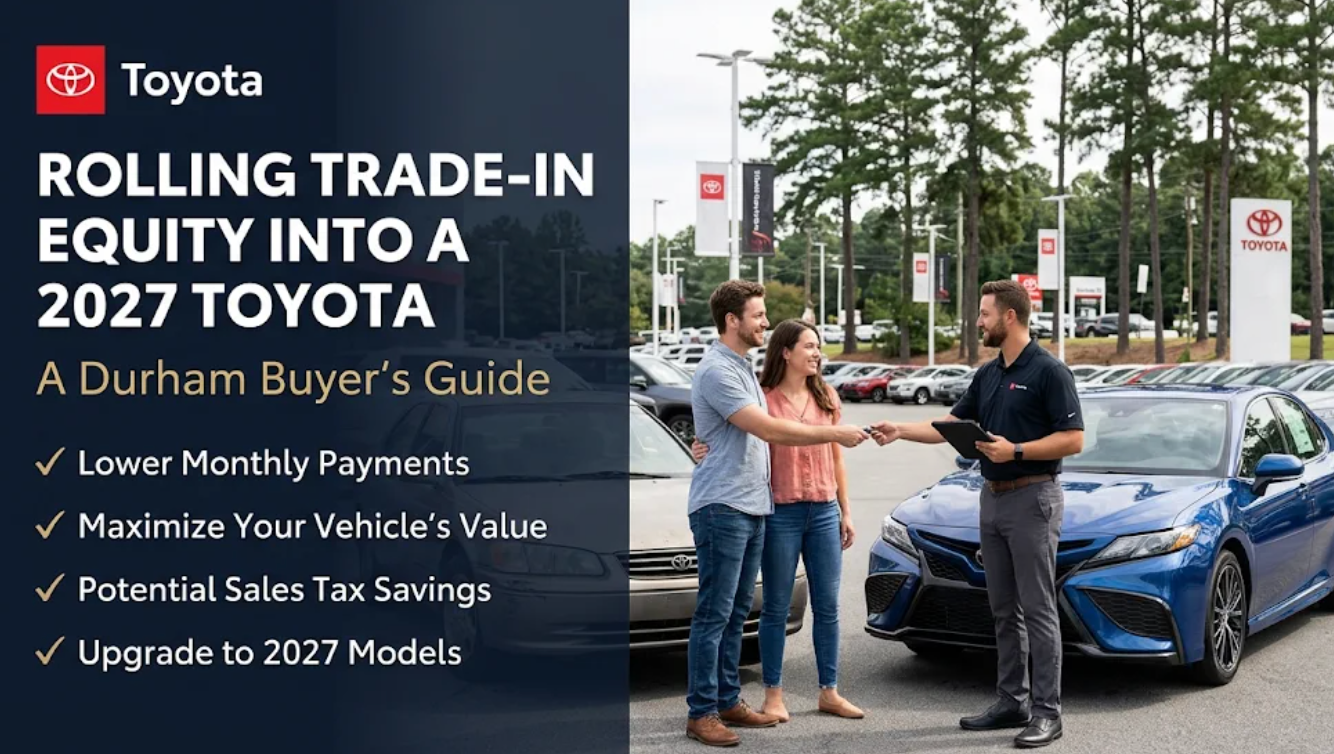
Rolling Trade-In Equity Into a 2027 Toyota

Rolling Your Trade-In Equity Into a 2027 Toyota

Toyota Ownership & Buying Guide • Durham, NC Rolling Trade-In Equity Into a 2027 Toyota: A Durham Buyer’s Guide Thinking about trading your current vehicle for a 2027 Toyota? Before you compare monthly payments, find out what your vehicle is worth and how much you still owe. The difference is your trade-in equity. It can give you a useful down payment—or create an extra balance that makes the next loan more expensive. For Durham buyers, there's another detail worth understanding: North Carolina's highway use tax generally uses the full trade-in allowance, not your equity after the old loan is paid. Here's how to put all those numbers together before making a decision. Definition: Trade-in equity is the difference between a vehicle's appraised trade-in value and the remaining balance on its loan. Positive equity becomes a credit toward the next vehicle, while negative equity is an amount still owed that must be paid or, if approved, added to a new loan. For drivers in Durham, Chapel Hill, Raleigh, Cary, and the Triangle, knowing this number is the first step in budgeting for a new Toyota. Trade-In Equity Buying Guide Trade-In Equity and 2027 Toyota Shopping: Find Your Answer How Equity Applies to a New Purchase Positive Equity vs Being Underwater Which 2027 Models This Fits Best Model-by-Model Equity Planning Getting a Current Appraisal Financing the Difference Key Takeaways Trade-In Equity FAQ How Trade-In Equity Applies to a New Purchase Start with an appraisal and a payoff quote, not a payment advertisement. If the vehicle is appraised at $20,000 and your lender needs $12,000 to close the loan, you have $8,000 in positive equity. The dealer can settle the old loan and apply the remaining $8,000 to the new purchase. If the loan payoff is $23,000 instead, you have $3,000 in negative equity. You would need to pay that shortfall yourself or find a lender willing to finance it as part of the next transaction. Positive equity generally lowers the cash you need to bring to the deal or the principal on your new loan. It does not make a higher-priced model free: you still pay for every dollar above the allowance and any remaining payoff. Look at the vehicle's out-the-door price, payoff, financing charges, and the amount being borrowed as separate lines. That way you can compare a lower-price vehicle and a more expensive trim without being distracted by one monthly payment. North Carolina's 3% highway use tax is a separate calculation from equity. Under state law, for a qualifying dealer retail transaction, the taxable vehicle value generally equals the new vehicle's sales price minus the trade-in allowance, with applicable taxable fees and accessories included. If you trade a vehicle appraised at $15,000 toward a $30,000 vehicle, the trade allowance may reduce that portion of the tax base to $15,000—even when you still owe $15,000 on the old vehicle and have no equity. The actual transaction documents control; request a line-item breakdown before signing. This is general information, not personalized tax advice. Positive Equity vs Being Underwater on a Loan National data shows both sides of the market at once. Edmunds' second-quarter 2026 report, published July 30, found that positive equity reached a record average of $13,330, with 68.8% of trade-ins toward new-vehicle purchases carrying positive equity. Several Toyota models appeared near the top of Edmunds' list of average positive equity, including the Tacoma at $16,755, the Highlander at $14,415, and the RAV4 at $11,194. Edmunds' third-quarter 2026 negative equity report, published in late October, tells the other half of the story. It found that 29.1% of new-vehicle trade-ins were underwater, with an average shortfall of $7,107. Buyers rolling negative equity into a new loan financed an average of $57,235, paid an average of $952 per month at an average 8.1% APR, and 91.2% of them took loans of 72 months or longer. National Trade-In Equity Snapshot, 2026 Metric Figure Period and Source Average positive equity on trade-ins toward new vehicles $13,330 (record) Q2 2026, Edmunds Share of trade-ins with positive equity 68.8% Q2 2026, Edmunds Average new-vehicle APR, positive-equity trade buyers 5.9% Q2 2026, Edmunds Share of trade-ins with negative equity 29.1% Q3 2026, Edmunds Average negative equity $7,107 Q3 2026, Edmunds Average amount financed with rolled-over negative equity $57,235 at an average 8.1% APR Q3 2026, Edmunds National averages only. Your vehicle's value, payoff, and financing terms will differ. Edmunds data reflects trade-ins toward new-vehicle purchases nationwide. Being underwater does not automatically rule out a trade. It does mean the negative balance has to go somewhere. You can pay it down before trading, keep your current vehicle longer while the loan catches up to its value, or, with lender approval, roll it into the new loan. That last option raises the amount financed and the total interest you pay, so it deserves a careful look at the full loan, not only the monthly payment. How Equity Changes the Numbers: A Simplified North Carolina Example Consider a hypothetical $30,000 vehicle with no additional fees, options, or cash down. A $20,000 trade allowance and $12,000 payoff create $8,000 equity, leaving a $22,000 vehicle balance before tax; the simplified 3% highway use tax is $300, for $22,300 before other charges. A $15,000 trade allowance with a $15,000 payoff creates no equity, but the simplified tax is still only $450. This illustrates why the amount credited for the vehicle, the amount needed to retire its loan, and the taxable trade-in allowance should never be treated as the same number. Scenario Trade Value / Payoff Equity 3% Highway Use Tax Amount Before Fees and Down Payment No trade-in None $0 $900 $30,900 Positive equity $20,000 / $12,000 +$8,000 $300 $22,300 Break-even $15,000 / $15,000 $0 $450 $30,450 Negative equity rolled in $15,000 / $20,000 -$5,000 $450 $35,450 Hypothetical illustration. Highway use tax shown as 3% of the $30,000 price less the trade-in allowance, per North Carolina's highway use tax statute; confirm current rules with NCDMV. Excludes processing fees, title, registration, and incentives. Rolling negative equity into a loan is subject to lender approval. Notice that even the break-even trade saves $450 in highway use tax compared with selling the vehicle privately and buying without a trade, because the tax is calculated on the price after the trade allowance. That does not mean a trade-in always beats a private sale, since a private buyer may pay more, but it is a real number to include in the comparison. Which 2027 Models This Makes the Most Sense For Equity goes furthest when it is paired with a vehicle that fits your budget and your driving, so it helps to know where Toyota's 2027 lineup actually stands this fall. Toyota has published 2027 information for several models, but not every model has full pricing, and one model in our earlier planning has a new model-year designation. Highlander, Corolla Hatchback, Tundra, Prius Plug-in Hybrid, and C-HR Model Powertrain Toyota Starting MSRP* Equity Planning Notes 2027 Corolla Hatchback Gas SE $24,780; XSE $27,875 Strong equity can cover a large share of the price, keeping the amount financed low 2027 Prius Plug-in Hybrid Plug-in hybrid SE $33,980 Equity can offset the higher price versus the standard Prius for drivers with home charging 2027 C-HR Battery-electric, standard AWD SE $37,080; XSE $39,080 Factor in home charging installation and North Carolina's annual EV registration fee 2027 Tundra Gas and i-FORCE MAX hybrid Not yet shown on Toyota.com; contact us for current pricing Truck owners with high equity may reduce the amount financed on a full-size purchase Highlander battery-electric (now designated 2028 by Toyota) Battery-electric, FWD or AWD Toyota USA has not announced pricing Toyota expects sales to begin in early 2027; your appraisal value may change before then *Base MSRP excludes Toyota's delivery, processing, and handling fee, taxes, title, registration, and options. Corolla Hatchback, Prius Plug-in Hybrid, and C-HR prices from Toyota.com and the Toyota USA Newsroom as of October 30, 2026. Contact Mark Jacobson Toyota for current pricing and availability. Toyota's electric Highlander announcement has undergone model-year updates, and timing is subject to change. For a vehicle that is not yet priced or available for the exact model year you intend to buy, do not use projected pricing as a firm financing assumption. Ask for the current Toyota USA announcement, official model year, and actual purchase terms. Your current trade allowance and payoff can change while you wait. If you have positive equity and want it to do the most work, the strongest match is usually a model whose price keeps the new loan short and the payment comfortable, such as the 2027 Corolla Hatchback or Prius Plug-in Hybrid, rather than the most expensive vehicle the equity can reach. If your current truck or SUV carries high equity and you need similar capability, applying it to a Tundra can keep the amount financed on a full-size truck closer to what a smaller vehicle would require. If you are underwater, a lower-priced model or a Toyota Certified Used Vehicle can keep the rolled-over balance from stretching the new loan, though both options remain subject to lender approval. Our earlier model guides go deeper on each vehicle, including the 2027 Corolla Hatchback trim guide and the 2027 Tundra i-FORCE MAX trim guide. Getting a Current Appraisal Before You Decide National trade-in figures can be interesting, but they won't tell you what a dealer will offer for your car this week. A current appraisal looks at its age, mileage, accident history, service records, condition, trim, equipment, and local demand. Then compare that appraisal with the lender's payoff quote, which may differ from your statement balance because interest keeps accruing. Mileage, condition, and any mechanical or cosmetic issues Vehicle history, including accidents and the number of owners Service records, especially documented scheduled maintenance Trim, options, and color, along with current demand for that model in our market Open recalls, which are worth checking and addressing before a trade You can start online with our online trade appraisal tool, then bring the vehicle in for a firm number. Bring your loan account information, the title or lien holder details, all keys, and any maintenance receipts. Also request a 10-day payoff from your lender so the equity calculation uses an accurate figure. Timing matters too. Used-vehicle values move with supply and demand, and your loan balance falls a little each month. If you are close to break-even, a few more payments can shift you into positive equity. If your vehicle has high mileage or is approaching a major scheduled service, its value may soften. Neither situation calls for rushing; both call for current numbers. Talking to Our Finance Team About Financing the Difference Once you know your equity, the remaining question is how to finance the difference. Rates have climbed over the past decade. Edmunds reported a 5.9% average APR in Q2 2026 for new-vehicle buyers trading in with positive equity, compared with 3.8% in Q2 2016, and the average APR for buyers rolling negative equity forward was 8.1% in Q3 2026. Your rate will depend on your credit, the vehicle, the term, and current lender programs. A few habits help keep the deal healthy: Compare the total amount financed and total interest, not only the monthly payment. Be cautious about stretching the term to make a payment fit, especially when rolling over negative equity, because longer terms can leave you underwater again. Ask about current Toyota Financial Services and Southeast Toyota Finance programs, which can vary by model, month, and credit tier. Consider getting pre-approved online so you know your options before you visit. Our finance team can lay out side-by-side options using your actual appraisal and payoff, such as a new 2027 model versus a Toyota Certified Used Vehicle, or a shorter versus a longer term. All financing is subject to credit approval, and we cannot guarantee a specific rate, payment, or trade-in value before an appraisal and application. Ask for four numbers before discussing the monthly payment Request the selling price of the new Toyota, the allowance for your trade, the exact payoff on your existing loan, and the amount financed after taxes and fees. Those four figures expose whether a quote includes positive equity, negative equity, dealer-added products, or a larger down payment than you intended. If you're comparing offers from more than one dealership, make sure each quote uses the same vehicle, term, cash down, and estimated taxes. When keeping your current car may be the better move Replacing a vehicle isn't automatically a good deal because it has positive equity. A car with a manageable payment, suitable safety equipment, and no immediate expensive repair may still be cheaper to keep. Conversely, a larger down payment from a trade can be worthwhile if your household needs change or your vehicle is becoming expensive to maintain. Estimate the next 12 months of maintenance and insurance, not just the next installment. Understand how negative equity affects the next loan Imagine your current vehicle is worth $18,000 but has a $23,000 payoff. That's a $5,000 gap. If a lender allows you to carry the full amount into a new loan, you'll be paying interest on that old debt while the replacement vehicle starts depreciating. A longer term can lower the installment while increasing the total amount paid, so compare total interest and the final payoff date as carefully as the payment. Compare selling privately against a dealer trade A private buyer might pay more for your vehicle, but you may forfeit the trade-in allowance used for the dealer transaction's highway use tax calculation. Compare the actual private-sale proceeds, the loan payoff, the paperwork and timing, and the potential tax difference. There isn't a universal winner. The better choice is the one that leaves you with the lowest realistic out-of-pocket cost and a transaction you understand. What the Numbers Mean for Your Next Toyota Positive equity, appraised value minus loan payoff, can be applied like a down payment toward a 2027 Toyota. Edmunds reported a record $13,330 average positive equity in Q2 2026, while 29.1% of trade-ins were underwater in Q3 2026 with an average shortfall of $7,107. In North Carolina, the 3% highway use tax on a dealer sale is generally calculated after the trade-in allowance, which can lower your tax bill. Toyota now designates its all-electric three-row Highlander as a 2028 model, with sales expected in early 2027 and pricing not yet announced. The best use of equity is often a vehicle that keeps the new loan short and the payment comfortable, not the most expensive vehicle it can reach. Get a current appraisal and an official payoff quote before deciding, because both numbers change month to month. Trade-In Equity Questions Durham Buyers Ask How do I know if I have positive equity in my car? Subtract your lender's payoff amount from your vehicle's appraised trade-in value. If the result is positive, you have equity you can apply to your next vehicle; if it is negative, you are underwater. Online estimates are a starting point, but an in-person appraisal and an official payoff quote from your lender give you the accurate number. We can provide a current appraisal at our Durham dealership. Can I roll negative equity into a 2027 Toyota? In many cases a lender can approve adding negative equity to a new loan, but it raises the amount financed and the total interest you pay. Edmunds found that buyers rolling over negative equity in Q3 2026 financed an average of $57,235 at an average 8.1% APR. Approval depends on your credit, the vehicle, and lender guidelines, so we recommend reviewing alternatives such as a lower-priced model before deciding. Does a trade-in lower my North Carolina vehicle tax? Generally, yes. North Carolina's 3% highway use tax on a dealer retail sale is calculated on the sales price less the trade-in allowance, according to the state's highway use tax statute. For example, a $10,000 trade allowance on a $30,000 vehicle reduces the taxable amount to $20,000. Confirm current rules with NCDMV or our finance team, and consult a tax professional for advice on your situation. Should I wait for the new Highlander before trading in? That depends on how long you can wait and how your vehicle's value is trending. Toyota now calls the all-electric three-row Highlander a 2028 model and expects sales to begin in early 2027, with pricing not yet announced. Your current vehicle's value and loan balance will change in the meantime, so a current appraisal helps you decide whether to trade now or wait. If you want to know what your current vehicle could put toward a new Toyota, we can give you real numbers instead of national averages. Visit us at 4516 Durham-Chapel Hill Blvd, Durham, NC 27707, or call our sales team at 919-493-5599. Our sales hours are Monday through Friday from 9:00 AM to 8:00 PM and Saturday from 9:00 AM to 7:00 PM. As an authorized Toyota dealer serving Durham, Chapel Hill, Raleigh, Cary, and Apex, we can appraise your trade, review your payoff, and show how your equity fits a 2027 model or a Toyota Certified Used Vehicle, with all financing subject to credit approval. Get Your Trade-In Estimate Review Financing Options Related Toyota Insights & Ownership Guides Trade-In Timing When Is the Right Time to Trade In Your Vehicle? Learn how mileage, vehicle condition and market demand can influence the best time to trade in your car. Read Article → Vehicle Appraisals How a Vehicle Appraisal Works Understand what dealerships consider when determining your vehicle's trade-in value, from mileage to condition. Read Article → Trade-In Preparation How to Prepare Your Vehicle for a Trade-In Discover practical ways to prepare your vehicle, organize paperwork and get ready for an appraisal. Read Article → Equity & Financing What Record Trade-In Equity Means for Toyota Owners Explore how positive trade-in equity could affect your down payment and next Toyota purchase. Read Article →

What Record Trade-In Equity Means for Durham Toyota Owners

What Record Trade-In Equity Means for Durham Toyota Owners

Toyota Trade-In & Ownership Guide • Durham, NC How to Leverage Your Vehicle’s Value Toward a New Upgrade in Durham If you bought or financed your current vehicle a few years ago, there is a good chance it is worth more toward a trade-in today than you might expect. According to recent national trade-in data, trade-ins with positive equity toward new-vehicle purchases averaged roughly $13,330 in equity in the second quarter of 2026, with about 68.8% of trade-ins toward new-vehicle purchases nationally showing positive equity. Here at Mark Jacobson Toyota, we want Durham and Triangle owners to understand what that actually means before they decide whether now is a good time to trade in, rather than just reacting to a headline. Positive equity means your vehicle is currently worth more than what you still owe on it, which gives you a real credit toward a new or certified used purchase. At the same time, the data also showed that average new-vehicle loan APRs for shoppers trading in with positive equity reached around 5.9% in Q2 2026, compared to roughly 3.8% in Q2 2016. Higher rates, alongside higher vehicle prices, contributed to an average monthly payment increase of about $228 for that group over the same period. Those two trends pull in opposite directions, and understanding both matters more than focusing on either one alone. This guide walks through what positive equity actually means, why the current market looks the way it does, and how to get an accurate, current appraisal instead of guessing based on a national average. Definition: Positive equity is the amount by which a vehicle's current market value exceeds the remaining balance on its loan, giving the owner a credit toward a future purchase rather than an amount still owed. It is commonly relevant to owners trading in a financed vehicle for a new or certified used one. For drivers across Durham, Chapel Hill, Raleigh, Cary, and the Research Triangle, understanding current equity helps determine whether trading in now makes financial sense compared to waiting, subject to an individual vehicle appraisal. Trade-In Equity Research Guide Toyota Trade-In Equity Guide: Vehicle Value, Loan Rates, and Your Next Purchase What Positive Equity Means How Auto Loan Rates Affect a Trade-In Getting an Accurate Trade-In Appraisal Applying Equity to a New or Certified Used Toyota Toyota Owners and National Equity Trends Deciding When to Trade In Key Takeaways Trade-In Equity Frequently Asked Questions What "Positive Equity" Means When You Trade In a Vehicle Positive equity is straightforward in concept but easy to get wrong in practice. If your vehicle is currently worth $22,000 and you owe $16,000 on your loan, you have $6,000 in positive equity, which applies as a credit toward your next vehicle rather than cash you need to come up with. The opposite situation, owing more than the vehicle is worth, is called negative equity or being "underwater." That shortfall still needs to be paid; if a lender approves rolling it into a replacement loan, it increases the amount financed instead of reducing it. The tricky part is that your loan balance and your vehicle's market value move independently of each other, on different timelines and for different reasons. Your loan balance decreases predictably each month as you make payments. Your vehicle's market value depends on broader used-vehicle market conditions, including supply, demand, and how your specific model and trim have held up, which can shift for reasons that have nothing to do with your personal loan. Why Average Equity Has Been Higher Than in Past Years According to national trade-in data, average equity among positive-equity trade-ins toward new-vehicle purchases reached approximately $13,330 in the second quarter of 2026. About 68.8% of trade-ins toward new-vehicle purchases carried positive equity. The dollar amount remained near record territory, while the share of positive-equity trade-ins was below its 2022 peak and closer to historical norms. At the same time, the same data shows that average new-vehicle loan APRs for shoppers trading in with positive equity rose to roughly 5.9%, compared to about 3.8% a decade earlier. Higher rates and higher vehicle prices contributed to an average monthly payment increase of approximately $228 for that group over the period. That combination matters for any Durham owner weighing a trade-in: your existing vehicle may be worth more than you expect, but financing a replacement today may cost more per month than it did when you financed your current vehicle. Neither fact cancels the other out, and the right decision depends on your specific loan balance, your vehicle's current value, and how a new payment compares to what you are paying now. Average Trade-In Equity and Auto Loan Rates, Then vs Now Metric Earlier Comparison Q2 2026 National Data Average new-vehicle loan APR for shoppers trading in with positive equity Approximately 3.8% in Q2 2016 Approximately 5.9% Share of trade-ins toward new-vehicle purchases with positive equity Record 83.6% in Q1 2022 Approximately 68.8% Average equity among positive-equity trade-ins toward new-vehicle purchases Nearly half the Q2 2026 amount before the pandemic Approximately $13,330 Average monthly payment change for shoppers trading in with positive equity Q2 2016 comparison point Approximately $228 higher, reflecting higher rates and vehicle prices These figures are national averages and are not specific to any individual vehicle, loan, or Mark Jacobson Toyota customer. We recommend treating them as general market context rather than an estimate of what your specific vehicle is worth or what your specific payment would be. Check Your Trade-In Value How Today's Auto Loan Rates Factor Into a Trade-In Decision Higher equity does not automatically mean trading in is the right move, and we think it is important to say that directly rather than just pointing to a favorable-sounding statistic. If your current vehicle has a low interest rate from a few years ago and you are happy with it, trading in today means taking on a new loan at current rates, which for many buyers now sits noticeably higher than what they are used to. Your positive equity can offset some of that difference by reducing the amount you need to finance, but it does not eliminate the effect of a higher rate entirely. Where trading in tends to make the most sense is when your current vehicle no longer fits your needs, when you are interested in a 2027 model with technology or capability your current vehicle does not have, or when your equity is substantial enough that the math works out favorably even at today's rates. Where it makes less sense is trading in purely because you saw a headline about record equity, without checking your specific numbers first. Getting an Accurate, Current Appraisal Instead of Guessing National averages are a starting point for a conversation, not a substitute for knowing what your specific vehicle is worth. Online trade-in estimators can give you a rough range, but the accuracy of that estimate depends on the vehicle details supplied, including mileage, condition, equipment, and history. An in-person appraisal can confirm those details and account for current local demand in the Triangle. What We Look at When We Appraise a Trade-In When our team appraises a trade-in, we look at your vehicle's mileage relative to its age, its overall condition inside and out, its maintenance and accident history, and current demand for that specific model and trim in our market. Documented maintenance history can help our team assess how the vehicle has been cared for, which is one of the practical, long-term benefits of keeping up with ToyotaCare and routine service through our Toyota-certified technicians. Service records do not guarantee a particular appraisal amount. Questions to Answer Before You Decide on a Trade-In Question Why It Matters What do you currently owe on your loan? Compare your lender's current payoff amount with the appraisal to determine whether you have positive or negative equity What is your vehicle actually worth in current condition? A real appraisal beats a generic online estimate What would a new payment look like at today's rates? Positive equity offsets cost, but higher APRs still affect the math Does your current vehicle still fit your needs? Equity alone is not a reason to trade in if your vehicle still works for you Are you considering a new 2027 model or a Certified Used Toyota? Changes which incentives, warranty terms, and financing options apply We recommend working through these questions with our team rather than deciding based on a national average alone, since your specific numbers are what actually determine whether trading in makes sense right now. Start Your Trade-In Appraisal Rolling Trade-In Equity Into a New or Certified Used Toyota Once you know your actual equity position, the next question is where that equity goes furthest. Rolling it into a new 2027 Toyota applies your equity toward the transaction, which can meaningfully reduce your financed amount even at today's rates, particularly if you are moving into a model with a lower starting price than what you are trading in. Rolling it into a Toyota Certified Used Vehicle is worth considering if you want a lower overall price point while still getting Toyota Certified's Gold or Silver-level inspection and warranty coverage, which can stretch a given amount of equity further toward a lower monthly payment. Neither option is automatically better than the other, and the right choice depends on what you are looking for. If you specifically want the latest technology or a particular powertrain, such as the Crown's available Hybrid MAX system, a new purchase may be the more direct path. Toyota now identifies the upcoming all-electric Highlander as a 2028 model, so contact our team for its availability rather than treating it as a 2027 purchase option. If your priority is minimizing monthly payment while still driving a well-inspected, warrantied Toyota, a Certified Used Vehicle may make your equity go further. Our finance team can walk through both scenarios using your actual numbers rather than a general comparison. See Also: Rolling Equity Into a 2027 Model We cover this specific path in more depth in a companion piece, Rolling Your Trade-In Equity Into a 2027 Toyota, which walks through which current 2027 models make the most sense depending on what you are trading in and what you are looking for next. If you already know you want to move into a new 2027 Toyota rather than a Certified Used Vehicle, that article is the more detailed next step after this one. Trade-In Paths and What Each One Offers Path Best For What to Ask Our Team Roll equity into a new 2027 Toyota Buyers who want the newest technology, powertrains, or safety features Which 2027 models fit your budget once equity is applied Roll equity into a Toyota Certified Used Vehicle Buyers prioritizing a lower price point with warranty coverage Which certification level (Gold or Silver) fits the vehicle you are considering Sell or trade separately without an immediate purchase Owners who want to capture equity now but are not ready to buy Current appraisal value and the offer's expiration date or conditions Our sales and finance teams can walk you through current trade-in appraisals, 2027 inventory, and Toyota Certified Used options together, so you can see the real numbers side by side rather than guessing which path makes more sense. Visit us at 4516 Durham-Chapel Hill Blvd in Durham, call 919-493-5599 during our current published sales hours, or start at https://www.markjacobsontoyota.com/. If financing is part of your decision, our finance team can also walk through current Toyota Financial Services rates and how your specific equity affects a new loan. Where Toyota Owners Fit Into the National Picture The national data also breaks down which vehicles are most commonly traded in with positive equity. Toyota models on that list include the RAV4, Camry, Tacoma, and Highlander, alongside mainstream vehicles from other brands. That pattern shows that positive equity is relevant to everyday vehicle owners, not only owners of expensive or luxury models. For Durham owners specifically, the useful next step is to compare your Toyota's current appraisal with your lender's payoff amount. A truck, SUV, sedan, or hybrid can have positive equity, but the Toyota badge or body style alone does not establish whether your equity will be above the national average. Your vehicle's condition, mileage, history, local demand, and remaining loan balance determine your actual position. Timing: Is Now Actually a Good Time for You to Trade In? We get asked this question directly, and the honest answer is that it depends more on your personal numbers than on market timing. Record average positive equity is a real, reported trend, not a promise about your specific vehicle. The higher average APR reported for positive-equity trade-in shoppers also describes a particular group, not the rate every borrower will receive. The combination means this is a reasonable time to at least check your numbers, even if it turns out trading in right now does not make sense for your situation. For Durham owners who financed a vehicle three to five years ago, particularly a popular model that has held its value well, checking your current equity costs nothing and takes just a few minutes with our team. For owners who are still early in a loan or whose vehicle has higher mileage than average for its age, the math may look different, and that is useful information either way rather than a reason to avoid asking. Key Takeaways Positive equity means your vehicle is worth more than you owe on it, giving you a credit toward your next purchase rather than an added cost. National trade-in data showed average equity of approximately $13,330 among positive-equity trade-ins toward new-vehicle purchases in Q2 2026; about 68.8% of trade-ins toward new-vehicle purchases carried positive equity. For shoppers trading in with positive equity, average new-vehicle loan APRs rose from approximately 3.8% in Q2 2016 to 5.9% in Q2 2026. Higher rates and vehicle prices contributed to an average monthly payment increase of roughly $228. National averages are a starting point, not a substitute for a real appraisal based on your vehicle's actual condition and mileage. Equity can roll into a new 2027 Toyota or a Toyota Certified Used Vehicle, and the better fit depends on what you are looking for next. Bring documented maintenance history to your appraisal so our team can review how your vehicle has been cared for. Frequently Asked Questions What does it mean if I have "positive equity" on my car? It means your vehicle is currently worth more than the remaining balance on your loan. That difference applies as a credit toward your next vehicle rather than an amount you owe. The opposite situation, owing more than the vehicle is worth, is called negative equity. We can check your specific equity position with a current appraisal rather than a generic online estimate. Why has average trade-in equity been higher recently? According to national trade-in data, elevated used-vehicle values and loan paydowns have helped many owners build equity. In Q2 2026, positive-equity trade-ins toward new-vehicle purchases averaged around $13,330 in equity, and about 68.8% of trade-ins toward new-vehicle purchases showed positive equity. These are national figures, not a guarantee about any individual vehicle, so we recommend getting your own vehicle appraised to see where you actually stand. Does higher trade-in equity make up for today's higher interest rates? Not automatically. Equity reduces the amount you need to finance, which helps offset a higher rate, but it does not eliminate the effect of that rate. Whether trading in makes sense depends on your specific equity, your target vehicle's price, the APR and loan term you qualify for, and your comfort with the resulting payment and total borrowing cost. Our finance team can run the numbers with you directly. Should I roll my equity into a new 2027 Toyota or a Certified Used Vehicle? It depends on your priorities. A new 2027 model makes sense if you specifically want the newest technology or powertrain options, while a Toyota Certified Used Vehicle can stretch your equity further toward a lower monthly payment while still including Toyota Certified inspection and warranty coverage. We recommend reviewing both options with our team using your actual trade-in value before deciding. If you are wondering whether your current Toyota carries positive equity, or what that would mean for a trade-in toward a new 2027 model or a Toyota Certified Used Vehicle, we want to give you real numbers instead of a national average. Visit our team at 4516 Durham-Chapel Hill Blvd, Durham, NC 27707, or call 919-493-5599 during our current published sales hours for a current appraisal. You can also start browsing current inventory at https://www.markjacobsontoyota.com/ before you come in. As an authorized Toyota dealer, we can walk you through your specific equity, current Toyota Financial Services rates, and whether a new or Certified Used Toyota makes more sense for your budget and driving needs across Durham, Chapel Hill, Raleigh, Cary, and the Triangle. Get Your Trade-In Estimate Call Our Durham Team Related Toyota Insights & Ownership Guides Vehicle Appraisal Guide How a Vehicle Appraisal Works: Understanding Your Trade-In Car Value Learn how an appraisal evaluates vehicle condition, mileage, history, and market demand before you apply your trade toward another vehicle. Read More → Trade-In Preparation How to Get the Best Trade-In Value Before Year-End at Mark Jacobson Toyota Review practical ways to prepare your vehicle and organize the information you need for a trade-in appraisal in Durham. Read More →

Toyota High-Mileage Lease Guide for Durham and RTP Commuters

Toyota High-Mileage Lease Guide for Durham and RTP Commuters

Toyota Leasing Guide • Durham, NC Standard vs. High-Mileage Toyota Leases: Mileage Limits and Overage Fees Explained Understand Toyota lease mileage, estimate your annual driving, and compare leasing with financing before choosing a plan for your Durham or Research Triangle Park commute. If you drive a lot around Durham or Research Triangle Park, leasing a Toyota is not automatically off the table. The important question is whether the mileage allowance in the lease matches the miles you realistically expect to drive, because an attractive monthly payment can lose its appeal if the contract is built around far less driving than your actual routine. For a high-mileage commuter, the smartest way to evaluate a Toyota lease is to estimate annual mileage before choosing the offer, compare that estimate with the contract allowance, and then compare the complete lease structure against financing. If your driving is predictable and the available mileage structure fits it, leasing can still be worth considering. If your annual mileage is very high, changes often, or you plan to keep the vehicle for many years, buying may give you more flexibility. This guide focuses on the part of leasing that matters most to Durham and RTP commuters: mileage planning. We will show you how to estimate your annual driving, how excess mileage works, why a lower-mileage offer is not always the lowest-cost choice, and when financing deserves a closer look. What Is a High-Mileage Toyota Lease? A high-mileage Toyota lease is a practical way to describe a lease structured around a driver who expects to accumulate more miles than a low-mileage advertised offer allows. It should not be assumed to be the formal name of a specific Southeast Toyota Finance program. The actual mileage allowance, excess-mileage charge, term, fees, and lease-end obligations are determined by the specific offer and contract you sign. Toyota Leasing Guide Toyota Lease Mileage Guide: What Durham Commuters Should Know What Is a High-Mileage Toyota Lease? How to Estimate Your Annual Driving RTP Commute Mileage Example What Happens If You Exceed Lease Mileage? Mileage Overage vs. Planning More Miles Up Front Toyota Lease vs. Buy for High-Mileage Drivers Which Toyota Model Fits a Long Commute? Questions to Ask Before Signing Toyota High-Mileage Lease FAQ What Is a High-Mileage Toyota Lease? Lease mileage is one of the inputs used to structure a vehicle lease. The contract establishes how many miles are included over the term, and if the vehicle is returned with mileage above that allowance, an excess-mileage charge may apply. That makes mileage different from a traditional purchase or finance agreement, where there is no contractual limit on how far you can drive the vehicle. Current regional Toyota lease offers can be built around a defined annual mileage allowance and can specify a per-mile charge for mileage above the contracted amount. Those terms belong to the individual offer. They are useful evidence that mileage matters, but they should never be treated as a permanent rule that applies to every Toyota model, every lease, or every customer. That distinction is especially important for RTP commuters. A driver who sees a low monthly lease payment should first ask what annual mileage assumption was used to calculate it. If the allowance is below the miles you already know you drive, comparing monthly payments without adjusting for mileage can create a misleading picture. Two offers for the same model can also require different decisions if one includes an allowance that fits your routine while the other does not. The lower advertised payment is only one part of the lease. Mileage, due-at-signing costs, term, residual value, fees, and lease-end responsibilities all matter. If you want a broader explanation of how those pieces fit together, read our guide to evaluating a Toyota lease offer in Durham. Here, we are concentrating specifically on the mileage side of the decision. How to Estimate Your Annual Driving Before You Lease The best mileage estimate starts with your actual routine, not with the number printed on an advertisement. You are trying to answer a straightforward question: if your life looks roughly the same for the next year, how many miles are you likely to put on the Toyota? Start with the miles you can measure. Look at your work commute, how many days each week you make it, and how many weeks per year you expect that schedule to continue. Then add regular errands, school trips, medical appointments, activities, weekend driving, airport runs, family visits, and longer road trips. If your job involves travel between offices, customer locations, job sites, or campuses around Durham and the Triangle, those miles should be included too. Someone with a short trip to an office but substantial work-related driving during the day can easily underestimate annual mileage if they count only the morning and evening commute. Use a Four-Part Mileage Estimate Work commute: Round-trip mileage multiplied by commuting days and working weeks. Regular personal driving: Grocery trips, school transportation, appointments, activities, and local errands. Weekend and travel mileage: Visits around the Triangle, vacations, family travel, lake trips, mountain trips, and longer drives. Buffer for change: Additional mileage for schedule changes, new responsibilities, temporary detours, or occasional trips that are not part of a normal week. One of the easiest ways to make that estimate more accurate is to use your current odometer. If you have owned your current vehicle for several months or longer, find an older service invoice, inspection record, maintenance receipt, or photo showing the odometer. Compare that mileage with what the vehicle shows today. That calculation gives you evidence of how quickly you actually accumulate miles. It may reveal that your driving is higher than you thought because small trips add up, or lower because remote-work days reduce your commute. Mileage Source What to Measure Why It Matters Commute Round-trip miles, days per week, working weeks Usually one of the most predictable blocks of annual mileage. Local Driving Errands, school, appointments, activities Small trips can accumulate into thousands of miles over a year. Weekend Travel Triangle travel, family visits, recreation, and road trips Prevents your estimate from reflecting work mileage only. Driving Changes Job schedule, relocation, family responsibilities, or shared use Helps identify whether your mileage is too unpredictable for a tight contractual allowance. RTP Commute Mileage Example A mileage example becomes more useful when every assumption is visible. Imagine a driver whose round trip from home in Durham to work in Research Triangle Park is 32 miles. They commute four days per week and expect to make that trip for 48 working weeks during the year. The commute portion would be: Example Commute Calculation 32 miles × 4 commuting days × 48 working weeks = 6,144 commute miles per year. Now assume that driver averages another 90 miles per week for grocery shopping, appointments, local visits, dining, activities, and weekend driving. Over 52 weeks, that adds approximately 4,680 miles. Before adding any vacations, unusually long trips, or changes to the driver's work schedule, the estimate is already approximately 10,824 miles for the year. This is why a commuter should not look only at the home-to-office distance. The 6,144 work miles in this example might initially sound comfortably below an advertised 10,000-mile annual allowance, but the complete driving routine crosses that threshold after ordinary personal mileage is included. A driver who takes several longer road trips, visits family outside the Triangle, travels to the mountains, or regularly drives to Raleigh or Chapel Hill could finish substantially higher. The numbers above are hypothetical. They are not a claim about a typical Durham or RTP commute. Your route may be shorter or longer, your work schedule may be different, and your personal driving may represent a much larger or smaller share of your annual mileage. The useful part is the method: define the route, define the frequency, calculate the predictable miles, add non-work driving, then compare the result with the actual mileage allowance in the lease you are considering. A Useful Lease-Shopping Checkpoint If your estimate is already close to the maximum mileage in an offer before you account for vacations, work changes, family travel, or unexpected trips, ask about alternative mileage structures and compare financing before signing. What Happens If You Exceed Your Toyota Lease Mileage? If you return a leased Toyota with more miles than the contract allows, you may be billed for excess mileage under the terms of the lease agreement. The exact rate and calculation should come from your contract rather than from a generic number found in another advertisement or online article. The basic calculation becomes straightforward once the contract rate is known. Imagine a hypothetical lease that provides a total allowance of 30,000 miles over the full term and a vehicle that is returned with 34,000 miles. That vehicle would be 4,000 miles above the contracted allowance. You would then multiply those excess miles by the per-mile charge stated in that specific lease agreement. What matters for a commuter is that this is not exclusively a lease-end problem. You can estimate the exposure while you are shopping. If your mileage forecast indicates that you are likely to exceed the proposed allowance by several thousand miles, that information should be part of your decision before the agreement is signed. Ask whether a different mileage structure is available and compare its economics with both the lower-mileage lease and a financing option. Mileage Overage vs. Planning More Miles Up Front The correct comparison is not simply “lower monthly payment versus higher monthly payment.” A lease with a lower mileage allowance can produce an appealing advertised payment, but that does not automatically make it less expensive for someone who already expects to exceed the mileage allowance. Before signing, ask the finance team to show you exactly how much mileage is included in the proposed agreement and what the contract says happens above that figure. If another mileage structure is available, compare the total cost of that lease with the realistic excess-mileage exposure of the lower-mileage option. For example, assume your driving estimate is 14,000 miles per year but the offer you are examining is structured around materially less annual mileage. You already know there is a mismatch. The relevant next question is not whether you can simply hope to drive less. It is whether another available lease structure or financing produces a better fit for the way you actually use the vehicle. There is no universal answer stating that buying additional mileage up front is always cheaper, that paying an overage later is always cheaper, or that financing always wins above a specific number of annual miles. Contract terms vary, and a useful comparison should be made with current written numbers. Toyota Lease vs. Buy for High-Mileage Drivers A high-mileage driver should compare leasing and buying based on flexibility, ownership horizon, predictable mileage, and the overall financial structure, not the monthly payment alone. Leasing can still work when annual driving is predictable and the contract can be structured around that use. Financing deserves stronger consideration when mileage is very high or unpredictable, when you want no contractual mileage ceiling, or when you expect to keep the Toyota well beyond a typical lease cycle. Buying does not make mileage irrelevant. More driving can affect maintenance frequency, tire replacement, depreciation, future trade value, and resale value. A vehicle driven 20,000 miles per year accumulates wear and mileage regardless of whether it is leased or purchased. The important difference is that an owned or financed vehicle does not impose a contractual excess-mileage charge simply because you crossed a predetermined mileage allowance. Leasing can still appeal to drivers who prefer changing vehicles every few years and whose mileage is stable enough to plan. If your commute, work schedule, and personal driving are relatively consistent, you can estimate the required mileage before signing rather than discovering the mismatch near lease-end. Driver Situation Leasing Deserves Consideration Financing Deserves Consideration Annual mileage is predictable Yes, if the contract allowance fits the forecast. Yes, especially if long-term ownership is appealing. Mileage changes significantly from year to year Requires extra caution and additional planning. Can provide more mileage flexibility. You prefer a newer vehicle every few years Can align well with that ownership preference. Possible, but eventually requires selling or trading. You plan to keep the vehicle for many years May be less aligned with your goal. More directly supports long-term ownership. You expect mileage far above the advertised allowance Compare available higher-mileage structures carefully. Worth a serious side-by-side comparison. You want no contractual mileage ceiling No. Yes. Another factor is uncertainty. Someone who has driven about the same number of miles every year for several years can forecast future mileage more confidently than someone starting a new job, moving to a different part of the Triangle, or transitioning from remote work to a five-day commute. The more uncertain your mileage is, the more valuable flexibility becomes. Mark Jacobson Toyota has a separate lease vs. buy resource if you want to compare the two structures more broadly. You can also visit the Mark Jacobson Toyota Finance Center to discuss current lease and financing options and the qualification requirements that apply to them. Review Financing Options Compare Lease vs. Buy Which Toyota Model Fits a Long Commute? Mileage planning should come before model selection, but the vehicle itself still matters because a long commute can make efficiency, seating comfort, cargo needs, parking ease, and everyday usability more important. The goal is not to identify one “best” Toyota for every RTP driver. It is to narrow the lineup based on what the vehicle needs to do throughout the entire week, not only during the morning commute. Toyota Camry The Toyota Camry is a logical model to compare when you want midsize sedan space and a vehicle designed around everyday road use. Its current hybrid powertrain also makes efficiency an important part of the commute conversation. If Camry is already on your list, our 2026 Toyota Camry Hybrid MPG and Commute Guide for RTP Drivers goes deeper into its hybrid powertrain, efficiency, and Triangle-area use case. For a lease decision, however, there is an additional step. Efficiency can reduce gasoline consumption, but it does not increase the mileage allowance in the lease contract. A high-mileage Camry driver still needs a lease structure that accurately reflects the miles they expect to accumulate. Toyota Corolla and Corolla Hybrid Corolla models may appeal to commuters who prefer a smaller footprint for daily driving and parking. Corolla Hybrid adds hybrid efficiency to the compact sedan format, which may be relevant for drivers whose weekly mileage includes substantial city or stop-and-go driving. Still, the lease calculation remains separate from the efficiency calculation. A fuel-efficient vehicle does not automatically make a low-mileage lease suitable for someone driving a high number of annual miles. Toyota Corolla Cross and RAV4 Corolla Cross and RAV4 are worth comparing when commuting is only part of the vehicle's job and you also need crossover cargo room, easier loading, passenger flexibility, or more versatility for weekends. This is also a good example of why non-work mileage matters. A crossover used for family activities, recreation, road trips, or weekend travel may accumulate substantially more personal mileage than a sedan used primarily for commuting. If the more versatile vehicle encourages more driving, that should be reflected in your lease-mileage estimate. The Model Does Not Replace the Mileage Calculation A Durham commuter with a predictable office route and modest weekend use may approach leasing very differently from someone who drives to client sites throughout the Triangle and then travels frequently on weekends. The Toyota model does not solve that difference. The annual mileage forecast does. Once you understand your likely mileage, you can evaluate Camry, Corolla, Corolla Cross, RAV4, or another Toyota based on the features, space, and efficiency you need while keeping the lease structure aligned with actual use. Questions to Ask Before Signing a High-Mileage Toyota Lease Before signing a lease, ask for the mileage terms and major costs in writing. You should be able to explain the deal to yourself without relying on the monthly payment as a shortcut. Useful questions include: What is the total mileage allowance over the entire lease term? How is that mileage allowance expressed in the contract? What is the charge for mileage above the allowance? Is another mileage structure available for this model and current program? How would a higher mileage allowance change the payment or overall lease cost? What amount is due at signing? Which lease-end charges may apply if I return the vehicle? What happens if my work schedule changes significantly during the lease? What are my options if I decide I want to keep the vehicle? How does financing the same Toyota compare with this lease? A useful lease should still make sense after those questions are answered. If you need to ignore your likely mileage to make the monthly payment fit the plan, that mismatch is valuable information before you sign. Check Your Mileage Again Before Delivery If you have several weeks between starting the shopping process and taking delivery, check your mileage estimate one more time. Driving routines can change quickly, especially with hybrid work schedules, job changes, family responsibilities, and new commuting requirements. A recent estimate is more useful than one based on what your commute looked like a year ago. Key Takeaways for Durham and RTP Commuters A high-mileage commute does not automatically rule out leasing, but the contract mileage needs to fit your realistic driving. Estimate annual mileage using your commute, personal driving, weekend travel, and a reasonable buffer before comparing offers. Do not assume that one advertised Toyota mileage allowance or excess-mileage rate applies to every lease, model, customer, or month. A lower advertised payment does not necessarily create a lower overall cost if the mileage assumption is unrealistic for your driving. Compare any available higher-mileage lease structure with the likely overage exposure of a lower-mileage option. Financing deserves closer consideration when mileage is very high, unpredictable, or you expect to keep the vehicle for the long term. Toyota High-Mileage Lease FAQ for Durham Drivers How many miles can I drive on a Toyota lease? The answer depends on the specific lease agreement. Toyota lease offers can be structured with different mileage assumptions, and the allowance shown in one advertisement should not be treated as universal. Review the total mileage allowance, lease term, and excess-mileage provision in the contract you are actually considering. Can I lease a Toyota if I drive more than 15,000 miles a year? Driving more than 15,000 miles per year does not by itself prove that leasing is impossible, but you should not assume a particular high-mileage structure is available. Ask what mileage options apply to the specific vehicle and current program, compare those options with your realistic annual mileage, and compare financing if your driving is substantially above the proposed allowance. What happens if I go over my Toyota lease mileage? If you return the vehicle above the mileage allowed by the lease, an excess-mileage charge may apply according to your agreement. Check the exact per-mile rate and other lease-end terms in your own contract rather than relying on a figure associated with another offer. Is leasing or buying better for an RTP commuter? Neither option is automatically better for every RTP commuter. Leasing can work well when mileage is predictable, the lease allowance matches the driver's routine, and changing vehicles every few years is appealing. Buying can make more sense when annual mileage is very high or unpredictable, the driver wants no contractual mileage ceiling, or long-term ownership is the goal. Plan the Lease Around the Miles You Actually Drive The most useful number for a high-mileage commuter is not simply the advertised monthly payment. It is your realistic annual mileage. Once you know that figure, you can compare the lease allowance, excess-mileage provision, due-at-signing costs, and financing alternative on a more meaningful basis. If you are commuting from Durham to RTP, Raleigh, Chapel Hill, or elsewhere in the Triangle, bring your mileage estimate into the conversation before choosing a lease structure. Mark Jacobson Toyota can help you review current lease and finance options, while the final decision should reflect the actual contract, your expected driving, and how long you want to keep the vehicle. Talk With Our Finance Team Related Toyota Insights & Ownership Guides Toyota Leasing Guide How to Evaluate a Toyota Lease Offer in Durham, NC Review capitalized cost, residual value, money factor, term, mileage allowance, and fees before comparing Toyota lease payments. Read More → RTP Commute Guide 2026 Toyota Camry Hybrid MPG and Commute Guide for RTP Drivers See how the current Toyota Camry Hybrid lineup fits repeated Durham and RTP commuting, including efficiency and drivetrain considerations. Read More → Toyota Buying Guide Toyota Car Buying Checklist for Triangle College Graduates Prepare your documents, budget, financing questions, commute needs, and vehicle priorities before shopping for your next Toyota. Read More → Toyota SUV Comparison 2026 Toyota Highlander vs Grand Highlander: Which Toyota SUV Fits Your Family? Compare Toyota's three-row SUVs if passenger space, cargo needs, family travel, and everyday usability are part of your next lease or purchase decision. Read More →