


Blog / Durham Toyota Dealer

How to Get the Best Trade-In Value Before Year-End at Mark Jacobson Toyota

Residents around Durham, NC often ask how to make the most of their Toyota trade-in value. Maybe you see newer models with Toyota Safety Sense 3.0 on local roads and you are ready for an upgrade, or you simply want a payment that fits your current budget. At Mark Jacobson Toyota, the team focuses on clear information, helpful tools, and honest appraisals so you can move forward with confidence.
In this guide, you will learn what affects your offer, how online tools can help you estimate Trade-in value Toyota Durham, and why timing your visit around year end inventory can be a smart move. The goal is to give you practical, local information you can use today, without guesswork.

What Determines Your Trade-in Value Toyota Durham

When you bring your Toyota to a dealership in Durham, your trade-in value is based on a mix of data and real-world inspection. Appraisers look at your vehicle’s year, trim, mileage, and equipment, along with the overall demand for that model in the Triangle market, including nearby Chapel Hill, Cary, and Raleigh. They also compare what similar vehicles are selling for at auction and in retail listings, as well as guidebook values from trusted sources like Kelley Blue Book and NADA that track wholesale and retail prices nationwide.

Local market conditions in Durham, NC play a big role. If you drive a popular Toyota SUV like RAV4 or Highlander and these vehicles are moving quickly in the region, your Toyota trade-in value Durham estimate can be stronger than a model with slower demand. Appraisers also consider how cleanly your vehicle fits the reconditioning process. A Toyota with well documented maintenance, a clean history report, and normal wear is easier for the dealership to certify or resell, which helps your offer. Finally, your equity position matters. If your payoff is lower than the trade value, you may have money to put toward your next Toyota. If the payoff is higher, the team at Mark Jacobson Toyota works with you to roll any negative equity into a new loan or lease when it makes sense for your budget.

How Local Demand In Durham Shapes Your Toyota Trade-in Value

For drivers in Durham and surrounding communities, local demand is often the quiet factor that explains why two similar Toyotas can receive different trade-in offers. When shoppers across Durham, Chapel Hill, and Apex are looking for fuel efficient hybrids or compact SUVs, the dealership may value vehicles like Prius and RAV4 Hybrid more aggressively because they know these models will not sit long on the lot. On the other hand, a vehicle style that moves more slowly might require additional reconditioning or price adjustments, which can reduce the starting offer.

Appraisers review recent sales data, regional pricing information, and current inventory mix before they finalize a number. If Mark Jacobson Toyota is short on clean late model sedans or crossovers, your Trade-in value Toyota Durham estimate might be stronger because your vehicle helps fill an immediate need. Seasonal trends also play a part. Families may shop for larger SUVs before summer road trips, while commuters may focus on efficient compact models when fuel prices climb. As a result, the same Toyota can see its trade value shift throughout the year as demand changes. Understanding this local market heartbeat helps you decide when to request an appraisal, rather than relying only on a national average you found online.

Using Online Tools To Estimate Trade-in Value Toyota Durham

Before you drive over to the showroom, it is helpful to get a clear estimate of your Trade-in value Toyota Durham using online tools. Mark Jacobson Toyota offers a Value Your Trade tool that lets you share your vehicle details from home and receive an estimate based on current market data. You simply enter basic information about your Toyota, such as year, model, mileage, and equipment, then provide your contact details so a specialist can review your submission. For many shoppers, this step removes the stress of guessing what their current vehicle is worth and makes it easier to build a realistic budget for the next Toyota.

The dealership also highlights how your online trade estimate can be paired with the payment calculator so you can preview possible monthly payments. By adjusting your estimated trade value, down payment, and term, you can see how different scenarios affect your budget before you ever step into the store. This local process works alongside Toyota’s SmartPath digital shopping tools, which let you explore payments, apply for financing, and even receive a trade-in valuation as you build out your next vehicle. When you finally visit the dealership in Durham, the appraisal team can confirm your online estimate in person. This creates a smooth handoff from digital research to an in-store trade-in offer, which fits the customer-first approach that Mark Jacobson Toyota emphasizes.

Step By Step, From Online Estimate To In-store Toyota Trade-in

Once you have a preliminary Trade-in value Toyota Durham estimate, it is helpful to know what will happen when you arrive at the dealership. Most guests start by meeting with a sales or appraisal specialist who confirms the details you submitted online. They will check your Toyota’s VIN, current mileage, and basic equipment, then take a short test drive to listen for noises and confirm that key features operate correctly. While you relax in the showroom, the appraiser compares your vehicle to recent transactions, auction data, and similar models in current inventory.

During this visit, you can also review your options for the next vehicle, whether that means a new Toyota with the latest Toyota Safety Sense 3.0 features or a certified used model with warranty coverage. Your consultant can walk you through several payment scenarios that incorporate your confirmed trade value and any existing payoff amount. If you recently serviced your Toyota at Mark Jacobson Toyota, staff can reference those records to highlight how consistent maintenance supports your offer. Once you are comfortable with the numbers, you decide whether you want to move forward the same day or take your written offer home to think it over. The entire process is designed to be transparent and straightforward so you always understand how your trade value was determined.

Timing Your Toyota Trade-in Around Year End Inventory In Durham

Timing matters when you want the strongest Trade-in value Toyota Durham estimate, especially if you plan to upgrade during year end inventory events. As new model years roll into the showroom, dealerships often review their used and new stock side by side, which can create attractive opportunities for trade-in customers who are ready to move quickly. In the past, Mark Jacobson Toyota has promoted vehicle exchange events that included special trade allowances to help customers step into newer Toyotas with more features and updated technology. These types of promotions are not guaranteed every year, yet they show how timing your trade around inventory cycles can make a difference.

Year end is also a moment when buyers across Durham, Raleigh, and Cary focus on budget planning and may look for fuel efficient hybrids or family SUVs for the coming year. That increased demand supports strong trade values for popular Toyota models. When you pair this with online tools and available Toyota deals or incentives, you can sometimes move into a newer vehicle with a payment that feels very close to what you already pay. If you are not sure whether now is the ideal time to trade, the team at Mark Jacobson Toyota can review your equity position and local market conditions with you, so you are not pressured into acting before you are ready.

Why Year End Inventory Can Be A Smart Time To Trade Your Toyota

For many Toyota drivers in Durham, year end brings a mix of practical and emotional reasons to think about trading in. New model arrivals showcased on the showroom floor create excitement, especially when you see refreshed styling, updated interiors, and added tech like enhanced Toyota Safety Sense 3.0 features on certain models. At the same time, you may be considering your yearly mileage, upcoming maintenance, and how your current Toyota fits your plans for the next few years. Trading while your vehicle still has strong demand and appealing mileage can help protect its value before normal wear and tear begins to pull numbers down.

Dealerships also use the close of the calendar year to balance their inventory mix. If Mark Jacobson Toyota wants more late model trade-ins for customers shopping certified used vehicles, they may place extra emphasis on fair, competitive trade offers and tailored finance options. Holiday schedules can even make things more convenient. Many guests find it easier to trade in a vehicle when they already have time off work, and they appreciate the indoor showroom environment that Mark Jacobson Toyota is known for. When you combine all of these factors, it becomes clear why year end in Durham can be a smart window to review your trade-in options, even if you decide to make a move slightly earlier or later based on your personal timeline.

Comparing Trade-in vs Private Sale For Durham Drivers

One common question from current Toyota owners is whether they should trade in at the dealership or sell privately around Durham. Selling privately can sometimes result in a higher top line price, yet it also means handling listings, test drives with strangers, and paperwork on your own. Mark Jacobson Toyota emphasizes a faster, lower stress process where you can sell your vehicle directly or apply your trade value toward another Toyota, even if you are not ready to buy a vehicle that same day. You avoid handling your own advertising or negotiating with multiple buyers, and the dealership manages title work and payoff details. For many busy drivers commuting between Durham, Raleigh, and Chapel Hill, the time saved easily balances any small difference in price.

How Service History Supports Trade-in Value Toyota Durham

Another important factor in Trade-in value Toyota Durham is how your service history tells the story of your vehicle. Regular maintenance completed at a trusted service center makes it easier for appraisers to see that your Toyota has been cared for with the correct parts and procedures. Mark Jacobson Toyota’s service department offers Toyota trained technicians, genuine OEM parts, and maintenance schedules tailored to each model, which all help protect long term value. When you arrive for an appraisal, the team can reference your service records directly, so you do not have to dig through old paperwork. This history often gives buyers confidence when your vehicle becomes a certified used Toyota on the lot, which in turn supports stronger trade offers.

Thinking About Features On Your Next Toyota

As you evaluate your trade-in, it also helps to think ahead to the features that matter most on your next Toyota. Many of the latest models offer modern active safety technology, improved fuel efficiency, and more connected cabin features than older vehicles. Choosing a newer Toyota with the right mix of features can make you feel the trade was worthwhile every time you drive through Durham traffic or head out toward the Triangle Expressway. At Mark Jacobson Toyota, product specialists can show you how different trims and packages affect both your monthly payment and your future trade value. When you select a popular color and trim combination that stays in demand, you improve your ability to receive a strong offer again a few years down the road.

Visit Mark Jacobson Toyota Online For Trade-in Value Toyota Durham

If you are ready to see real numbers instead of estimates, visiting Mark Jacobson Toyota online is a simple next step. From the homepage, you can access the Value Your Trade tool, submit your vehicle information, and request a personalized Trade-in value Toyota Durham estimate that reflects current local conditions. You can then explore new and used inventory, calculate payments, and schedule a test drive, all while keeping your trade estimate in mind. When you arrive at the dealership on Durham Chapel Hill Boulevard, the team will confirm your offer in person and help you decide which path is right for you, whether that means trading into a new Toyota, a certified used model, or simply selling your current vehicle.

Understanding Trade-in value Toyota Durham is about more than a single number. It is about how your vehicle’s condition, local demand, timing, and digital research all come together to support your next move. Mark Jacobson Toyota combines online tools, transparent in-store appraisals, and a wide selection of new and used Toyota models so that local drivers can make decisions with confidence rather than pressure. Whether you are upgrading into a hybrid, moving into a family friendly SUV, or simply exploring your options, the dealership’s customer first philosophy and regional expertise help you get the most from your current Toyota and the best fit for your next one.


Posted in:

Related Posts

What Record Trade-In Equity Means for Durham Toyota Owners

What Record Trade-In Equity Means for Durham Toyota Owners

Toyota Trade-In & Ownership Guide • Durham, NC How to Leverage Your Vehicle’s Value Toward a New Upgrade in Durham If you bought or financed your current vehicle a few years ago, there is a good chance it is worth more toward a trade-in today than you might expect. According to recent national trade-in data, trade-ins with positive equity toward new-vehicle purchases averaged roughly $13,330 in equity in the second quarter of 2026, with about 68.8% of trade-ins toward new-vehicle purchases nationally showing positive equity. Here at Mark Jacobson Toyota, we want Durham and Triangle owners to understand what that actually means before they decide whether now is a good time to trade in, rather than just reacting to a headline. Positive equity means your vehicle is currently worth more than what you still owe on it, which gives you a real credit toward a new or certified used purchase. At the same time, the data also showed that average new-vehicle loan APRs for shoppers trading in with positive equity reached around 5.9% in Q2 2026, compared to roughly 3.8% in Q2 2016. Higher rates, alongside higher vehicle prices, contributed to an average monthly payment increase of about $228 for that group over the same period. Those two trends pull in opposite directions, and understanding both matters more than focusing on either one alone. This guide walks through what positive equity actually means, why the current market looks the way it does, and how to get an accurate, current appraisal instead of guessing based on a national average. Definition: Positive equity is the amount by which a vehicle's current market value exceeds the remaining balance on its loan, giving the owner a credit toward a future purchase rather than an amount still owed. It is commonly relevant to owners trading in a financed vehicle for a new or certified used one. For drivers across Durham, Chapel Hill, Raleigh, Cary, and the Research Triangle, understanding current equity helps determine whether trading in now makes financial sense compared to waiting, subject to an individual vehicle appraisal. Trade-In Equity Research Guide Toyota Trade-In Equity Guide: Vehicle Value, Loan Rates, and Your Next Purchase What Positive Equity Means How Auto Loan Rates Affect a Trade-In Getting an Accurate Trade-In Appraisal Applying Equity to a New or Certified Used Toyota Toyota Owners and National Equity Trends Deciding When to Trade In Key Takeaways Trade-In Equity Frequently Asked Questions What "Positive Equity" Means When You Trade In a Vehicle Positive equity is straightforward in concept but easy to get wrong in practice. If your vehicle is currently worth $22,000 and you owe $16,000 on your loan, you have $6,000 in positive equity, which applies as a credit toward your next vehicle rather than cash you need to come up with. The opposite situation, owing more than the vehicle is worth, is called negative equity or being "underwater." That shortfall still needs to be paid; if a lender approves rolling it into a replacement loan, it increases the amount financed instead of reducing it. The tricky part is that your loan balance and your vehicle's market value move independently of each other, on different timelines and for different reasons. Your loan balance decreases predictably each month as you make payments. Your vehicle's market value depends on broader used-vehicle market conditions, including supply, demand, and how your specific model and trim have held up, which can shift for reasons that have nothing to do with your personal loan. Why Average Equity Has Been Higher Than in Past Years According to national trade-in data, average equity among positive-equity trade-ins toward new-vehicle purchases reached approximately $13,330 in the second quarter of 2026. About 68.8% of trade-ins toward new-vehicle purchases carried positive equity. The dollar amount remained near record territory, while the share of positive-equity trade-ins was below its 2022 peak and closer to historical norms. At the same time, the same data shows that average new-vehicle loan APRs for shoppers trading in with positive equity rose to roughly 5.9%, compared to about 3.8% a decade earlier. Higher rates and higher vehicle prices contributed to an average monthly payment increase of approximately $228 for that group over the period. That combination matters for any Durham owner weighing a trade-in: your existing vehicle may be worth more than you expect, but financing a replacement today may cost more per month than it did when you financed your current vehicle. Neither fact cancels the other out, and the right decision depends on your specific loan balance, your vehicle's current value, and how a new payment compares to what you are paying now. Average Trade-In Equity and Auto Loan Rates, Then vs Now Metric Earlier Comparison Q2 2026 National Data Average new-vehicle loan APR for shoppers trading in with positive equity Approximately 3.8% in Q2 2016 Approximately 5.9% Share of trade-ins toward new-vehicle purchases with positive equity Record 83.6% in Q1 2022 Approximately 68.8% Average equity among positive-equity trade-ins toward new-vehicle purchases Nearly half the Q2 2026 amount before the pandemic Approximately $13,330 Average monthly payment change for shoppers trading in with positive equity Q2 2016 comparison point Approximately $228 higher, reflecting higher rates and vehicle prices These figures are national averages and are not specific to any individual vehicle, loan, or Mark Jacobson Toyota customer. We recommend treating them as general market context rather than an estimate of what your specific vehicle is worth or what your specific payment would be. Check Your Trade-In Value How Today's Auto Loan Rates Factor Into a Trade-In Decision Higher equity does not automatically mean trading in is the right move, and we think it is important to say that directly rather than just pointing to a favorable-sounding statistic. If your current vehicle has a low interest rate from a few years ago and you are happy with it, trading in today means taking on a new loan at current rates, which for many buyers now sits noticeably higher than what they are used to. Your positive equity can offset some of that difference by reducing the amount you need to finance, but it does not eliminate the effect of a higher rate entirely. Where trading in tends to make the most sense is when your current vehicle no longer fits your needs, when you are interested in a 2027 model with technology or capability your current vehicle does not have, or when your equity is substantial enough that the math works out favorably even at today's rates. Where it makes less sense is trading in purely because you saw a headline about record equity, without checking your specific numbers first. Getting an Accurate, Current Appraisal Instead of Guessing National averages are a starting point for a conversation, not a substitute for knowing what your specific vehicle is worth. Online trade-in estimators can give you a rough range, but the accuracy of that estimate depends on the vehicle details supplied, including mileage, condition, equipment, and history. An in-person appraisal can confirm those details and account for current local demand in the Triangle. What We Look at When We Appraise a Trade-In When our team appraises a trade-in, we look at your vehicle's mileage relative to its age, its overall condition inside and out, its maintenance and accident history, and current demand for that specific model and trim in our market. Documented maintenance history can help our team assess how the vehicle has been cared for, which is one of the practical, long-term benefits of keeping up with ToyotaCare and routine service through our Toyota-certified technicians. Service records do not guarantee a particular appraisal amount. Questions to Answer Before You Decide on a Trade-In Question Why It Matters What do you currently owe on your loan? Compare your lender's current payoff amount with the appraisal to determine whether you have positive or negative equity What is your vehicle actually worth in current condition? A real appraisal beats a generic online estimate What would a new payment look like at today's rates? Positive equity offsets cost, but higher APRs still affect the math Does your current vehicle still fit your needs? Equity alone is not a reason to trade in if your vehicle still works for you Are you considering a new 2027 model or a Certified Used Toyota? Changes which incentives, warranty terms, and financing options apply We recommend working through these questions with our team rather than deciding based on a national average alone, since your specific numbers are what actually determine whether trading in makes sense right now. Start Your Trade-In Appraisal Rolling Trade-In Equity Into a New or Certified Used Toyota Once you know your actual equity position, the next question is where that equity goes furthest. Rolling it into a new 2027 Toyota applies your equity toward the transaction, which can meaningfully reduce your financed amount even at today's rates, particularly if you are moving into a model with a lower starting price than what you are trading in. Rolling it into a Toyota Certified Used Vehicle is worth considering if you want a lower overall price point while still getting Toyota Certified's Gold or Silver-level inspection and warranty coverage, which can stretch a given amount of equity further toward a lower monthly payment. Neither option is automatically better than the other, and the right choice depends on what you are looking for. If you specifically want the latest technology or a particular powertrain, such as the Crown's available Hybrid MAX system, a new purchase may be the more direct path. Toyota now identifies the upcoming all-electric Highlander as a 2028 model, so contact our team for its availability rather than treating it as a 2027 purchase option. If your priority is minimizing monthly payment while still driving a well-inspected, warrantied Toyota, a Certified Used Vehicle may make your equity go further. Our finance team can walk through both scenarios using your actual numbers rather than a general comparison. See Also: Rolling Equity Into a 2027 Model We cover this specific path in more depth in a companion piece, Rolling Your Trade-In Equity Into a 2027 Toyota, which walks through which current 2027 models make the most sense depending on what you are trading in and what you are looking for next. If you already know you want to move into a new 2027 Toyota rather than a Certified Used Vehicle, that article is the more detailed next step after this one. Trade-In Paths and What Each One Offers Path Best For What to Ask Our Team Roll equity into a new 2027 Toyota Buyers who want the newest technology, powertrains, or safety features Which 2027 models fit your budget once equity is applied Roll equity into a Toyota Certified Used Vehicle Buyers prioritizing a lower price point with warranty coverage Which certification level (Gold or Silver) fits the vehicle you are considering Sell or trade separately without an immediate purchase Owners who want to capture equity now but are not ready to buy Current appraisal value and the offer's expiration date or conditions Our sales and finance teams can walk you through current trade-in appraisals, 2027 inventory, and Toyota Certified Used options together, so you can see the real numbers side by side rather than guessing which path makes more sense. Visit us at 4516 Durham-Chapel Hill Blvd in Durham, call 919-493-5599 during our current published sales hours, or start at https://www.markjacobsontoyota.com/. If financing is part of your decision, our finance team can also walk through current Toyota Financial Services rates and how your specific equity affects a new loan. Where Toyota Owners Fit Into the National Picture The national data also breaks down which vehicles are most commonly traded in with positive equity. Toyota models on that list include the RAV4, Camry, Tacoma, and Highlander, alongside mainstream vehicles from other brands. That pattern shows that positive equity is relevant to everyday vehicle owners, not only owners of expensive or luxury models. For Durham owners specifically, the useful next step is to compare your Toyota's current appraisal with your lender's payoff amount. A truck, SUV, sedan, or hybrid can have positive equity, but the Toyota badge or body style alone does not establish whether your equity will be above the national average. Your vehicle's condition, mileage, history, local demand, and remaining loan balance determine your actual position. Timing: Is Now Actually a Good Time for You to Trade In? We get asked this question directly, and the honest answer is that it depends more on your personal numbers than on market timing. Record average positive equity is a real, reported trend, not a promise about your specific vehicle. The higher average APR reported for positive-equity trade-in shoppers also describes a particular group, not the rate every borrower will receive. The combination means this is a reasonable time to at least check your numbers, even if it turns out trading in right now does not make sense for your situation. For Durham owners who financed a vehicle three to five years ago, particularly a popular model that has held its value well, checking your current equity costs nothing and takes just a few minutes with our team. For owners who are still early in a loan or whose vehicle has higher mileage than average for its age, the math may look different, and that is useful information either way rather than a reason to avoid asking. Key Takeaways Positive equity means your vehicle is worth more than you owe on it, giving you a credit toward your next purchase rather than an added cost. National trade-in data showed average equity of approximately $13,330 among positive-equity trade-ins toward new-vehicle purchases in Q2 2026; about 68.8% of trade-ins toward new-vehicle purchases carried positive equity. For shoppers trading in with positive equity, average new-vehicle loan APRs rose from approximately 3.8% in Q2 2016 to 5.9% in Q2 2026. Higher rates and vehicle prices contributed to an average monthly payment increase of roughly $228. National averages are a starting point, not a substitute for a real appraisal based on your vehicle's actual condition and mileage. Equity can roll into a new 2027 Toyota or a Toyota Certified Used Vehicle, and the better fit depends on what you are looking for next. Bring documented maintenance history to your appraisal so our team can review how your vehicle has been cared for. Frequently Asked Questions What does it mean if I have "positive equity" on my car? It means your vehicle is currently worth more than the remaining balance on your loan. That difference applies as a credit toward your next vehicle rather than an amount you owe. The opposite situation, owing more than the vehicle is worth, is called negative equity. We can check your specific equity position with a current appraisal rather than a generic online estimate. Why has average trade-in equity been higher recently? According to national trade-in data, elevated used-vehicle values and loan paydowns have helped many owners build equity. In Q2 2026, positive-equity trade-ins toward new-vehicle purchases averaged around $13,330 in equity, and about 68.8% of trade-ins toward new-vehicle purchases showed positive equity. These are national figures, not a guarantee about any individual vehicle, so we recommend getting your own vehicle appraised to see where you actually stand. Does higher trade-in equity make up for today's higher interest rates? Not automatically. Equity reduces the amount you need to finance, which helps offset a higher rate, but it does not eliminate the effect of that rate. Whether trading in makes sense depends on your specific equity, your target vehicle's price, the APR and loan term you qualify for, and your comfort with the resulting payment and total borrowing cost. Our finance team can run the numbers with you directly. Should I roll my equity into a new 2027 Toyota or a Certified Used Vehicle? It depends on your priorities. A new 2027 model makes sense if you specifically want the newest technology or powertrain options, while a Toyota Certified Used Vehicle can stretch your equity further toward a lower monthly payment while still including Toyota Certified inspection and warranty coverage. We recommend reviewing both options with our team using your actual trade-in value before deciding. If you are wondering whether your current Toyota carries positive equity, or what that would mean for a trade-in toward a new 2027 model or a Toyota Certified Used Vehicle, we want to give you real numbers instead of a national average. Visit our team at 4516 Durham-Chapel Hill Blvd, Durham, NC 27707, or call 919-493-5599 during our current published sales hours for a current appraisal. You can also start browsing current inventory at https://www.markjacobsontoyota.com/ before you come in. As an authorized Toyota dealer, we can walk you through your specific equity, current Toyota Financial Services rates, and whether a new or Certified Used Toyota makes more sense for your budget and driving needs across Durham, Chapel Hill, Raleigh, Cary, and the Triangle. Get Your Trade-In Estimate Call Our Durham Team Related Toyota Insights & Ownership Guides Vehicle Appraisal Guide How a Vehicle Appraisal Works: Understanding Your Trade-In Car Value Learn how an appraisal evaluates vehicle condition, mileage, history, and market demand before you apply your trade toward another vehicle. Read More → Trade-In Preparation How to Get the Best Trade-In Value Before Year-End at Mark Jacobson Toyota Review practical ways to prepare your vehicle and organize the information you need for a trade-in appraisal in Durham. Read More →

Toyota High-Mileage Lease Guide for Durham and RTP Commuters

Toyota High-Mileage Lease Guide for Durham and RTP Commuters

Toyota Leasing Guide • Durham, NC Standard vs. High-Mileage Toyota Leases: Mileage Limits and Overage Fees Explained Understand Toyota lease mileage, estimate your annual driving, and compare leasing with financing before choosing a plan for your Durham or Research Triangle Park commute. If you drive a lot around Durham or Research Triangle Park, leasing a Toyota is not automatically off the table. The important question is whether the mileage allowance in the lease matches the miles you realistically expect to drive, because an attractive monthly payment can lose its appeal if the contract is built around far less driving than your actual routine. For a high-mileage commuter, the smartest way to evaluate a Toyota lease is to estimate annual mileage before choosing the offer, compare that estimate with the contract allowance, and then compare the complete lease structure against financing. If your driving is predictable and the available mileage structure fits it, leasing can still be worth considering. If your annual mileage is very high, changes often, or you plan to keep the vehicle for many years, buying may give you more flexibility. This guide focuses on the part of leasing that matters most to Durham and RTP commuters: mileage planning. We will show you how to estimate your annual driving, how excess mileage works, why a lower-mileage offer is not always the lowest-cost choice, and when financing deserves a closer look. What Is a High-Mileage Toyota Lease? A high-mileage Toyota lease is a practical way to describe a lease structured around a driver who expects to accumulate more miles than a low-mileage advertised offer allows. It should not be assumed to be the formal name of a specific Southeast Toyota Finance program. The actual mileage allowance, excess-mileage charge, term, fees, and lease-end obligations are determined by the specific offer and contract you sign. Toyota Leasing Guide Toyota Lease Mileage Guide: What Durham Commuters Should Know What Is a High-Mileage Toyota Lease? How to Estimate Your Annual Driving RTP Commute Mileage Example What Happens If You Exceed Lease Mileage? Mileage Overage vs. Planning More Miles Up Front Toyota Lease vs. Buy for High-Mileage Drivers Which Toyota Model Fits a Long Commute? Questions to Ask Before Signing Toyota High-Mileage Lease FAQ What Is a High-Mileage Toyota Lease? Lease mileage is one of the inputs used to structure a vehicle lease. The contract establishes how many miles are included over the term, and if the vehicle is returned with mileage above that allowance, an excess-mileage charge may apply. That makes mileage different from a traditional purchase or finance agreement, where there is no contractual limit on how far you can drive the vehicle. Current regional Toyota lease offers can be built around a defined annual mileage allowance and can specify a per-mile charge for mileage above the contracted amount. Those terms belong to the individual offer. They are useful evidence that mileage matters, but they should never be treated as a permanent rule that applies to every Toyota model, every lease, or every customer. That distinction is especially important for RTP commuters. A driver who sees a low monthly lease payment should first ask what annual mileage assumption was used to calculate it. If the allowance is below the miles you already know you drive, comparing monthly payments without adjusting for mileage can create a misleading picture. Two offers for the same model can also require different decisions if one includes an allowance that fits your routine while the other does not. The lower advertised payment is only one part of the lease. Mileage, due-at-signing costs, term, residual value, fees, and lease-end responsibilities all matter. If you want a broader explanation of how those pieces fit together, read our guide to evaluating a Toyota lease offer in Durham. Here, we are concentrating specifically on the mileage side of the decision. How to Estimate Your Annual Driving Before You Lease The best mileage estimate starts with your actual routine, not with the number printed on an advertisement. You are trying to answer a straightforward question: if your life looks roughly the same for the next year, how many miles are you likely to put on the Toyota? Start with the miles you can measure. Look at your work commute, how many days each week you make it, and how many weeks per year you expect that schedule to continue. Then add regular errands, school trips, medical appointments, activities, weekend driving, airport runs, family visits, and longer road trips. If your job involves travel between offices, customer locations, job sites, or campuses around Durham and the Triangle, those miles should be included too. Someone with a short trip to an office but substantial work-related driving during the day can easily underestimate annual mileage if they count only the morning and evening commute. Use a Four-Part Mileage Estimate Work commute: Round-trip mileage multiplied by commuting days and working weeks. Regular personal driving: Grocery trips, school transportation, appointments, activities, and local errands. Weekend and travel mileage: Visits around the Triangle, vacations, family travel, lake trips, mountain trips, and longer drives. Buffer for change: Additional mileage for schedule changes, new responsibilities, temporary detours, or occasional trips that are not part of a normal week. One of the easiest ways to make that estimate more accurate is to use your current odometer. If you have owned your current vehicle for several months or longer, find an older service invoice, inspection record, maintenance receipt, or photo showing the odometer. Compare that mileage with what the vehicle shows today. That calculation gives you evidence of how quickly you actually accumulate miles. It may reveal that your driving is higher than you thought because small trips add up, or lower because remote-work days reduce your commute. Mileage Source What to Measure Why It Matters Commute Round-trip miles, days per week, working weeks Usually one of the most predictable blocks of annual mileage. Local Driving Errands, school, appointments, activities Small trips can accumulate into thousands of miles over a year. Weekend Travel Triangle travel, family visits, recreation, and road trips Prevents your estimate from reflecting work mileage only. Driving Changes Job schedule, relocation, family responsibilities, or shared use Helps identify whether your mileage is too unpredictable for a tight contractual allowance. RTP Commute Mileage Example A mileage example becomes more useful when every assumption is visible. Imagine a driver whose round trip from home in Durham to work in Research Triangle Park is 32 miles. They commute four days per week and expect to make that trip for 48 working weeks during the year. The commute portion would be: Example Commute Calculation 32 miles × 4 commuting days × 48 working weeks = 6,144 commute miles per year. Now assume that driver averages another 90 miles per week for grocery shopping, appointments, local visits, dining, activities, and weekend driving. Over 52 weeks, that adds approximately 4,680 miles. Before adding any vacations, unusually long trips, or changes to the driver's work schedule, the estimate is already approximately 10,824 miles for the year. This is why a commuter should not look only at the home-to-office distance. The 6,144 work miles in this example might initially sound comfortably below an advertised 10,000-mile annual allowance, but the complete driving routine crosses that threshold after ordinary personal mileage is included. A driver who takes several longer road trips, visits family outside the Triangle, travels to the mountains, or regularly drives to Raleigh or Chapel Hill could finish substantially higher. The numbers above are hypothetical. They are not a claim about a typical Durham or RTP commute. Your route may be shorter or longer, your work schedule may be different, and your personal driving may represent a much larger or smaller share of your annual mileage. The useful part is the method: define the route, define the frequency, calculate the predictable miles, add non-work driving, then compare the result with the actual mileage allowance in the lease you are considering. A Useful Lease-Shopping Checkpoint If your estimate is already close to the maximum mileage in an offer before you account for vacations, work changes, family travel, or unexpected trips, ask about alternative mileage structures and compare financing before signing. What Happens If You Exceed Your Toyota Lease Mileage? If you return a leased Toyota with more miles than the contract allows, you may be billed for excess mileage under the terms of the lease agreement. The exact rate and calculation should come from your contract rather than from a generic number found in another advertisement or online article. The basic calculation becomes straightforward once the contract rate is known. Imagine a hypothetical lease that provides a total allowance of 30,000 miles over the full term and a vehicle that is returned with 34,000 miles. That vehicle would be 4,000 miles above the contracted allowance. You would then multiply those excess miles by the per-mile charge stated in that specific lease agreement. What matters for a commuter is that this is not exclusively a lease-end problem. You can estimate the exposure while you are shopping. If your mileage forecast indicates that you are likely to exceed the proposed allowance by several thousand miles, that information should be part of your decision before the agreement is signed. Ask whether a different mileage structure is available and compare its economics with both the lower-mileage lease and a financing option. Mileage Overage vs. Planning More Miles Up Front The correct comparison is not simply “lower monthly payment versus higher monthly payment.” A lease with a lower mileage allowance can produce an appealing advertised payment, but that does not automatically make it less expensive for someone who already expects to exceed the mileage allowance. Before signing, ask the finance team to show you exactly how much mileage is included in the proposed agreement and what the contract says happens above that figure. If another mileage structure is available, compare the total cost of that lease with the realistic excess-mileage exposure of the lower-mileage option. For example, assume your driving estimate is 14,000 miles per year but the offer you are examining is structured around materially less annual mileage. You already know there is a mismatch. The relevant next question is not whether you can simply hope to drive less. It is whether another available lease structure or financing produces a better fit for the way you actually use the vehicle. There is no universal answer stating that buying additional mileage up front is always cheaper, that paying an overage later is always cheaper, or that financing always wins above a specific number of annual miles. Contract terms vary, and a useful comparison should be made with current written numbers. Toyota Lease vs. Buy for High-Mileage Drivers A high-mileage driver should compare leasing and buying based on flexibility, ownership horizon, predictable mileage, and the overall financial structure, not the monthly payment alone. Leasing can still work when annual driving is predictable and the contract can be structured around that use. Financing deserves stronger consideration when mileage is very high or unpredictable, when you want no contractual mileage ceiling, or when you expect to keep the Toyota well beyond a typical lease cycle. Buying does not make mileage irrelevant. More driving can affect maintenance frequency, tire replacement, depreciation, future trade value, and resale value. A vehicle driven 20,000 miles per year accumulates wear and mileage regardless of whether it is leased or purchased. The important difference is that an owned or financed vehicle does not impose a contractual excess-mileage charge simply because you crossed a predetermined mileage allowance. Leasing can still appeal to drivers who prefer changing vehicles every few years and whose mileage is stable enough to plan. If your commute, work schedule, and personal driving are relatively consistent, you can estimate the required mileage before signing rather than discovering the mismatch near lease-end. Driver Situation Leasing Deserves Consideration Financing Deserves Consideration Annual mileage is predictable Yes, if the contract allowance fits the forecast. Yes, especially if long-term ownership is appealing. Mileage changes significantly from year to year Requires extra caution and additional planning. Can provide more mileage flexibility. You prefer a newer vehicle every few years Can align well with that ownership preference. Possible, but eventually requires selling or trading. You plan to keep the vehicle for many years May be less aligned with your goal. More directly supports long-term ownership. You expect mileage far above the advertised allowance Compare available higher-mileage structures carefully. Worth a serious side-by-side comparison. You want no contractual mileage ceiling No. Yes. Another factor is uncertainty. Someone who has driven about the same number of miles every year for several years can forecast future mileage more confidently than someone starting a new job, moving to a different part of the Triangle, or transitioning from remote work to a five-day commute. The more uncertain your mileage is, the more valuable flexibility becomes. Mark Jacobson Toyota has a separate lease vs. buy resource if you want to compare the two structures more broadly. You can also visit the Mark Jacobson Toyota Finance Center to discuss current lease and financing options and the qualification requirements that apply to them. Review Financing Options Compare Lease vs. Buy Which Toyota Model Fits a Long Commute? Mileage planning should come before model selection, but the vehicle itself still matters because a long commute can make efficiency, seating comfort, cargo needs, parking ease, and everyday usability more important. The goal is not to identify one “best” Toyota for every RTP driver. It is to narrow the lineup based on what the vehicle needs to do throughout the entire week, not only during the morning commute. Toyota Camry The Toyota Camry is a logical model to compare when you want midsize sedan space and a vehicle designed around everyday road use. Its current hybrid powertrain also makes efficiency an important part of the commute conversation. If Camry is already on your list, our 2026 Toyota Camry Hybrid MPG and Commute Guide for RTP Drivers goes deeper into its hybrid powertrain, efficiency, and Triangle-area use case. For a lease decision, however, there is an additional step. Efficiency can reduce gasoline consumption, but it does not increase the mileage allowance in the lease contract. A high-mileage Camry driver still needs a lease structure that accurately reflects the miles they expect to accumulate. Toyota Corolla and Corolla Hybrid Corolla models may appeal to commuters who prefer a smaller footprint for daily driving and parking. Corolla Hybrid adds hybrid efficiency to the compact sedan format, which may be relevant for drivers whose weekly mileage includes substantial city or stop-and-go driving. Still, the lease calculation remains separate from the efficiency calculation. A fuel-efficient vehicle does not automatically make a low-mileage lease suitable for someone driving a high number of annual miles. Toyota Corolla Cross and RAV4 Corolla Cross and RAV4 are worth comparing when commuting is only part of the vehicle's job and you also need crossover cargo room, easier loading, passenger flexibility, or more versatility for weekends. This is also a good example of why non-work mileage matters. A crossover used for family activities, recreation, road trips, or weekend travel may accumulate substantially more personal mileage than a sedan used primarily for commuting. If the more versatile vehicle encourages more driving, that should be reflected in your lease-mileage estimate. The Model Does Not Replace the Mileage Calculation A Durham commuter with a predictable office route and modest weekend use may approach leasing very differently from someone who drives to client sites throughout the Triangle and then travels frequently on weekends. The Toyota model does not solve that difference. The annual mileage forecast does. Once you understand your likely mileage, you can evaluate Camry, Corolla, Corolla Cross, RAV4, or another Toyota based on the features, space, and efficiency you need while keeping the lease structure aligned with actual use. Questions to Ask Before Signing a High-Mileage Toyota Lease Before signing a lease, ask for the mileage terms and major costs in writing. You should be able to explain the deal to yourself without relying on the monthly payment as a shortcut. Useful questions include: What is the total mileage allowance over the entire lease term? How is that mileage allowance expressed in the contract? What is the charge for mileage above the allowance? Is another mileage structure available for this model and current program? How would a higher mileage allowance change the payment or overall lease cost? What amount is due at signing? Which lease-end charges may apply if I return the vehicle? What happens if my work schedule changes significantly during the lease? What are my options if I decide I want to keep the vehicle? How does financing the same Toyota compare with this lease? A useful lease should still make sense after those questions are answered. If you need to ignore your likely mileage to make the monthly payment fit the plan, that mismatch is valuable information before you sign. Check Your Mileage Again Before Delivery If you have several weeks between starting the shopping process and taking delivery, check your mileage estimate one more time. Driving routines can change quickly, especially with hybrid work schedules, job changes, family responsibilities, and new commuting requirements. A recent estimate is more useful than one based on what your commute looked like a year ago. Key Takeaways for Durham and RTP Commuters A high-mileage commute does not automatically rule out leasing, but the contract mileage needs to fit your realistic driving. Estimate annual mileage using your commute, personal driving, weekend travel, and a reasonable buffer before comparing offers. Do not assume that one advertised Toyota mileage allowance or excess-mileage rate applies to every lease, model, customer, or month. A lower advertised payment does not necessarily create a lower overall cost if the mileage assumption is unrealistic for your driving. Compare any available higher-mileage lease structure with the likely overage exposure of a lower-mileage option. Financing deserves closer consideration when mileage is very high, unpredictable, or you expect to keep the vehicle for the long term. Toyota High-Mileage Lease FAQ for Durham Drivers How many miles can I drive on a Toyota lease? The answer depends on the specific lease agreement. Toyota lease offers can be structured with different mileage assumptions, and the allowance shown in one advertisement should not be treated as universal. Review the total mileage allowance, lease term, and excess-mileage provision in the contract you are actually considering. Can I lease a Toyota if I drive more than 15,000 miles a year? Driving more than 15,000 miles per year does not by itself prove that leasing is impossible, but you should not assume a particular high-mileage structure is available. Ask what mileage options apply to the specific vehicle and current program, compare those options with your realistic annual mileage, and compare financing if your driving is substantially above the proposed allowance. What happens if I go over my Toyota lease mileage? If you return the vehicle above the mileage allowed by the lease, an excess-mileage charge may apply according to your agreement. Check the exact per-mile rate and other lease-end terms in your own contract rather than relying on a figure associated with another offer. Is leasing or buying better for an RTP commuter? Neither option is automatically better for every RTP commuter. Leasing can work well when mileage is predictable, the lease allowance matches the driver's routine, and changing vehicles every few years is appealing. Buying can make more sense when annual mileage is very high or unpredictable, the driver wants no contractual mileage ceiling, or long-term ownership is the goal. Plan the Lease Around the Miles You Actually Drive The most useful number for a high-mileage commuter is not simply the advertised monthly payment. It is your realistic annual mileage. Once you know that figure, you can compare the lease allowance, excess-mileage provision, due-at-signing costs, and financing alternative on a more meaningful basis. If you are commuting from Durham to RTP, Raleigh, Chapel Hill, or elsewhere in the Triangle, bring your mileage estimate into the conversation before choosing a lease structure. Mark Jacobson Toyota can help you review current lease and finance options, while the final decision should reflect the actual contract, your expected driving, and how long you want to keep the vehicle. Talk With Our Finance Team Related Toyota Insights & Ownership Guides Toyota Leasing Guide How to Evaluate a Toyota Lease Offer in Durham, NC Review capitalized cost, residual value, money factor, term, mileage allowance, and fees before comparing Toyota lease payments. Read More → RTP Commute Guide 2026 Toyota Camry Hybrid MPG and Commute Guide for RTP Drivers See how the current Toyota Camry Hybrid lineup fits repeated Durham and RTP commuting, including efficiency and drivetrain considerations. Read More → Toyota Buying Guide Toyota Car Buying Checklist for Triangle College Graduates Prepare your documents, budget, financing questions, commute needs, and vehicle priorities before shopping for your next Toyota. Read More → Toyota SUV Comparison 2026 Toyota Highlander vs Grand Highlander: Which Toyota SUV Fits Your Family? Compare Toyota's three-row SUVs if passenger space, cargo needs, family travel, and everyday usability are part of your next lease or purchase decision. Read More →

Toyota 4Runner vs Land Cruiser Durham SUV

Toyota 4Runner vs Land Cruiser: Durham SUV Guide

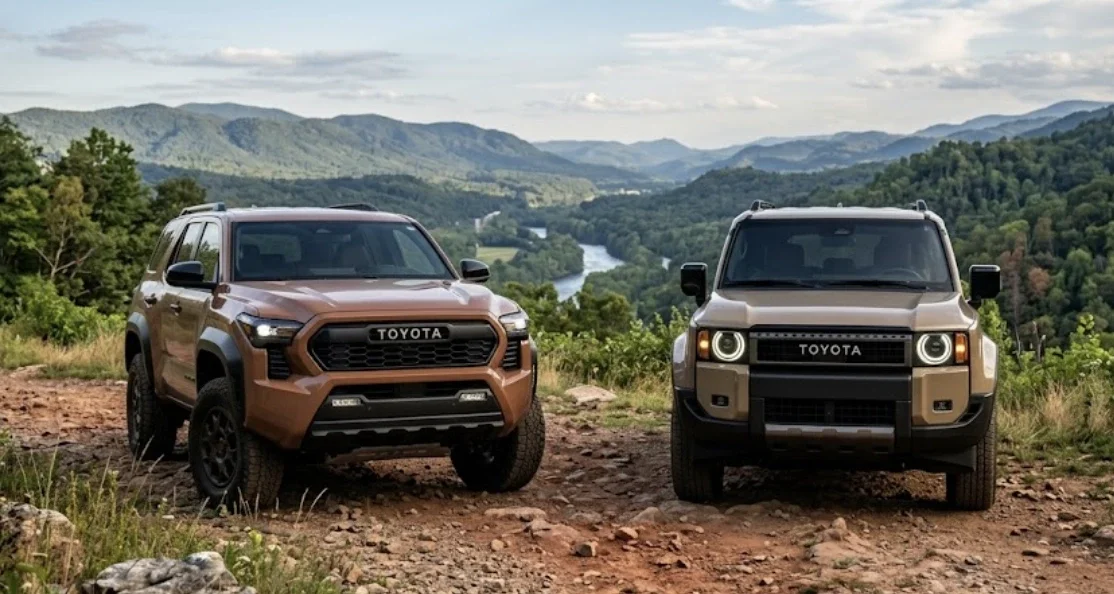
The Toyota 4Runner is the better choice for Durham drivers who want a lower starting price, available seven-passenger seating, and a choice between gas and hybrid power, while the Land Cruiser is the better choice for drivers who want standard hybrid power and dedicated off-road hardware on every trim without shopping between engine options. At Mark Jacobson Toyota, we get this question constantly from Triangle shoppers cross-shopping our rugged Toyota SUV lineup, and the honest answer depends less on which SUV is "better" and more on how your household actually drives. For a Cary family that needs a third row for carpool season but also wants weekend trail capability, the 4Runner's available seven-passenger SR5 or Limited solves a problem the two-row-only Land Cruiser cannot. Both SUVs share Toyota's TNGA-F body-on-frame platform and Toyota Safety Sense 3.0, but they diverge quickly after that. The 4Runner spans nine trims from a value-focused SR5 to a trail-ready TRD Pro and overland-inspired Trailhunter, with i-FORCE MAX hybrid power standard on some trims and optional on others. The Land Cruiser keeps things simple with just two trims, the 1958 and Land Cruiser, and every single one is a hybrid. In this guide, we compare powertrain and towing, price and daily comfort, who actually buys each SUV around Durham, and which one we recommend for different households, so you can walk into our showroom already knowing which questions to ask. Table of Contents Introduction Definition Block Powertrain, 4WD, Towing, and Off-Road Hardware i-FORCE vs i-FORCE MAX hybrid specs Towing capacity and locking differentials compared Trail Features and Body-on-Frame Confidence Price, Value, Comfort, and Daily Practicality Price, seating, and cargo comparison Triangle Family Use vs Blue Ridge Adventure Use 4Runner and Land Cruiser Buyer Profiles Around Durham Who actually buys each SUV in the Triangle Which SUV We Recommend for Durham Drivers 4Runner vs Land Cruiser Ownership: Fuel, Maintenance, and Long-Term Value Key Takeaways 4Runner vs Land Cruiser FAQ for Durham Shoppers Closing The Toyota 4Runner and Toyota Land Cruiser are both body-on-frame, off-road-capable SUVs built on Toyota's TNGA-F platform. The 4Runner offers a wider trim range with a choice of gas or hybrid power, while the Land Cruiser is a smaller, two-trim lineup that is hybrid on every model. For drivers in Durham, Raleigh, Chapel Hill, Cary, and Apex, the right choice depends on seating needs, budget, and how often the vehicle will actually leave pavement. Powertrain, 4WD, Towing, and Off-Road Hardware The 4Runner lets you choose between a gas i-FORCE engine and an available i-FORCE MAX hybrid, while every Land Cruiser comes standard with the same 326-horsepower hybrid powertrain, and that single difference shapes almost every other comparison between the two. i-FORCE vs i-FORCE MAX hybrid specs The 2026 Toyota 4Runner starts with a standard 2.4-liter turbocharged i-FORCE engine producing 278 horsepower and 317 lb.-ft. of torque on SR5, TRD Sport, and TRD Sport Premium trims. Stepping up to the i-FORCE MAX hybrid, available on TRD Off-Road, TRD Off-Road Premium, and Limited, and standard on Platinum, TRD Pro, and Trailhunter, raises output to 326 horsepower and 465 lb.-ft. of torque, identical figures to every Land Cruiser trim. We recommend the i-FORCE MAX 4Runner for Durham drivers who want Land Cruiser-level power in a trim lineup with more price flexibility. The 2026 Toyota Land Cruiser skips the choice entirely: every 1958 and Land Cruiser trim uses the same i-FORCE MAX hybrid powertrain, with 326 horsepower, 465 lb.-ft. of torque, and an eight-speed automatic transmission. For a Raleigh driver who wants hybrid torque without researching which 4Runner trims include it, that simplicity is part of the Land Cruiser's appeal. You can review full specifications on our 4Runner research page or our Land Cruiser research page before you decide. Spec 4Runner (gas i-FORCE) 4Runner (i-FORCE MAX hybrid) Land Cruiser (all trims) Horsepower 278 hp 326 hp 326 hp Torque 317 lb.-ft. 465 lb.-ft. 465 lb.-ft. Transmission 8-speed automatic 8-speed automatic 8-speed automatic Combined MPG Up to 23 mpg Slightly lower than gas in most trims 23 mpg Availability SR5, TRD Sport, TRD Sport Premium Optional on Limited/TRD Off-Road; standard on Platinum, TRD Pro, Trailhunter Standard on both trims Best For Budget-focused buyers not chasing max torque Buyers wanting Land Cruiser-level torque with trim flexibility Buyers who want hybrid power without comparing trims Based on Toyota's official website. Choose the gas 4Runner if you want the lowest entry price and do not need maximum torque. Choose the hybrid 4Runner if you want Land Cruiser-level power with more trim choices. Choose the Land Cruiser if you would rather not compare engine options at all. For a Durham commuter cross-shopping a base SR5 4Runner against a Land Cruiser 1958, the power difference is real: 278 hp and 317 lb.-ft. versus 326 hp and 465 lb.-ft. We recommend test-driving both before assuming the Land Cruiser's extra torque matters for your actual commute. See 4Runner i-FORCE MAX Trims Towing capacity and locking differentials compared Towing is one of the more counterintuitive parts of this comparison. Gas-powered 4Runner trims, including the base SR5, tow up to 6,000 pounds, matching the Land Cruiser's maximum. But the hybrid top trims, Platinum, TRD Pro, and Trailhunter, are actually rated slightly lower at 5,800 pounds because of the added weight of the hybrid battery and motor. The Land Cruiser holds its 6,000-pound rating on every trim since the hybrid hardware was engineered into the vehicle from the start rather than added to an existing gas platform. Off-road hardware follows a similar trim-dependent pattern on the 4Runner. Locking rear differentials and Multi-Terrain Select are concentrated on TRD Off-Road, TRD Pro, and Trailhunter grades, while SR5 and Limited focus more on comfort and available third-row seating. On the Land Cruiser, locking center and rear differentials and low-range gearing come standard on both trims, no upgrade required. For an Apex household deciding between a 4Runner TRD Off-Road and a Land Cruiser 1958, both deliver similar trail hardware, but the Land Cruiser guarantees it without trim research. Trail Features and Body-on-Frame Confidence Both SUVs share Toyota's TNGA-F body-on-frame platform, which is the underlying reason either one can handle rutted trails, gravel forest-service roads, and towing loads that would stress a car-based crossover. The 4Runner's most capable trims reach up to 10.1 inches of ground clearance, noticeably more than the Land Cruiser's 8.7 inches, which gives TRD Pro and Trailhunter buyers an edge on technical terrain. The Land Cruiser counters with a more consistent off-road spec sheet across its narrower trim range, so buyers are not choosing between comfort trims and capability trims the way 4Runner shoppers sometimes have to. For a Chapel Hill trail regular comparing a 4Runner Trailhunter to a Land Cruiser trim, the deciding factor often comes down to whether overland-style equipment, like the Trailhunter's upgraded suspension and rear bumper, matters more than the Land Cruiser's simpler, standardized approach to off-road readiness. Price, Value, Comfort, and Daily Practicality The 4Runner's nine-trim lineup gives Durham shoppers far more price flexibility than the Land Cruiser's two trims, but that flexibility means comfort and off-road features are not standardized the way they are on every Land Cruiser. Price, seating, and cargo comparison Price is where the two SUVs separate the most. The 2026 4Runner starts at $41,870 MSRP for the SR5 and reaches $68,200 for the TRD Pro, giving Durham shoppers a wide range of entry points. The Land Cruiser starts around $58,000 for the 1958 and around $63,000 for the Land Cruiser trim, which puts its base price closer to a mid-to-upper 4Runner trim than to the 4Runner's entry point. Seating is another key difference: the 4Runner offers an available third row on gas SR5 and Limited trims for up to seven passengers, while hybrid 4Runner trims and every Land Cruiser trim seat five only, since the hybrid battery occupies the space a third row would use. Criteria 4Runner Land Cruiser Best For Starting MSRP* $41,870 (SR5) Around $58,000 (1958) 4Runner for lowest entry price Top Trim MSRP* $68,200 (TRD Pro) Around $63,000 (Land Cruiser) 4Runner for widest trim spread Seating 5 or 7 passengers (gas trims) 5 passengers only 4Runner for families needing a third row Cargo (2-row) 48.4 cu ft behind rear seat 37.5 cu ft behind second row 4Runner for more everyday cargo room Ground Clearance Up to 10.1 in (TRD Pro/Trailhunter) Up to 8.7 in 4Runner top trims for extreme clearance Trim Count 9 trims 2 trims Land Cruiser for simpler shopping Best For Buyers wanting price range and trim variety Buyers wanting a simple, fully-equipped hybrid SUV Matches shopping style to household Based on Toyota's official website. *Starting MSRP shown before destination charge; confirm current pricing with our sales team. We recommend the 4Runner over the Land Cruiser when budget flexibility or third-row seating matter more than a standardized off-road spec sheet. We recommend the Land Cruiser over the 4Runner when you would rather skip comparing nine trims and simply buy a fully-equipped hybrid off-road SUV. Neither vehicle is the wrong choice; they are built for different shopping priorities. Schedule a Side-by-Side Test Drive Triangle Family Use vs Blue Ridge Adventure Use Daily life around Durham and RTP tends to favor the 4Runner's flexibility, while dedicated mountain and trail use tends to favor the Land Cruiser's standardized hardware. For a Cary family managing carpool and after-school activities most weekdays, the 4Runner's available third row solves a real logistics problem that the Land Cruiser cannot. For a Raleigh household that spends most weekends on Blue Ridge Parkway routes or forest-service roads, the Land Cruiser's guaranteed locking differentials and low-range gearing remove the guesswork of picking the right 4Runner trim. If you need a third row for carpool or sports schedules, choose the 4Runner SR5 or Limited. If you want maximum trail hardware without comparing trims, choose the Land Cruiser. If your budget caps out near $45,000, the 4Runner is your only option between these two. If you want the widest ground clearance for technical trails, look at the 4Runner TRD Pro or Trailhunter. For an Apex family that splits time between school runs and weekend trips to Jordan Lake or the mountains, we often recommend test-driving a 4Runner Limited hybrid and a Land Cruiser 1958 back to back, since the price gap between them is smaller than shoppers expect. If you are still weighing the 4Runner against the Land Cruiser, we would rather show you both in person than have you guess from a spec sheet. Our team at Mark Jacobson Toyota can pull current 4Runner and Land Cruiser inventory so you can sit in both, compare cargo access, and feel the difference in ride height and interior space for yourself. We can also walk you through which 4Runner trims include the i-FORCE MAX hybrid, since availability changes trim to trim in ways that are easy to misread online. Drivers from Durham, Raleigh, Chapel Hill, Cary, and Apex are welcome to call us at 919-493-5599 or check current availability on our website before stopping by. We want your visit to answer real questions about seating, towing, and price, not just repeat a spec sheet you already read. Get Pre-Approved for Either SUV 4Runner and Land Cruiser Buyer Profiles Around Durham Around Durham and the Triangle, 4Runner buyers tend to prioritize budget and flexibility, while Land Cruiser buyers tend to already know they want standardized off-road capability and are willing to pay for it. Who actually buys each SUV in the Triangle At our Mark Jacobson Toyota showroom, the 4Runner shopper is often a Durham or Cary family cross-shopping SUVs in the low-to-mid $40,000s who wants a rugged Toyota with room to grow into a higher trim later. The Land Cruiser shopper has typically already decided they want a hybrid, off-road-focused SUV and are comparing it mainly against the 4Runner's upper trims or the Sequoia, not against mainstream crossovers. Both groups value Toyota reliability, but they arrive at our lot asking different questions. For a Chapel Hill professional who wants distinctive retro styling and does not mind a narrower trim lineup, the Land Cruiser fits that identity better than a 4Runner ever will. For a Raleigh family that needs to justify the purchase across daily commuting, carpool duty, and occasional weekend trips, the 4Runner's range of trims makes it easier to find one configuration that covers all three jobs. We also see a third pattern locally: buyers who start out shopping the Land Cruiser for its styling, then end up in a 4Runner Limited once they realize they need the available third row after all. Local Buyer Profile Primary Priority Better Fit Why Durham budget-conscious family Lowest entry price 4Runner SR5 $41,870 starting MSRP vs Land Cruiser's higher floor Cary carpool family Seven-passenger seating 4Runner SR5 or Limited Only 4Runner offers an available third row Raleigh mountain-trip household Standardized off-road hardware Land Cruiser Locking diffs and low range on every trim Apex trail enthusiast Maximum ground clearance 4Runner TRD Pro/Trailhunter Up to 10.1 in of clearance Chapel Hill style-focused buyer Distinctive retro design Land Cruiser Simpler lineup with a stronger design identity Ideal Use Case Matching budget and passenger needs to trim 4Runner or Land Cruiser depending on priority Neither SUV fits every household equally well Based on Toyota's official website and current trim availability. Value Your Trade Toward a 4Runner or Land Cruiser If one of these buyer profiles sounds like you, we invite you to stop by our Durham showroom so we can match you to the right trim rather than the right model on paper alone. Our team has helped drivers across Durham, Raleigh, Chapel Hill, Cary, and Apex work through this exact decision, and we are glad to pull current 4Runner and Land Cruiser inventory for a side-by-side look. As part of our Mark Says Yes! approach, we focus on finding financing and trade options that fit your budget rather than steering you toward whichever SUV has the higher price tag. If you already own a vehicle to trade, we can give you a real trade value before you commit to either model. Call us at 919-493-5599, review current inventory on our website, or visit us at 4516 Durham-Chapel Hill Blvd so we can help you make this decision with confidence. Browse 4Runner and Land Cruiser Inventory Which SUV We Recommend for Durham Drivers We recommend the 4Runner for most Durham households and the Land Cruiser specifically for buyers who already know they want standardized hybrid off-road hardware and are willing to pay for it. If you are still undecided, our honest recommendation starts with your budget and passenger count, not the spec sheet. If you need to stay closer to $45,000 or need seating for seven, the 4Runner is the only one of the two that can meet you there. If your budget already sits closer to $58,000 to $65,000 and you do not need a third row, the Land Cruiser's standardized hybrid power and off-road hardware make the decision simple. For a Durham family cross-shopping a 4Runner Limited hybrid against a Land Cruiser 1958, the two vehicles land closer in price than most shoppers expect, and at that point the decision often comes down to seating flexibility versus design identity rather than capability. For a Cary or Apex buyer who has already ruled out a third row and wants the most trail-ready SUV without comparing engine options, we recommend heading straight to the Land Cruiser. For a Raleigh household that genuinely cannot decide, we recommend a back-to-back test drive at our Durham showroom, since ride height, interior feel, and cargo access are easier to judge in person than from any comparison chart, including this one. We also encourage bringing your actual gear, whether that is car seats, camping equipment, or a trailer hitch, so you can confirm fit before signing paperwork rather than after. 4Runner vs Land Cruiser Ownership: Fuel, Maintenance, and Long-Term Value Ownership costs favor the 4Runner if you choose a gas trim and stay off trails, and favor the Land Cruiser's predictability if you want the same hybrid coverage and service routine on every trim without comparing options. Because the 4Runner offers both gas and hybrid trims, ownership costs vary more than they do on the hybrid-only Land Cruiser. A gas SR5 will cost less to service in some respects since it lacks hybrid-specific components, while an i-FORCE MAX 4Runner or any Land Cruiser trim carries the same hybrid system warranty coverage and ToyotaCare-eligible maintenance schedule. If you choose a gas 4Runner, expect simpler service intervals but no hybrid fuel-economy benefit. If you choose a hybrid 4Runner or any Land Cruiser, expect ToyotaCare coverage and hybrid system warranty protection. If you tow near the maximum rating regularly, budget for more frequent fluid and brake inspections on either SUV. If you plan heavy trail use, plan for tire and alignment costs regardless of which model you choose. Our service team advises owners of either SUV to keep up with differential fluid checks and skid plate inspections after seasons of off-road use, and to stick with genuine OEM parts for drivetrain service. For a Durham family planning to keep either SUV for eight to ten years, the Land Cruiser's single-powertrain simplicity can make budgeting slightly more predictable, while the 4Runner's trim range gives more control over the upfront price you pay to get there. Either way, we recommend using scheduled ToyotaCare visits to catch small issues, like uneven tire wear from trail use, before they turn into larger repairs. Schedule Service for Your 4Runner or Land Cruiser Key Takeaways The 4Runner starts at $41,870 MSRP; the Land Cruiser starts around $58,000. Every Land Cruiser is a 326-hp hybrid; the 4Runner offers both gas (278 hp) and hybrid (326 hp) options. Only the 4Runner offers available seven-passenger seating, on gas SR5 and Limited trims. The 4Runner's top trims reach 10.1 inches of ground clearance versus 8.7 inches on the Land Cruiser. We recommend the Land Cruiser for buyers who want standardized off-road hardware without comparing trims. 4Runner vs Land Cruiser FAQ for Durham Shoppers Is the 4Runner or Land Cruiser better for off-roading? Both are capable, but they get there differently. Every Land Cruiser trim comes standard with locking differentials and low-range gearing, while that same hardware on the 4Runner is concentrated on TRD Off-Road, TRD Pro, and Trailhunter trims. We recommend the Land Cruiser if you want guaranteed off-road hardware without trim research, and the 4Runner TRD Pro or Trailhunter if you want the highest ground clearance available between the two, since it reaches up to 10.1 inches versus the Land Cruiser's 8.7 inches. Does the 2026 Toyota 4Runner come as a hybrid? Yes, the 2026 4Runner offers an i-FORCE MAX hybrid powertrain producing 326 horsepower and 465 lb.-ft. of torque, standard on Platinum, TRD Pro, and Trailhunter and available on TRD Off-Road, TRD Off-Road Premium, and Limited. The SR5, TRD Sport, and TRD Sport Premium use the standard gas i-FORCE engine instead. We recommend confirming hybrid availability trim by trim, since it is not offered across the entire 4Runner lineup the way it is on every Land Cruiser. Can the 4Runner seat seven passengers? Yes, but only on gas-powered SR5 and Limited trims with the available third-row seat. Hybrid 4Runner trims are five-passenger only because the battery sits under the cargo floor where a third row would go. The Land Cruiser is five-passenger only on every trim. For a Cary family that needs seven seats, we recommend a gas SR5 or Limited 4Runner over any Land Cruiser or hybrid 4Runner trim. Is the 4Runner cheaper than the Land Cruiser? Yes, at the entry level. The 4Runner SR5 starts at $41,870 MSRP, well below the Land Cruiser 1958's starting price of around $58,000. At the top of each lineup, the gap narrows: a 4Runner Limited or Platinum can approach Land Cruiser pricing once options are added. We are here to help you choose between the 2026 Toyota 4Runner and Land Cruiser at Mark Jacobson Toyota, 4516 Durham-Chapel Hill Blvd, Durham, NC 27707. Our team works with drivers across Durham, Raleigh, Chapel Hill, Cary, and Apex who want a clear answer instead of a longer spec sheet. We can compare trims side by side, explain ToyotaCare and hybrid warranty coverage on either SUV, and help you decide based on your real budget and passenger needs. As part of our Mark Says Yes! approach, we keep financing and trade conversations straightforward rather than stressful, and we are glad to give you an honest opinion even if it points you toward the less expensive option. Call us at 919-493-5599, review current inventory on our website, or visit our Durham showroom so we can help you settle this comparison in person. Related Articles Keep reading more Toyota model guides, service tips, and ownership advice from Mark Jacobson Toyota. Adventure SUV Guide 2026 Toyota Land Cruiser Hybrid: Mountain Trip and Adventure Guide for Durham Drivers Get the full breakdown of Land Cruiser trims, hybrid ownership, and Blue Ridge and Jordan Lake trip planning. Read More Full-Size SUV Guide 2026 Toyota Sequoia: Power, Space, and Luxury for Durham Families Need three rows and more towing than either the 4Runner or Land Cruiser offers? See how Sequoia compares. Read More Family SUV Guide 2026 Toyota Highlander vs Grand Highlander: Which Toyota SUV Fits Your Family? If neither the 4Runner nor Land Cruiser fits your family's seating needs, compare these two crossover SUVs instead. Read More Service Guide Toyota A/C Service & Repair Guide for Durham Summer Driving Whichever SUV you choose, keep it comfortable on hot Triangle days and long mountain drives. Read More