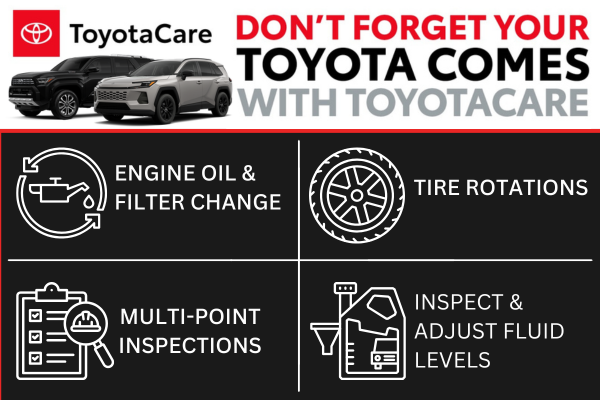
Toyota Ownership Guide • Durham, NC Maintenance Plan or Repair Protection? Know What Your Toyota Coverage Actually Does ToyotaCare, ToyotaCare Plus and a Toyota Vehicle Service Agreement can all be part of the ownership conversation, but they cover different expenses and should not be treated as interchangeable products. ToyotaCare, ToyotaCare Plus and what shoppers often call a Toyota extended warranty serve different purposes. ToyotaCare is the no-cost scheduled-maintenance program included with eligible new Toyota vehicles. ToyotaCare Plus is an optional prepaid maintenance plan that can continue eligible scheduled services beyond the initial ToyotaCare period. A Toyota Vehicle Service Agreement, often described conversationally as an extended warranty, is optional protection for certain covered repair costs under the agreement. ToyotaCare Plus is not an extended repair warranty. That distinction matters because maintenance and repairs solve different ownership problems. An oil change, tire rotation or scheduled inspection is maintenance. A covered component that fails unexpectedly is a repair issue. Paying for a maintenance plan does not automatically mean future mechanical repairs are covered, and buying a Vehicle Service Agreement does not mean routine scheduled maintenance is included. There is another reason Durham Toyota owners should look closely at the details in 2026: ToyotaCare terms now differ by model year. A 2026 Toyota and a 2027 Toyota can begin ownership with different standard ToyotaCare structures. Before comparing plans, identify your vehicle's model year, date of first use and current mileage, then read the specific agreement that applies to that vehicle. The Simplest Way to Understand the Difference ToyotaCare and ToyotaCare Plus are centered on scheduled maintenance. A Toyota Vehicle Service Agreement is centered on eligible covered repairs. The factory warranty is another separate layer. Start by identifying whether you are trying to plan routine service costs or protect against certain future repair costs, then evaluate the product designed for that purpose. Toyota Ownership Coverage Guide ToyotaCare Coverage Guide: Maintenance Plans vs Repair Protection ToyotaCare vs ToyotaCare Plus vs Extended Warranty What Does ToyotaCare Cover? ToyotaCare for 2026 vs 2027 Models What Does ToyotaCare Plus Cover? What Is a Toyota Vehicle Service Agreement? Maintenance Plan vs Extended Warranty What About Toyota Service Care? Which Option Fits Your Ownership Plan? Questions to Ask Before Buying Coverage ToyotaCare and Warranty FAQ ToyotaCare vs ToyotaCare Plus vs Extended Warranty The names can sound as though they represent increasing levels of the same coverage. They do not. ToyotaCare starts the ownership experience with eligible scheduled maintenance and roadside assistance. ToyotaCare Plus is an optional prepaid maintenance product for owners who want to continue eligible scheduled services under a plan. A Toyota Vehicle Service Agreement focuses instead on eligible repairs to covered components, subject to its terms, exclusions, limitations and any applicable deductible. Product Main Purpose Scheduled Maintenance Eligible Covered Repairs How You Get It ToyotaCare Initial factory-scheduled maintenance plus roadside assistance for eligible new Toyotas Yes, according to the applicable maintenance schedule and program terms No. It is not a repair warranty or VSA. Included at no additional cost with eligible new Toyota vehicles ToyotaCare Plus Continue eligible prepaid scheduled maintenance Yes, according to the selected plan and vehicle maintenance guide No. It does not replace a repair VSA. Optional purchase, subject to eligibility Toyota Vehicle Service Agreement Protection for certain eligible repair costs Not a routine maintenance plan Yes, for covered components subject to agreement terms Optional purchase, subject to eligibility and availability Factory Warranty Manufacturer warranty protection for applicable covered defects/components Not a prepaid maintenance plan Coverage depends on the warranty and component involved Comes with the new vehicle under Toyota's applicable warranty terms This four-layer view is more useful than asking which plan has the most benefits. The products are aimed at different expenses. A driver may care about predictable service visits, unexpected repair exposure, or both. That is why an owner can conceptually have maintenance coverage and repair protection at the same time without the two products being duplicates. What Does ToyotaCare Cover? ToyotaCare is Toyota's no-cost maintenance program for eligible new Toyota vehicles. It is designed around normal factory-scheduled maintenance during the applicable program period. Services follow the vehicle's Warranty and Maintenance Guide, which is important because not every Toyota uses the same maintenance schedule or requires identical service at the same mileage. Depending on the vehicle and maintenance interval, ToyotaCare can include items such as engine oil and oil-filter changes when due, tire rotations, multi-point inspections and fluid-level inspections or adjustments. Toyota-trained technicians perform the eligible services using the maintenance schedule for the specific vehicle. ToyotaCare also includes roadside assistance for an applicable period. Roadside services can include assistance for situations such as a flat tire, battery jump-start, lockout, emergency fuel delivery, towing or winching, subject to program limitations. Roadside assistance should not be confused with repair coverage either. A tow may help get a vehicle to the dealership, but that does not automatically mean the cause of the breakdown is covered by ToyotaCare. What ToyotaCare Does Not Mean ToyotaCare is not a promise that every maintenance item, wear item or repair during ownership is free. The exact scheduled services depend on the vehicle's maintenance guide, and program exceptions exist for certain models and powertrains. For example, tires, brake friction materials, wiper blades and other items can wear with use. Whether a particular item or repair is covered depends on the applicable maintenance plan, warranty, service agreement or other protection product, not simply on the fact that the Toyota originally came with ToyotaCare. The safest approach is to separate the question into two parts: “Is this service scheduled maintenance included under my current plan?” and “If this is a repair, is it covered by an applicable warranty or service agreement?” Those are not the same question. ToyotaCare Changed for 2027 Model-Year Vehicles For 2027-model-year and newer Toyota vehicles, Toyota's current standard ToyotaCare structure differs from many 2026-and-earlier vehicles. Toyota currently states that ToyotaCare covers normal factory-scheduled maintenance for 1 year or 10,000 miles, whichever comes first, while 2026-model-year and earlier vehicles are an exception that retain the 2-year/25,000-mile ToyotaCare structure. Other model-specific exceptions also exist, so owners should identify the model year and vehicle before assuming the historical 2-year/25,000-mile figure applies. Vehicle Group Current ToyotaCare Maintenance Structure Why Owners Should Check Most MY2027 and newer eligible Toyota vehicles 1 year or 10,000 miles, whichever comes first This is different from the historical ToyotaCare structure many owners remember. MY2026 and earlier eligible Toyota vehicles 2 years or 25,000 miles, whichever comes first Toyota currently lists these model years as an exception to the newer structure. Selected models or electrified vehicles Program terms can differ Check the specific ToyotaCare disclosure and Warranty and Maintenance Guide. Roadside-assistance terms also have their own rules and model-specific exceptions. That is another reason not to describe all ToyotaCare benefits with one universal time-and-mileage statement. This change is particularly relevant in late 2026 because a dealership can have shoppers researching both 2026 and 2027 vehicles at the same time. Two customers buying new Toyotas during the same month may see different ToyotaCare maintenance periods because the vehicles belong to different model years. If you already own a Toyota, the model year and original date of first use matter more than today's calendar date. Your coverage follows the program applicable to the vehicle rather than automatically changing because Toyota introduced a newer structure for later model years. What Does ToyotaCare Plus Cover? ToyotaCare Plus is an optional prepaid maintenance plan. Its purpose is to help eligible owners continue scheduled Toyota maintenance beyond the initial no-cost ToyotaCare period or otherwise add eligible future maintenance services under the plan structure that applies to the vehicle. Current Toyota Financial information lists services that may include engine oil and oil-filter changes, tire rotations, multi-point inspections and other maintenance specified by the vehicle's maintenance guide. For MY2027-and-newer plans, Toyota Financial also lists eligible cabin and engine air-filter changes where applicable. Roadside-assistance benefits are also included under current ToyotaCare Plus program terms, subject to the plan's restrictions. ToyotaCare Plus Eligibility for MY2026 and Earlier For vehicles model year 2026 and older, Toyota Financial currently says eligible vehicles generally need to have been eligible for the no-cost 2-year/25,000-mile ToyotaCare program, be within 37 months of the date of first use and have 31,000 miles or fewer. Current plan choices for that group can range from 3 years or 35,000 miles through 5 years or 75,000 miles, depending on the plan and vehicle. Importantly, Toyota Financial measures this coverage from the date of first use. A 5-year plan should not be interpreted as five additional years beginning only after ToyotaCare ends. ToyotaCare Plus for MY2027 and Newer The newer structure is different. Toyota Financial currently lists eligibility for MY2027-and-newer ToyotaCare Plus plans when the vehicle has fewer than 16,000 miles, was ToyotaCare eligible and does not already have another prepaid maintenance plan. Depending on the selected plan, current options range from 2 years with up to 3 services through 6 years with up to 13 services. Toyota Financial states that coverage begins at the point of sale or once ToyotaCare expires, depending on the circumstances, and ends when the plan's maximum time or number of services is reached. Check the Model Year Before Comparing ToyotaCare Plus A ToyotaCare Plus description written for a 2026 vehicle may not accurately describe eligibility, plan length or service-count structure for a 2027 vehicle. Use the agreement and current Toyota Financial information for the specific model year instead of relying on an older ToyotaCare Plus explanation. ToyotaCare Plus Does Not Replace an Extended Warranty This is the point most worth remembering. ToyotaCare Plus helps plan eligible scheduled maintenance. It is not designed as broad repair protection for a failed transmission, electronics module, air-conditioning component or other mechanical system simply because the repair occurs while the maintenance plan is active. Likewise, a Vehicle Service Agreement is not a substitute for your maintenance schedule. If the agreement covers an eligible mechanical repair, that does not eliminate the need to change oil, rotate tires, inspect components or perform other maintenance identified in the Warranty and Maintenance Guide. Maintenance history can also matter when diagnosing problems or evaluating coverage. Following the manufacturer's maintenance requirements helps document that the vehicle was serviced appropriately, but maintenance itself should still be treated separately from contractual repair coverage. What Is a Toyota Vehicle Service Agreement? A Toyota Vehicle Service Agreement, or VSA, is the Toyota Financial product most closely related to what consumers commonly mean when they say “extended warranty.” Technically, it is a service agreement rather than the original factory warranty. It provides coverage for eligible repair costs to specified components according to the protection level and terms selected. For qualifying new Toyota vehicles, Toyota Financial currently offers levels including Platinum Protection, Gold Protection and Powertrain Protection, plus separate products for certain battery-electric vehicles. The covered component list becomes broader or narrower depending on the protection level, so the plan name alone is not enough to determine whether a specific repair is covered. Current Toyota Financial rules say new Toyota vehicles can generally be eligible to purchase a new-vehicle VSA up to 3 years or 36,000 total vehicle miles, whichever comes first. Eligibility does not mean every plan is identical or available in every situation. State availability, vehicle type, purchase date and program rules can affect the agreement. For Platinum Protection, Toyota Financial currently lists term choices that can range from 3 years/50,000 total vehicle miles to as long as 10 years/125,000 total vehicle miles. Other protection levels can have different maximum terms. Coverage periods are measured according to the agreement, and deductibles, exclusions and limitations can apply. What Should You Look for in the VSA Agreement? Do not evaluate repair protection only by the maximum number of years printed in a brochure. Look at what components are included, what is excluded, how the deductible works, where covered repairs can be performed, when the term starts, the mileage limit and what happens if the vehicle is sold or the agreement is canceled. Toyota Financial also states that its VSAs are optional and are not required to obtain credit. That is important whenever a protection product is discussed during vehicle financing. A shopper should understand the vehicle price, financing terms and optional protection products as separate parts of the transaction. Mark Jacobson Toyota maintains an Extended Warranty Options page where Durham shoppers can review available protection categories and discuss current eligibility. ToyotaCare Plus vs Extended Warranty: Which Expense Are You Planning For? Choose based on the expense you are trying to plan for. If your goal is to prepay eligible factory-scheduled maintenance, a maintenance product such as ToyotaCare Plus is the relevant category. If your concern is the cost of certain unexpected mechanical or electrical repairs after applicable warranty coverage, a Vehicle Service Agreement is the relevant category. One product does not automatically substitute for the other, and some owners may consider both because they address different costs. Your Main Concern Product to Understand Reason Oil changes and scheduled service ToyotaCare / ToyotaCare Plus These products center on eligible scheduled maintenance. Planning maintenance costs beyond ToyotaCare ToyotaCare Plus It is an optional prepaid maintenance plan for qualifying vehicles. Unexpected eligible component repair Factory warranty or VSA, depending on timing and coverage Repair coverage is different from scheduled maintenance. Longer-term repair-cost protection Toyota Vehicle Service Agreement VSAs cover eligible components according to the selected agreement. Roadside assistance Review the current ToyotaCare, ToyotaCare Plus or VSA terms Roadside benefits can exist in multiple products, but duration and limitations differ. It is also reasonable to choose neither optional product if you prefer to pay maintenance and repairs as they occur. These are voluntary protection products, not mandatory components of owning or financing a Toyota. The useful question is whether a particular plan's services, eligibility and cost fit the way you expect to own and maintain the vehicle. What About the Toyota Factory Warranty? The factory warranty should be treated as its own layer. A new Toyota includes manufacturer warranty coverage under Toyota's warranty terms, with different coverage periods potentially applying to different systems or components. Your Warranty and Maintenance Guide is the controlling source for the specific vehicle. A Vehicle Service Agreement can provide eligible repair protection beyond or alongside applicable warranty periods according to the VSA contract, but it does not rewrite the factory warranty. Similarly, ToyotaCare does not extend the factory warranty simply because scheduled maintenance is being performed at the dealership. If a problem occurs while your vehicle is still within an applicable factory warranty period, the service department can determine whether the issue is covered by that warranty, another applicable campaign or agreement, or is the owner's responsibility. You do not need to decide which coverage applies by guessing based on the repair cost. What About Toyota Service Care? Toyota Service Care is another prepaid maintenance product, but it is aimed at a different stage of ownership. Toyota Financial describes it as maintenance coverage available through the service drive for vehicles that are no longer covered by ToyotaCare and do not have another active prepaid maintenance plan. Current Toyota Financial information says Toyota Service Care has no vehicle age or mileage maximum under its general eligibility rules, provided ToyotaCare has expired and there is no other active prepaid maintenance plan. Services can include oil and filter changes, tire rotations and multi-point inspections, along with roadside assistance under the applicable terms. Mark Jacobson Toyota also has a dedicated Toyota Service Care page for owners who want to explore maintenance options after the original ToyotaCare stage. That means Toyota Service Care should not be confused with a VSA either. Like ToyotaCare Plus, it belongs primarily in the maintenance-planning bucket rather than the repair-protection bucket. What About Toyoguard Platinum? Durham is in the Southeast Toyota region, so some buyers may also encounter the name Toyoguard Platinum. Toyoguard is a separate Southeast Toyota program and should not be assumed to be another name for ToyotaCare Plus or a Vehicle Service Agreement. If your purchase paperwork mentions Toyoguard, review the actual benefits attached to that vehicle rather than merging them mentally with ToyotaCare. We cover that regional distinction separately in our ToyotaCare vs Toyoguard Platinum guide for Durham, Raleigh and Cary owners. Which Toyota Protection Fits Your Ownership Plan? Start with how long you expect to keep the Toyota. A driver who normally trades vehicles after a few years may view long-term repair protection differently from an owner planning to keep a Toyota well beyond the original warranty period. At the same time, both drivers still have scheduled maintenance responsibilities while they own the vehicle. Next, think about how you prefer to handle expenses. Some owners like the predictability of prepaying eligible maintenance rather than paying at each visit. Others prefer keeping that money available and paying service costs when they occur. Neither approach automatically guarantees lower total ownership cost. For repair protection, consider your tolerance for an unexpected covered repair bill, the components included in the agreement, the deductible, the ownership period and the price of the VSA. A longer term can sound attractive, but only if its start date, mileage limit and coverage list match how long and how far you expect to drive. Can You Have ToyotaCare Plus and a VSA at the Same Time? Conceptually, yes, because the products address different categories of expense. ToyotaCare Plus can cover eligible scheduled maintenance under its agreement while a VSA can provide protection for eligible covered repairs under a separate agreement. Actual eligibility and plan availability still need to be confirmed for the specific vehicle. The presence of one plan should not be used as proof that the other is unnecessary. Nor should buying both automatically be described as the best value. The decision depends on what each agreement covers, what it costs and whether those benefits fit your ownership plan. Questions to Ask Before Buying a Toyota Protection Product Before agreeing to any optional maintenance or repair product, ask for the plan name and written agreement. Product names can sound similar, but the contract makes clear what you are actually purchasing. Is this a maintenance plan or repair-protection agreement? What exact services or components are covered? What is specifically excluded? When does the coverage period begin? Does the term run from today's purchase date or the vehicle's original date of first use? What mileage or service-count limit ends the plan? Is there a deductible for covered repairs? Where can maintenance or repairs be performed? What roadside-assistance benefits are included and for how long? Is the agreement transferable if I sell the Toyota? What are the cancellation terms? Is this Toyota-backed, Southeast Toyota-related or administered by another provider? Is the product optional? If you cannot tell from the paperwork whether you are buying maintenance or repair protection, ask for that distinction to be explained before signing. That one question prevents a large portion of the confusion surrounding ToyotaCare Plus and extended warranties. Key Takeaways for Durham Toyota Owners ToyotaCare is the initial no-cost scheduled-maintenance program for eligible new Toyota vehicles, with roadside assistance under applicable program terms. ToyotaCare Plus is an optional prepaid maintenance plan, not an extended repair warranty. MY2027-and-newer ToyotaCare generally uses a 1-year/10,000-mile maintenance structure, while MY2026-and-earlier vehicles are currently listed as a 2-year/25,000-mile exception. ToyotaCare Plus eligibility and plan structure also differ by model-year group, so older plan descriptions should not automatically be applied to a 2027 vehicle. A Toyota Vehicle Service Agreement is optional repair protection for eligible covered components and can have exclusions, deductibles and other contract-specific limitations. Toyota Service Care is another prepaid maintenance option aimed at owners beyond the ToyotaCare stage, not a repair warranty. Optional protection products should be evaluated separately from the vehicle purchase and financing terms. ToyotaCare, ToyotaCare Plus and Extended Warranty FAQ Is ToyotaCare Plus an extended warranty? No. ToyotaCare Plus is a prepaid maintenance plan. It can cover eligible scheduled maintenance such as oil and filter changes when applicable, tire rotations, inspections and other services specified by the vehicle maintenance guide. A Toyota Vehicle Service Agreement is the product designed to provide protection for certain eligible repair costs under its contract. Does ToyotaCare cover repairs? ToyotaCare is primarily a scheduled-maintenance and roadside-assistance program. It should not be treated as general repair coverage. A repair may instead fall under an applicable Toyota factory warranty, recall or service campaign, Vehicle Service Agreement or another protection product depending on the specific problem and vehicle. Is ToyotaCare different for 2027 Toyota models? Yes. Toyota's current program information states that most eligible 2027-model-year and newer vehicles receive ToyotaCare scheduled maintenance for 1 year or 10,000 miles, whichever comes first. Toyota currently lists 2026-model-year and earlier vehicles as an exception with the previous 2-year/25,000-mile structure. Additional model-specific exceptions can apply. When does ToyotaCare Plus coverage start? It depends on the model-year group and plan. For MY2026-and-earlier ToyotaCare Plus plans, Toyota Financial states that coverage is measured from the vehicle's date of first use. For MY2027-and-newer plans, current Toyota Financial information says coverage begins at the point of sale or once ToyotaCare expires, depending on the circumstances. Review the specific agreement before purchasing. Can I buy a Toyota Vehicle Service Agreement after buying the vehicle? Potentially, yes. Toyota Financial currently states that qualifying new Toyota vehicles can generally be eligible for a new-vehicle VSA up to 3 years or 36,000 total vehicle miles, whichever comes first. Eligibility, available plans and state-specific terms can vary, so confirm the current options for your vehicle before relying on that window. Review the Plan Before You Decide ToyotaCare, ToyotaCare Plus and Vehicle Service Agreements can each be useful in the right ownership situation, but they solve different problems. The best starting point is the actual vehicle: its model year, current mileage, maintenance schedule, existing warranty coverage and how long you expect to keep it. Mark Jacobson Toyota can help Durham owners review current maintenance and protection options, confirm eligibility and explain how the applicable agreement works before a decision is made. Explore Protection Options Visit Our Service Center Related Toyota Insights & Ownership Guides Toyota Ownership Coverage ToyotaCare vs. Toyoguard Platinum: What's Covered for Durham, Raleigh & Cary Toyota Owners Understand how ToyotaCare differs from the Southeast Toyota Toyoguard Platinum program that may appear in your vehicle paperwork. Read More → Scheduled Maintenance Tire Rotations and Alignment: The Definitive Guide to Spring Vehicle Health Learn why tire rotation, alignment checks and routine inspections matter when building a long-term Toyota maintenance routine. Read More → Toyota Service Guide Why Brake and Battery Services Keep Durham Drivers Covered for the Long Haul See how brake inspections, battery service and routine Toyota maintenance fit into real-world ownership beyond plan names and paperwork. Read More → Seasonal Maintenance Toyota Fall Maintenance Tips for Durham Drivers Review practical tire, battery, brake, fluid and visibility checks that complement your Toyota's factory maintenance schedule. Read More →