



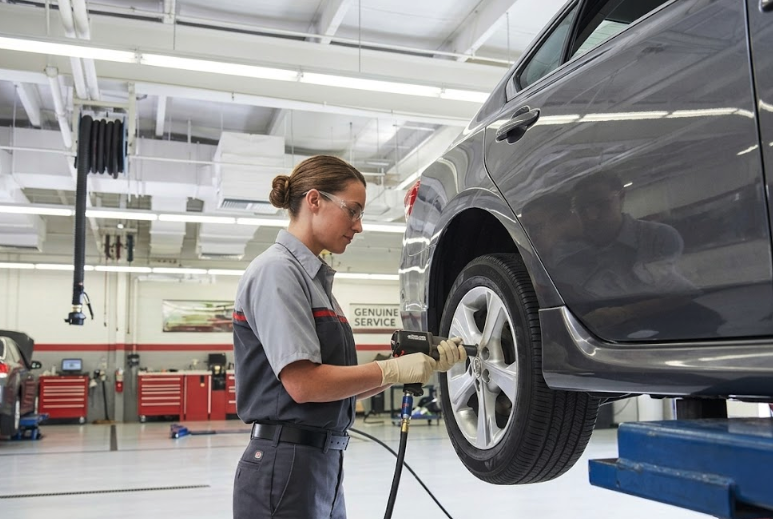
The physical reality of driving a modern vehicle in Durham involves a complex interplay between rubber, asphalt, and weight distribution. Tire rotation is far more than a simple chore; it is a critical engineering necessity dictated by the laws of physics. In a standard vehicle, particularly front-wheel-drive models like the Toyota Camry, the front tires are burdened with a disproportionate amount of labor. They must support the heavy weight of the engine and transmission, manage the friction required for steering, and absorb nearly eighty percent of the kinetic energy during braking. This creates a thermal and mechanical environment where the front tires degrade at a much higher rate than the rear counterparts. Without regular intervention, this imbalance leads to a rapid decline in tread depth, eventually compromising the structural integrity of the tire and the safety of the occupants.
The Science of Tire Longevity and Strategic Rotation Patterns
When we perform a tire rotation at Mark Jacobson Toyota, we are effectively resetting the wear clock for each tire. By systematically moving the front tires to the rear and the rear tires to the front often using the “Forward Cross” or “Rearward Cross” patterns depending on your specific drivetrain we ensure that no single tire is subjected to localized stress for too long.
This process allows the rubber compounds to wear down at a uniform rate across the entire set. Uniform tread wear is the cornerstone of vehicle stability; it ensures that all four corners of your car provide equal grip during cornering and identical water evacuation capabilities during Durham’s sudden spring thunderstorms.
Furthermore, maintaining a matched set of tires preserves the delicate balance of your suspension system, preventing secondary wear on wheel bearings and struts. By adhering to a strict 5,000-mile rotation interval, you are not merely extending the life of the rubber; you are protecting the complex mechanical symphony that keeps your vehicle moving efficiently.
This proactive approach saves thousands of dollars over the life of the vehicle, as it prevents the premature purchase of new tires and maximizes the return on your initial investment. In the long run, consistent rotation ensures that when it finally comes time to replace your tires, you can replace all four at once, which is the only way to maintain the manufacturer’s intended handling characteristics and safety ratings for your specific Toyota model.
Drivetrain Dynamics and Positional Wear Characteristics
The specific way your vehicle delivers power to the road whether through Front-Wheel Drive (FWD), Rear-Wheel Drive (RWD), or All-Wheel Drive (AWD) drastically alters the wear characteristics of your tires. In FWD vehicles, the front tires are the “workhorses,” handling propulsion, steering, and the majority of braking forces, leading to rapid shoulder wear.
Conversely, in RWD vehicles, the rear tires often see more center-tread wear due to the forces of acceleration. AWD systems present a unique challenge; because all four wheels are powered, the tires must be almost identical in tread depth to prevent strain on the center differential. A difference of even a few millimeters can cause the computer systems to misinterpret wheel speed, potentially leading to expensive drivetrain damage.
Therefore, rotation is not just about the tires themselves, but about protecting the expensive transmission and differential components. By understanding these dynamics, our technicians can apply the most effective rotation pattern for your specific Toyota. This technical precision ensures that your vehicle remains balanced, preventing the “feathering” or “cupping” that often occurs when tires are left in the same position for too long, ultimately providing a smoother and much quieter ride on the North Carolina highways.
The Technical Nuances of Wheel Alignment and Suspension Geometry
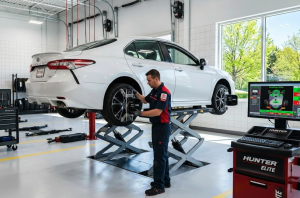
While tire rotation addresses the wear on the rubber, wheel alignment focuses on the intricate geometry of the vehicle’s suspension system. Alignment is the process of adjusting the angles of the wheels so they are perfectly parallel to each other and perpendicular to the ground. This is achieved by fine-tuning three primary measurements: camber, caster, and toe.
Camber refers to the inward or outward tilt of the tire when viewed from the front; improper camber causes the tire to lean, wearing out one edge prematurely. Caster is the angle of the steering axis when viewed from the side, which is essential for steering stability and the “self-centering” feel of the wheel. Toe is the most critical setting for tire life; it describes whether the fronts of the tires are pointing toward or away from each other. Even a fraction of a degree of “toe-in” or “toe-out” is equivalent to dragging your tires sideways across the pavement for every mile you drive.
In the Durham area, the transition from winter to spring is particularly treacherous for alignment. The expansion and contraction of the asphalt on roads like I-40 and University Drive create deep potholes that can easily jar a vehicle’s suspension out of its factory specifications. When your alignment is compromised, your car has to fight against itself. You may notice a persistent “pull” to one side, or you might find that your steering wheel is no longer centered when driving straight.
This misalignment creates a significant amount of “rolling resistance,” meaning your engine must work harder and burn more fuel just to maintain speed. At Mark Jacobson Toyota, we use state-of-the-art laser alignment technology to measure these angles with microscopic precision. Our certified technicians don’t just look at the tires; they inspect the entire suspension ecosystem, including ball joints, tie rods, and bushings.
If these components are worn or damaged by winter road debris, even a perfect alignment won’t hold. By restoring your vehicle to its original factory settings, we ensure that your Toyota tracks straight, handles predictably in emergency maneuvers, and maintains the highest possible level of fuel efficiency, all while protecting your tires from the devastating effects of uneven wear.
Calibrating the Future: Alignment and ADAS Integration
Modern Toyota vehicles are equipped with Toyota Safety Sense (TSS), a sophisticated suite of Advanced Driver Assistance Systems (ADAS) that includes Lane Departure Alert and Dynamic Radar Cruise Control. These systems rely on cameras and sensors that are calibrated based on the vehicle’s “thrust angle” the direction the rear wheels are pointing. If a technician performs a mechanical alignment but fails to perform a “Zero Point Calibration” of the electronic sensors, the safety systems may become confused.
The car might “think” it is drifting out of a lane when it is actually traveling straight, leading to intrusive steering corrections or even system failure. At Mark Jacobson Toyota, we understand that a modern alignment is a dual process involving both mechanical wrenches and digital software. We ensure that your car’s digital brain is perfectly synchronized with its physical wheels.
This holistic approach is something that many independent “quick-lube” shops simply cannot offer because they lack the proprietary Toyota diagnostic tools. By choosing dealership service, you are guaranteeing that your vehicle’s safety technology works exactly as the engineers intended, providing you with peace of mind every time you merge onto the busy Durham-Chapel Hill Boulevard.
Beyond the Tread: Fuel Efficiency and Environmental Stewardship
The relationship between tire maintenance and environmental impact is often underestimated by the average driver. However, the physics of “rolling resistance” plays a massive role in your vehicle’s carbon footprint and your monthly fuel budget. When tires are improperly aligned or unevenly worn, they do not roll across the pavement smoothly; instead, they experience increased friction. This friction acts as a constant drag on the vehicle, requiring the internal combustion engine or electric motor to exert significantly more energy to overcome the resistance.
Studies have shown that a vehicle with poor alignment can suffer a decrease in fuel economy by as much as ten percent. Over the course of a year, for a commuter in the Durham area, this equates to hundreds of dollars in wasted fuel and a substantial increase in CO2 emissions. Proper tire rotation and alignment are, therefore, essential components of “green” driving, ensuring that your Toyota operates at its peak aerodynamic and mechanical efficiency.
Furthermore, the environmental cost of premature tire disposal is staggering. Tires are notoriously difficult to recycle and often end up in landfills where they can take centuries to decompose. By extending the life of your tires through regular maintenance at Mark Jacobson Toyota, you are directly reducing the demand for new rubber production and decreasing the volume of waste generated by your vehicle.
A set of tires that lasts for 60,000 miles instead of 30,000 miles represents a fifty-percent reduction in your automotive waste footprint. Additionally, well-maintained tires contribute to a quieter urban environment. Tires with uneven wear patterns, such as “cupping” or “feathering,” generate significantly more road noise, contributing to noise pollution in our local neighborhoods.
By investing in a spring alignment and rotation, you are not just performing a mechanical service; you are engaging in responsible vehicle ownership that benefits the local Durham ecosystem. Our service center is committed to this philosophy of efficiency, using precision tools to ensure that every drop of fuel is used to move you forward rather than overcoming the friction of a misaligned suspension. This intersection of economic savings and environmental protection makes tire maintenance one of the most impactful decisions a vehicle owner can make.
Distinguishing Between Wheel Balance and Alignment
It is a common misconception among drivers that wheel balancing and wheel alignment are the same service, but they address entirely different issues. Balancing refers to the compensation for weight imbalances within the tire and wheel assembly itself. Even high-quality tires have tiny manufacturing imperfections that make one side heavier than the other. At high speeds, these heavy spots create centrifugal force, causing the wheel to wobble or bounce. This is typically felt as a vibration in the steering wheel or seat at speeds between 55 and 70 miles per hour.
During a tire rotation at Mark Jacobson Toyota, we often recommend a balance check. We use specialized machines to identify these heavy spots and apply small lead-free weights to the rim to ensure a perfectly smooth rotation. While alignment ensures the wheels are pointing in the right direction, balancing ensures they spin without vibrating. Neglecting balance can lead to “cupped” wear patterns that permanently ruin the tire’s ride quality. By performing both services together, we provide a comprehensive solution that eliminates vibrations and prevents the premature destruction of your suspension components, ensuring your drive through the Research Triangle remains serene and controlled.
Spring Restoration: Healing Your Vehicle After Winter Road Hazards
The transition from winter to spring in North Carolina brings a hidden set of challenges for your vehicle’s undercarriage. While our winters may not be as snowy as those in the north, the fluctuating temperatures and frequent rain-freeze cycles are devastating to road surfaces. Salt and brine used during occasional freezes can seep into the rubber bushings and metal joints of your suspension, leading to corrosion and stiffness.
More importantly, the “pothole season” that follows winter is the primary enemy of your vehicle’s alignment. Hitting a single deep pothole at speed on a road like NC-54 can instantly bend a tie rod or knock a strut out of its mounting position. This damage is often invisible to the naked eye but manifests quickly as uneven tire wear or a wandering steering feel. Spring is the optimal time for a professional intervention to “heal” the vehicle from these seasonal traumas and prepare it for the high-temperature demands of the upcoming summer.
At Mark Jacobson Toyota, our spring car care service goes far beyond a simple tire swap. When your car is on the alignment rack, our technicians perform a comprehensive “shakedown” of the suspension. We check the integrity of the CV boots, which protect the drive axles from dirt and moisture, and we inspect the shock absorbers for signs of leaking fluid. A vehicle with worn shocks will allow the tires to bounce excessively, leading to a wear pattern known as “scalloping,” which ruins the tire and increases stopping distances.
By catching these issues in the spring, we prevent them from escalating into major mechanical failures during your summer road trips. Furthermore, we take this opportunity to inspect the brake lines and rotors, which are often exposed to the same harsh winter elements as the suspension. This holistic approach ensures that your Toyota is not just driving straight, but is structurally sound and safe for your family. The peace of mind that comes from a professional multi-point inspection is invaluable, especially when navigating the high-speed traffic and unpredictable weather of the Durham-Chapel Hill area.
The Role of Pressure and TPMS in Vehicle Stability
A critical but often overlooked aspect of tire maintenance is the management of the Tire Pressure Monitoring System (TPMS) and maintaining the correct PSI. Tire pressure is not static; it fluctuates with the outside temperature roughly one pound per square inch (PSI) for every ten-degree change. As Durham warms up in the spring, your tire pressure can rise, potentially leading to over-inflation, which causes the center of the tread to wear out prematurely and reduces traction.
Conversely, under-inflation causes the sidewalls to flex excessively, generating heat that can lead to a catastrophic blowout. During your alignment service at Mark Jacobson Toyota, we manually set your pressures to the exact manufacturer specifications listed on your door placard. We also test your TPMS sensors to ensure they are communicating correctly with the vehicle’s computer.
If you have recently replaced a sensor or rotated your tires, the system may need to be “relearned” so it accurately identifies which tire is low. This attention to detail ensures that your dashboard warning lights stay off and that your tires provide the optimal “footprint” on the road, maximizing both safety and comfort.
Additional Insights on Regional Maintenance
The unique geography of Durham, situated between the coast and the mountains, means your tires face a variety of stresses from high-speed highway commuting to stop-and-go city traffic. This diversity of driving conditions makes frequent inspections even more vital than in more uniform climates. A vehicle driven primarily on I-40 will experience different wear patterns than one used for short trips around Duke University.
Furthermore, the resale value of your Toyota is directly tied to its maintenance history. A vehicle with documented, regular alignments and rotations at a certified dealership like Mark Jacobson Toyota commands a higher price on the secondary market. It proves to potential buyers that the vehicle was cared for by professionals who understood the specific needs of the brand, ensuring the long-term health of the drivetrain.
Finally, the quality of service at a dedicated dealership cannot be overstated. We use genuine Toyota parts and factory-calibrated equipment that “talks” to your car’s specific software. While a generic shop might offer a cheaper “quick” alignment, they often lack the data to handle the complexities of modern steering systems. Investing in professional service today prevents the need for expensive repairs and tire replacements tomorrow.
Visit Mark Jacobson Toyota Today
Don’t let the remnants of winter road damage compromise your driving experience this season. Our team of Toyota-certified technicians at Mark Jacobson Toyota is ready to provide the precision care your vehicle deserves. Whether you need a simple tire rotation to even out your tread wear or a full four-wheel laser alignment to restore your steering to factory perfection, we are here to help. Our state-of-the-art facility on the Durham-Chapel Hill Blvd offers a comfortable lounge, transparent pricing, and the expertise only a dealership can provide. Visit us today at 14516 Durham-Chapel Hill Blvd or schedule your appointment online in just a few clicks to ensure your Toyota is safe, efficient, and ready for the road ahead.
Connect with us


Recent Blog Entries
- 2026 Toyota Sienna AWD Guide for Durham Families
- Toyota Car Buying Checklist for Triangle College Graduates
- 2026 Toyota Camry Hybrid MPG and Commute Guide for RTP Drivers
- Toyota A/C Service & Repair Guide for Durham Summer Driving
- 2026 Toyota Prius vs Prius Plug-in Hybrid: Which Saves You More in Durham?