


Toyota Ownership & Buying Guide • Durham, NC
Why the Prius Plug-in Hybrid is the Perfect Commuter Vehicle for the Triangle Area
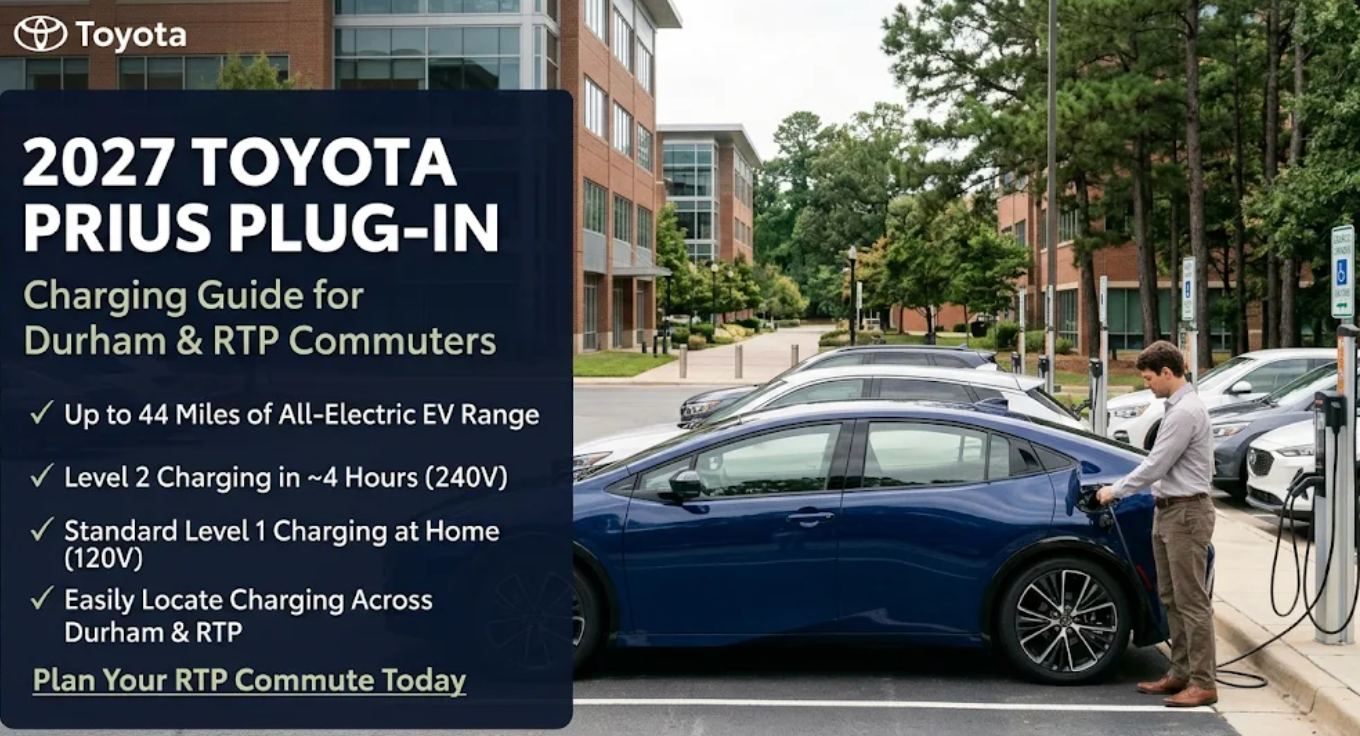
The 2027 Toyota Prius Plug-in Hybrid can cover many Durham-to-RTP round trips on electricity alone, because Toyota lists an EPA-estimated all-electric range of up to 44 miles on the SE grade and up to 39 miles on the XSE, Nightshade, and XSE Premium grades. Toyota estimates a full charge takes about 11 hours on a standard 120V household outlet and about 4 hours on a 240V Level 2 charger under ideal conditions. When the battery runs low, the hybrid system takes over automatically, so an empty battery does not leave you stranded the way it could in a battery-electric vehicle.
That combination is why the plug-in Prius keeps coming up for Triangle commuters who are curious about electric driving but not ready to depend on public chargers. Here at Mark Jacobson Toyota, we wrote this guide for drivers who want the practical side of ownership: how far the battery really goes on a weekday, what a home charging setup involves, where public charging fits around Durham and Research Triangle Park, and whether the plug actually saves money compared with the regular Prius hybrid. We use Toyota's published figures for the 2027 model year, current North Carolina energy prices, and clearly labeled assumptions so you can swap in your own commute.
Definition: A plug-in hybrid electric vehicle (PHEV) pairs a gasoline engine with a larger battery that can be recharged from an outlet, allowing a limited distance of all-electric driving before it operates as a conventional hybrid. The 2027 Toyota Prius Plug-in Hybrid uses a 13.6-kWh lithium-ion battery and a 2.0-liter engine. For commuters across Durham, Chapel Hill, Raleigh, and Research Triangle Park, it allows many daily trips on electricity without depending on public charging.
Plug-in Hybrid Powertrain and Electric-Only Range
The 2027 Prius Plug-in Hybrid uses Toyota's fifth-generation hybrid system with a 2.0-liter four-cylinder engine and two motor-generators. Toyota rates the combined system at 220 net horsepower, with an EPA-estimated 0-60 mph time of 6.6 seconds, and the car is front-wheel drive with an electronically controlled continuously variable transmission. The traction battery is a 13.6-kWh lithium-ion pack, and Toyota lists only 120V and 240V charging times for it, which tells you how this car is meant to be used: plug in at home or at work, and let the gas engine handle the long trips.
A standard hybrid recharges its small battery through braking and the engine, and you never plug it in. The plug-in version stores enough energy to drive dozens of miles with the engine off, then shifts into hybrid operation on its own once the usable charge is spent.
For 2027, Toyota added dual-zone automatic climate control so the driver and front passenger can set separate temperatures, plus a new Inked exterior color. The core hardware, including the battery capacity and system output, carries over. That matters if you are comparing a 2027 against a remaining 2026 unit, a point we come back to in the ToyotaCare section.
2027 Prius Plug-in Hybrid Grades: Price, Electric Range, and Efficiency
| Grade | Base MSRP* | EPA-Est. Electric Range | EPA-Est. MPGe | Hybrid Mode MPG (City/Hwy/Comb.) |
|---|---|---|---|---|
| SE | $33,980 | Up to 44 miles | 128 | 55/46/51 |
| XSE | $37,230 | Up to 39 miles | 114 | 50/43/47 |
| Nightshade | $38,000 | Up to 39 miles | 114 | 50/43/47 |
| XSE Premium | $40,675 | Up to 39 miles | Confirm with our team | Confirm with our team |
*Base MSRP excludes Toyota's $1,295 delivery, processing, and handling fee, taxes, title, registration, and dealer-installed options. Figures from Toyota.com
The SE's longer electric range comes mostly from its smaller wheels and lighter curb weight. Toyota lists the SE at 3,461 pounds and the XSE at 3,516 pounds, and the SE also carries a lower drag figure. If maximum electric miles are your main goal, the SE is the efficiency choice. If you want the larger feature set on the XSE grades, you give up roughly five miles of rated electric range.
Realistic All-Electric Range for RTP Commuting
There is no single "typical" RTP commute, so here is a worked example you can adjust. Assume a driver who lives near our dealership on Durham-Chapel Hill Boulevard and works in Research Triangle Park, about 12 miles each way, for a 24-mile round trip. Five commuting days a week for 48 weeks comes to about 5,760 commuting miles per year. With a full overnight charge, that daily round trip sits comfortably inside the SE's 44-mile EPA estimate and the XSE's 39-mile estimate, which leaves a cushion for a lunch errand or a stop on the way home.
Now stretch the example. A Chapel Hill driver heading to the far side of RTP, or a Durham driver commuting to downtown Raleigh, can easily exceed 40 miles round trip. In that case the car simply uses its electric range first and then finishes the drive as a hybrid. You still benefit from the electric miles; you just do not complete the whole day without gas.
A few conditions can shorten electric range in everyday use:
- Sustained highway speeds on I-40 or NC-147 use more energy per mile than stop-and-go surface streets.
- Heavy use of climate control during a humid Triangle summer or a cold January morning draws on the same battery.
- Cold temperatures generally reduce how much usable energy a lithium-ion battery delivers.
- Extra passengers and cargo add weight.
Treat the EPA number as a planning figure, not a promise. If your round trip is well under the rated range, most weekday driving can happen on electricity with regular overnight charging; if it is well above, the gap between the plug-in and a regular hybrid narrows.
Home Charging Setup and Charge Times
Regular access to an outlet is what makes this Prius different from a standard hybrid. Toyota confirms that a dual-voltage charging cable is supplied with the 2027 Prius Plug-in Hybrid. You can charge from a suitable 120-volt household outlet, or use compatible 240-volt Level 2 equipment for a faster refill. Have a licensed electrician evaluate an outlet or circuit if you are unsure about its condition or capacity; do not assume an extension cord or an aging garage outlet is safe for continuous charging.
Prius Plug-in Hybrid Charging Options at a Glance
| Charging Method | Typical Location | Toyota-Estimated Time to Full | Best Fit |
|---|---|---|---|
| Level 1 (120V) | Standard household outlet, ideally on a dedicated circuit | About 11 hours | Overnight charging when you park from early evening to morning |
| Level 2 (240V) | Home wall-mounted equipment, workplaces, public parking decks | About 4 hours | Shorter overnight windows, two daily trips, or topping up at work |
| DC fast charging | Highway fast-charging sites | Not listed by Toyota for this model | Plan on Level 1 or Level 2; use hybrid mode on road trips |
Charge times are Toyota estimates under ideal conditions and can vary with temperature, battery state, and the electrical supply. Confirm the charge port type and any adapter needs on a specific vehicle with our team before buying charging equipment.
In practice, Level 1 charging works well if you are home from about 7 p.m. to 6 a.m. That 11-hour window matches Toyota's estimate for a full charge from a depleted battery, and most nights you will start with some charge already in the pack. Level 2 makes more sense if your household parks late and leaves early, if two drivers share the car, or if you want to recharge between a morning commute and an evening trip.
A few planning steps before you install anything:
- Have a licensed electrician check whether your garage outlet is on a circuit shared with freezers, power tools, or other heavy loads.
- Ask about permits, since Durham, Wake, and Orange County jurisdictions may require one for new 240V circuits.
- Check with your electric utility, such as Duke Energy, about any current EV charging programs or time-of-use rates, because program terms change.
- Renters and condo owners should confirm parking-space access to an outlet before relying on home charging.
The cost side is simple to estimate. The U.S. Energy Information Administration reported an average North Carolina residential electricity price of 14.95 cents per kilowatt-hour for August 2026. Using the SE's EPA rating of 128 MPGe, which works out to roughly 26.3 kWh per 100 miles, electric driving costs about 3.9 cents per mile at that average rate. Your utility bill, rate plan, and charging losses will move that number up or down.
Public Charging Options Near Durham and RTP
Public charging is a convenience for a plug-in hybrid, not a requirement. If a public station is occupied or out of service, you simply drive on as a hybrid.
At a compatible Level 2 station, a multi-hour parking stop can restore a useful portion of the battery. But availability, parking rules, and fees vary by location. Check the station’s current connector, access requirements, and operating status before making charging part of your day. Unlike a battery-electric vehicle, this Prius can continue in hybrid mode if there is no available charger.
The most reliable way to find current stations is a live map rather than a printed list, since locations, pricing, and access rules change often. Good options include:
- The U.S. Department of Energy's Alternative Fuels Data Center station locator, which lets you filter by Level 2 and connector type.
- Charging network apps and community maps that show real-time availability and user check-ins.
- The Toyota app, which can help locate charging and, with the right Connected Services trial or subscription, show charge status.
Check whether a station bills by the hour, the kilowatt-hour, or the session. An hourly rate can make a slow public session cost more per mile than charging at home.
Fuel Savings and Ownership Cost vs the Standard Prius Hybrid
This is where we want to be careful, because the plug-in does not automatically save money over the regular Prius. The standard 2027 Prius LE is rated at an EPA-estimated 59/50/55 MPG with a base MSRP of $28,755, while the Prius Plug-in Hybrid SE starts at $33,980. North Carolina gasoline was also relatively inexpensive at the end of October 2026, with AAA reporting a statewide average of about $3.43 per gallon for regular on October 29.
Estimated Annual Energy Cost: 12,000 Miles in North Carolina
| Scenario (12,000 miles per year) | Cost per Mile | Estimated Annual Energy Cost |
|---|---|---|
| Prius Plug-in Hybrid SE, 100% electric miles | About 3.9 cents | About $472 |
| Prius Plug-in Hybrid SE, 60% electric and 40% hybrid miles | About 5.0 cents (blended) | About $606 |
| 2027 Prius LE hybrid (55 MPG combined) | About 6.2 cents | About $748 |
| Older vehicle averaging 30 MPG | About 11.4 cents | About $1,371 |
Assumptions: 14.95 cents per kWh (EIA North Carolina residential average, August 2026), $3.43 per gallon (AAA North Carolina average, October 2026), EPA ratings of 128 MPGe and 51 MPG for the SE, and 55 MPG for the Prius LE. Estimates exclude maintenance, insurance, taxes, and fees and are for comparison only.
The table shows a pattern that surprises some shoppers. For a driver replacing an older 30 MPG car, either Prius cuts energy spending sharply. Between the two Priuses, the gap is much smaller, roughly $140 to $280 per year in these scenarios. North Carolina also charges an additional annual registration fee for plug-in hybrids, listed by the U.S. Department of Energy's Alternative Fuels Data Center at $107.25, which offsets part of that difference. The federal new clean vehicle tax credit is also not available for vehicles acquired after September 30, 2025, according to the IRS, so it should not be part of a 2027 purchase calculation.
For RTP commuters with home charging, the 2027 Prius Plug-in Hybrid makes the most sense when the value of driving most weekday miles on electricity, plus its 220 horsepower and quieter electric operation, matters more to you than the lowest purchase price. If your priority is the lowest total cost and you cannot charge reliably at home, the standard Prius hybrid is likely the better financial fit because it delivers similar efficiency without the higher MSRP or the plug-in registration fee. Either way, comparing current pricing, incentives, and financing on both models side by side gives you a clearer answer than fuel math alone.
A short way to decide:
- Lean toward the Plug-in Hybrid if you can charge at home or work, your round trip is under about 35 to 40 miles, and you value electric driving and stronger acceleration.
- Lean toward the standard Prius if you park on the street without an outlet, drive long highway distances daily, or want the lowest upfront price.
- Consider AWD needs too. Toyota offers the standard Prius with available all-wheel drive on several grades, while the Plug-in Hybrid is front-wheel drive.
ToyotaCare and Plug-in Hybrid Battery Coverage
The 2027 Prius Plug-in Hybrid comes with ToyotaCare normal factory-scheduled maintenance for one year or 10,000 miles, whichever comes first. Toyota’s model-year-specific program literature states that 2026 and earlier Toyota vehicles generally received two years or 25,000 miles under the previous terms. If you compare a 2027 car against a remaining 2026, check both model years’ actual coverage; the difference may affect your first two years of routine service planning.
Toyota’s model-year-2027 ToyotaCare brochure describes three years of roadside assistance with unlimited mileage for Prius and PHEV models, while Toyota’s July 2026 Prius Plug-in Hybrid announcement describes two years. That mismatch should not be presented as settled coverage. Before buying, request the current VIN-specific ToyotaCare and roadside-assistance terms from Mark Jacobson Toyota and keep a copy with the purchase documents.
The battery coverage is strong. Toyota.com lists these 2027 warranty terms for the Prius Plug-in Hybrid:
- Hybrid battery warranty: 10 years or 150,000 miles
- Hybrid system warranty: 8 years or 100,000 miles
- Basic warranty: 3 years or 36,000 miles
- Powertrain warranty: 5 years or 60,000 miles
Connected Services matter for a plug-in too. Toyota lists a 5-year trial for Remote Connect, Safety Connect, and Service Connect on the 2027 model, which supports features such as remote climate control and vehicle status in the Toyota app. Trials end, and continued use requires a subscription after the trial period. After ToyotaCare ends, our Toyota service team in Durham can follow the same factory maintenance schedule with Genuine Toyota parts.
Key Takeaways
- The 2027 Prius Plug-in Hybrid offers EPA-estimated electric range of up to 44 miles on the SE and up to 39 miles on the XSE, Nightshade, and XSE Premium.
- Toyota estimates about 11 hours to charge on a 120V outlet and about 4 hours on 240V Level 2, so many owners only need overnight home charging.
- At August 2026 North Carolina electricity prices, electric driving in the SE costs roughly 3.9 cents per mile before charging losses and rate differences.
- Savings over the standard Prius hybrid are modest in North Carolina, so the plug-in makes the most sense for drivers who can charge at home and value electric driving.
- MY2027 ToyotaCare covers scheduled maintenance for 1 year or 10,000 miles, compared with 2 years or 25,000 miles on 2026 and earlier models.
- The hybrid battery is covered for 10 years or 150,000 miles under Toyota's 2027 warranty terms.
Frequently Asked Questions
How long does it take to charge a 2027 Toyota Prius Plug-in Hybrid?
Toyota estimates about 11 hours for a full charge on a standard 120V household outlet and about 4 hours on a 240V Level 2 charger under ideal conditions. Toyota does not list DC fast charging for this model. Most owners plug in overnight at home, and if the battery runs out during the day, the car continues as a hybrid using gasoline. Starting with a partial charge shortens the time.
Can I use the Prius Plug-in Hybrid without ever charging it?
Yes, the car operates as a regular hybrid when the battery is depleted, and Toyota rates the SE at 51 MPG combined in hybrid mode. However, you would be paying for a larger battery you are not using. If you cannot charge at home or work, we suggest comparing the standard Prius, which has a lower MSRP and similar hybrid efficiency, before deciding.
Is 44 miles of electric range enough for an RTP commute?
For many drivers it is. A 24-mile round trip between central Durham and RTP fits within the SE's EPA-estimated 44 miles with room to spare, assuming a full overnight charge. Longer commutes, highway speeds, extreme heat or cold, and heavy climate control use reduce real-world range. Beyond that point the car switches to hybrid operation automatically, so you never have to stop to charge.
Does the 2027 Prius Plug-in Hybrid qualify for a federal tax credit?
According to the IRS, the new clean vehicle credit is not available for vehicles acquired after September 30, 2025, so a 2027 Prius Plug-in Hybrid purchased today does not qualify for it. Utility programs and manufacturer offers can change, so ask our team about current Toyota offers and any local programs. This is general information, not tax advice; please consult a tax professional for your situation.
The best next step is to compare your actual round-trip distance and charging access with a standard Prius. Mark Jacobson Toyota is at 4516 Durham-Chapel Hill Blvd, Durham, NC 27707. Call 919-493-5599 or explore available vehicles before you visit.
Schedule a Test Drive Call Our Durham Team