


Toyota Ownership & Buying Guide • Durham, NC
2027 Toyota C-HR Electric SUV: A Practical Guide for Durham Drivers
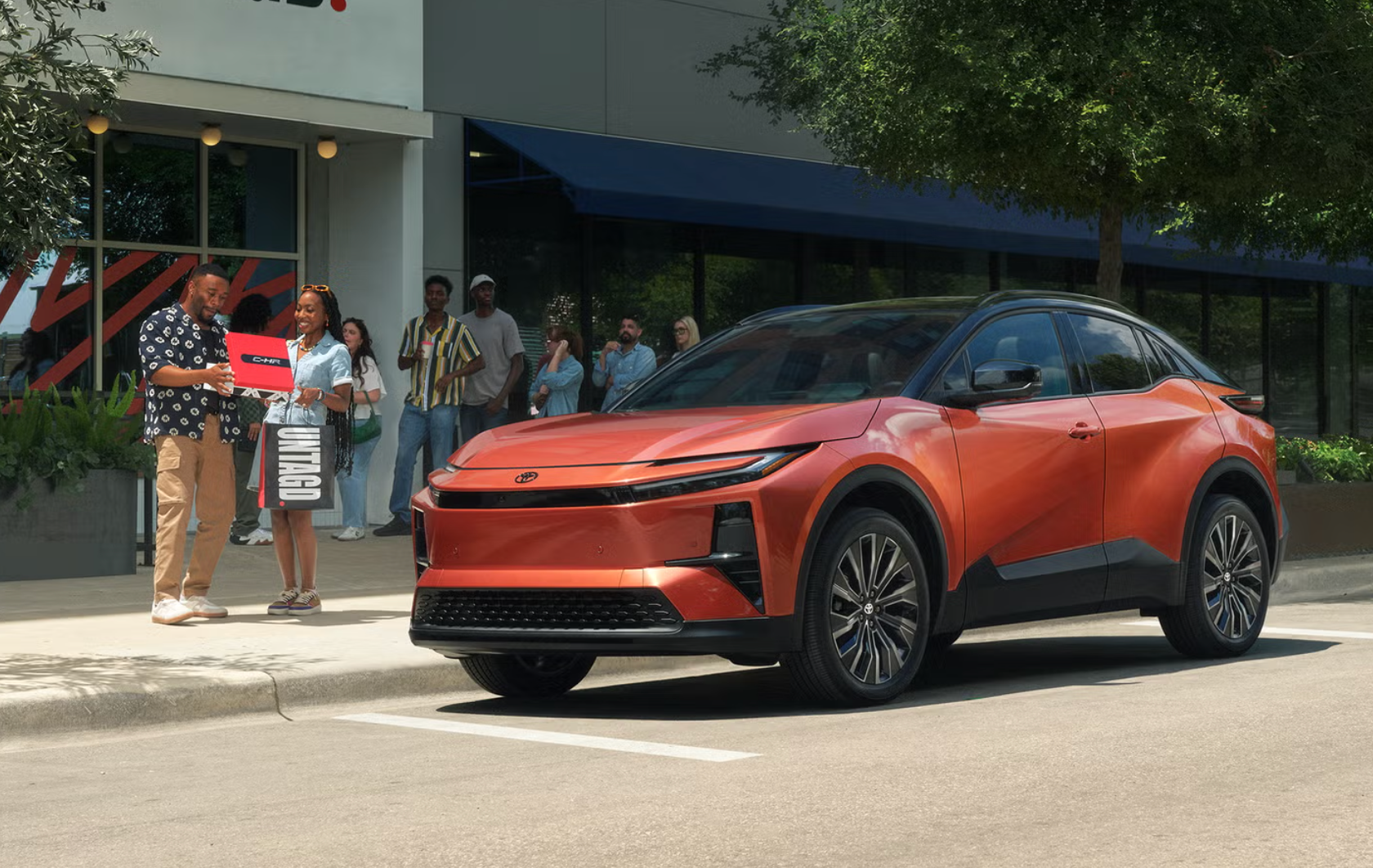
The 2027 Toyota C-HR is a compact electric SUV with standard all-wheel drive, 338 horsepower, and a Toyota-estimated driving range of up to 287 miles in SE form or 273 miles in XSE form. The numbers are useful, but they don't answer the question most Durham drivers really have: will an EV fit my home, commute, and weekend plans? This guide translates Toyota's official specifications into practical decisions about charging, daily range, rear-seat space, and what changes when you compare a 2026 C-HR with a 2027 model.
Definition: A battery-electric vehicle (BEV) runs entirely on electricity stored in a rechargeable battery and has no gasoline engine, so it must be charged from an outlet, a Level 2 charger, or a DC fast charger. The 2027 Toyota C-HR is a five-passenger compact BEV with standard electric all-wheel drive. For drivers in Durham, Chapel Hill, Raleigh, and Research Triangle Park, it suits households that can charge at home or work.
Battery, Range, and Charging Speed
Every 2027 C-HR uses the same 74.7-kWh lithium-ion battery and a dual-motor setup, with electric motors on front and rear eAxles. Toyota rates total system output at 338 horsepower and estimates 0-60 mph in 4.9 seconds. The wheel size is the main reason the two grades differ on range: the SE's 18-inch wheels help it reach Toyota's 287-mile estimate, while the XSE's 20-inch wheels bring it to 273 miles. Toyota.com also lists estimated efficiency of 117 MPGe for the SE and 112 MPGe for the XSE.
The 2027 C-HR has a North American Charging Standard (NACS) port built in, along with an 11-kW onboard AC charger. Toyota estimates a Level 2 charge from 10% to 100% takes about 7 hours on a 240V, 48-amp circuit, and a DC fast charge from 10% to 80% takes around 30 minutes on a station delivering 150 kW or more, under ideal conditions. The C-HR also includes battery preconditioning, which warms or cools the pack before fast charging and can activate automatically when a fast charger is set as the navigation destination with an active Drive Connect trial or subscription.
2027 Toyota C-HR SE vs XSE: Key Specifications
| Specification | C-HR SE | C-HR XSE |
|---|---|---|
| Base MSRP* | $37,080 | $39,080 |
| Estimated range | Up to 287 miles | Up to 273 miles |
| Estimated MPGe (combined) | 117 | 112 |
| Battery / drivetrain | 74.7 kWh, standard AWD | 74.7 kWh, standard AWD |
| Horsepower / 0-60 mph (est.) | 338 hp / 4.9 sec. | 338 hp / 4.9 sec. |
| Wheels | 18-in. black alloy with covers | 20-in. gunmetal-finished multi-spoke |
| Curb weight | 4,322 lb | 4,366 lb |
| Cargo behind rear seat / behind front seats | 25.3 / 59.5 cu. ft. | 25.3 / 59.5 cu. ft. |
*Base MSRP excludes delivery, processing, and handling fee, taxes, title, registration, and options. Range and efficiency are Toyota estimates; actual results vary with temperature, speed, terrain, climate control use, and battery age.
Realistic Range for Durham and RTP Commuting
The easiest way to evaluate an EV is to calculate your real weekly mileage. For example, a hypothetical 24-mile round-trip commute between Durham and Research Triangle Park, five days a week, adds up to 120 miles before errands or weekend outings. That's well within either C-HR grade's published full-charge range in favorable conditions. But don't build your plan around using every last mile: leave a buffer for unexpected trips, adverse weather, detours and battery conditioning.
Real-world range will run below the estimate at times. Sustained highway speeds on I-40 or I-85 use more energy than city driving, and cold weather reduces how much usable energy the battery delivers while also adding cabin heating load. Hot, humid summer days add air conditioning demand. Toyota gives the C-HR Eco, Normal, and Snow drive modes and four selectable regenerative braking levels, adjustable with paddle switches on the steering wheel, which can help recover energy in stop-and-go traffic on NC-147 or US-15-501.
Longer trips call for a little planning. A drive to the North Carolina coast or the mountains will likely include a fast-charging stop, and that is where preconditioning and a 30-minute 10-to-80% session estimate make a practical difference. Plan stops with a live charging map, since station availability and pricing change often.
Home Charging and Public Fast Charging
Before picking an EV, figure out where you will charge it most weeks. Toyota includes a dual-voltage charging cable with the C-HR, and a regular 120-volt outlet is an option for limited daily driving. A compatible 240-volt Level 2 setup is much more practical for routine replenishment of a 74.7-kWh battery. If you rent, live in a condo, or park on the street, investigate access and pricing before ordering the vehicle rather than assuming you'll find a public plug every night.
2027 C-HR Charging Options
| Charging Method | Toyota Estimate | Where It Fits |
|---|---|---|
| Level 1 (120V) | Toyota does not publish a full-charge time; adds limited miles overnight | Backup charging or very short daily driving |
| Level 2 (240V, 48A) | About 7 hours from 10% to 100% | Home garage, workplace, and destination charging |
| DC fast charging (150 kW or above) | About 30 minutes from 10% to 80% | Road trips and occasional quick top-ups |
Estimates under ideal conditions. Charging speed varies with battery temperature, state of charge, station output, and other factors. A 48-amp charger requires an appropriately rated circuit installed by a licensed electrician.
Running a 48-amp charger requires a properly rated 240V circuit, so have a licensed electrician assess your panel before you buy equipment. Durham, Wake, and Orange County jurisdictions may require permits. It is also worth asking your utility, such as Duke Energy, about any current EV programs or time-of-use rates, because program terms change.
The C-HR has a native NACS charge port. To use a particular public DC fast charger, confirm connector compatibility, billing requirements and current operating status in the charging network or Toyota app. Plug & Charge enrollment and connected-service availability can vary, so ask for a live setup demonstration before relying on automatic billing.
Energy costs are easy to estimate. The U.S. Energy Information Administration reported an average North Carolina residential electricity price of 14.95 cents per kWh for August 2026. At Toyota's estimated 117 MPGe, the SE uses roughly 28.8 kWh per 100 miles, or about 4.3 cents per mile at that average rate; the XSE comes in around 4.5 cents. Over 12,000 miles of home charging, that works out to roughly $520 to $540 a year before charging losses. Public fast charging usually costs more per kilowatt-hour than home electricity. North Carolina also charges an additional annual registration fee for battery-electric vehicles, listed by the U.S. Department of Energy at $214.50, and the IRS states that the federal new clean vehicle credit is not available for vehicles acquired after September 30, 2025.
Trim Differences and Standard Technology
The SE and XSE share the same battery, motors, all-wheel drive system, and safety suite. The XSE adds equipment and styling, while the SE gives you a little more estimated range for $2,000 less in base MSRP.
Toyota lists this technology for the 2027 C-HR:
- A 14-inch Toyota Audio Multimedia touchscreen with wireless Apple CarPlay and Android Auto compatibility
- An available 9-speaker JBL Premium Audio system with subwoofer
- Heated front seats and available heated rear seats
- Dual front Qi wireless chargers and USB-C ports front and rear
- Available panoramic fixed glass roof with a power sunshade
- Digital Key capability, which requires a Remote Connect trial or subscription
- Front and rear ambient lighting with 64 available colors
Both 2027 C-HR trims offer Toyota Safety Sense 3.0, with systems designed to support attentive driving. They do not replace a driver, and individual driver-assistance features have operating limits. If a specific feature matters to you such as a surround-view camera, lane-change support or parking assistance check its availability on the exact grade and package rather than assuming every item in the broader equipment list is standard on every C-HR.
Cargo Space and Everyday Practicality for a Compact EV
The C-HR's compact footprint is part of its appeal in the Triangle. At 177.9 inches long and 73.6 inches wide, it fits easily into downtown Durham parking decks and tight spaces near Duke or UNC. Toyota lists 25.3 cubic feet of cargo space behind the rear seat and 59.5 cubic feet with the 60/40 split rear seats folded, plus a height-adjustable power liftgate.
The tradeoff is rear-seat room. Toyota lists 42.1 inches of front legroom and 32.2 inches of rear legroom, so tall adults may find the back seat snug on a long trip. For a single commuter, a couple, or a small family with young children, that is often a fair trade for the easy-parking size. Families who regularly carry adults in back may want to compare it with the larger Toyota bZ.
Toyota also lists 8 inches of ground clearance and a Snow drive mode, which can help on the occasional icy Triangle morning, though tires and careful driving matter more than drivetrain alone in winter conditions.
2026 vs 2027 C-HR: Which Should You Buy?
Toyota describes the 2027 C-HR as unchanged from the previous model year. So, when comparing a remaining 2026 vehicle with a 2027, check the same trim and equipment first. Next, look at the actual selling price, incentives, build date, warranty start date and ToyotaCare coverage not simply which model year is printed on the window sticker. Toyota lists a shorter complimentary maintenance term for 2027, while the roadside assistance term remains three years for both years.
2026 vs 2027 Toyota C-HR at a Glance
| Factor | 2026 C-HR | 2027 C-HR |
|---|---|---|
| Hardware and range | Same battery, motors, AWD, and estimated range | Toyota states unchanged from previous model year |
| ToyotaCare scheduled maintenance | 2 years or 25,000 miles | 1 year or 10,000 miles |
| Roadside Assistance | 3 years, unlimited mileage per Toyota's BEV program document | 3 years, unlimited mileage per Toyota USA |
| EV component warranty | 8 years or 100,000 miles | 8 years or 100,000 miles |
| Pricing | Varies by remaining unit; contact us | SE $37,080; XSE $39,080 base MSRP |
| Model year for resale | Older model year | Newer model year |
Sources: Toyota ToyotaCare BEV program document and Toyota USA Newsroom. Program terms can change and may have exclusions. Verify coverage for a specific vehicle before purchase.
ToyotaCare and EV-Specific Ownership Support
Electric vehicles skip oil changes, but they still need scheduled care such as tire rotations and inspections. Your Toyota Warranty & Maintenance Guide lists the exact items and intervals for the C-HR. Regenerative braking handles much of the everyday slowing, but the friction brakes still need regular inspection.
Toyota's 2027 C-HR materials specify ToyotaCare normal factory-scheduled maintenance for one year or 10,000 miles, whichever comes first, and three years of roadside assistance with unlimited mileage. Toyota lists two years or 25,000 miles of scheduled maintenance for the 2026 C-HR, while both model years have three years of roadside assistance. Always review the applicable Warranty & Maintenance Guide for eligibility and exclusions, but there is no reason to frame the 2027 roadside term as unresolved: Toyota's C-HR press release and model FAQ agree on three years.
Toyota covers EV drive components, including the traction battery, transaxle, and inverter with converter, for 8 years or 100,000 miles, alongside a 3-year or 36,000-mile basic warranty and 5-year or 60,000-mile powertrain coverage. After ToyotaCare ends, our Toyota service center in Durham can continue the factory maintenance schedule with Genuine Toyota parts.
How much charging infrastructure do you actually need?
Someone driving 15 to 25 miles most days may find occasional top-ups manageable. Someone commuting 70 or 80 miles daily, driving for work, or frequently taking unplanned interstate trips needs a much more reliable charging routine. Ask an electrician about your electrical panel, parking location and charging circuit before buying hardware. The highest-power charging station isn't necessarily the most useful one; dependable overnight access often matters more than peak speed.
What to check before your first DC fast-charge stop
Find a station that supports the C-HR's NACS connector, confirm access and payment methods in the charging provider's live app, and build in a second option in case equipment is occupied or offline. Toyota's roughly 30-minute 10%-to-80% charging estimate assumes favorable conditions and sufficient station output. Charging may taper at high battery states of charge, so a stop designed around 80% is often more efficient than waiting for 100%.
The SE-versus-XSE choice for real households
The $2,000 base-MSRP gap isn't just a styling question. The SE has the longer published range rating and smaller wheels, while the XSE adds appearance and comfort features. Sit in both, check rear visibility, bring the car seat or stroller you'll actually use, and consider replacement tire costs. If you value extra range and a lower starting price, the SE has a straightforward case. If you value the XSE's equipment more, the range difference may be an acceptable tradeoff.
Renting, apartments and workplace charging
Not every buyer has a dedicated garage. If you depend on a shared apartment charger or workplace equipment, ask who controls access, what fees apply, whether the unit works after hours and what happens when all spaces are occupied. A battery-electric SUV can still suit apartment living, but the inconvenience and cost of public charging should be part of the ownership comparison not an afterthought after delivery.
Is the 2027 Toyota C-HR Right for Your Routine?
- The 2027 Toyota C-HR is a compact BEV with standard AWD, 338 horsepower, and a 74.7-kWh battery, starting at $37,080 (SE) and $39,080 (XSE) before fees.
- Toyota estimates up to 287 miles of range for the SE and 273 miles for the XSE.
- The built-in NACS port, 11-kW onboard charger, and roughly 30-minute 10-to-80% DC fast charge estimate support both home and road-trip charging.
- Toyota says the 2027 is unchanged from the 2026 model, but 2026 models carry 2 years or 25,000 miles of ToyotaCare maintenance versus 1 year or 10,000 miles for 2027.
- At August 2026 North Carolina electricity prices, home charging costs about 4.3 to 4.5 cents per mile.
- Cargo space is 25.3 cubic feet behind the rear seat and 59.5 cubic feet with the seats folded.
2027 Toyota C-HR Questions, Answered
What is the range of the 2027 Toyota C-HR?
Toyota estimates up to 287 miles for the C-HR SE with 18-inch wheels and up to 273 miles for the XSE with 20-inch wheels. Real-world range varies with temperature, highway speed, terrain, climate control use, and battery age. For a typical Durham-to-RTP commute of around 24 miles round trip, either grade leaves a large buffer between charges.
Can the 2027 C-HR use Tesla Superchargers?
The C-HR has a native NACS charge port. To use a particular public DC fast charger, confirm connector compatibility, billing requirements and current operating status in the charging network or Toyota app. Plug & Charge enrollment and connected-service availability can vary, so ask for a live setup demonstration before relying on automatic billing.
What is the difference between the 2026 and 2027 Toyota C-HR?
Toyota says the 2027 C-HR is unchanged from the previous model year in hardware and range. The main documented difference is ToyotaCare: 2026 models include scheduled maintenance for 2 years or 25,000 miles, while 2027 models include 1 year or 10,000 miles. Pricing on remaining 2026 units varies, so compare both with our team.
How long does it take to charge a Toyota C-HR at home?
Toyota estimates about 7 hours to charge from 10% to 100% on a 240V Level 2 charger at 48 amps, using the C-HR's 11-kW onboard charger. A standard 120V outlet works for backup charging but adds limited range overnight. A licensed electrician can tell you whether your home panel supports a 48-amp circuit and whether a permit is required.
Specifications and program details are supported by Toyota USA’s 2027 C-HR announcement and Toyota’s official C-HR FAQ.
If the C-HR fits your commute, the best next step is to drive one and talk through charging at your home. Visit us at 4516 Durham-Chapel Hill Blvd, Durham, NC 27707, or call our sales team at 919-493-5599. Our sales hours are Monday through Friday from 9:00 AM to 8:00 PM and Saturday from 9:00 AM to 7:00 PM. You can compare our current C-HR inventory, see our Toyota EV SUV overview, and ask our finance team about current Toyota Financial Services offers, subject to credit approval.
Schedule a Test Drive Call Our Durham Team