


Blog / Durham New Toyota Cars

2026 Toyota Highlander vs Grand Highlander: Which Toyota SUV Fits Your Family?

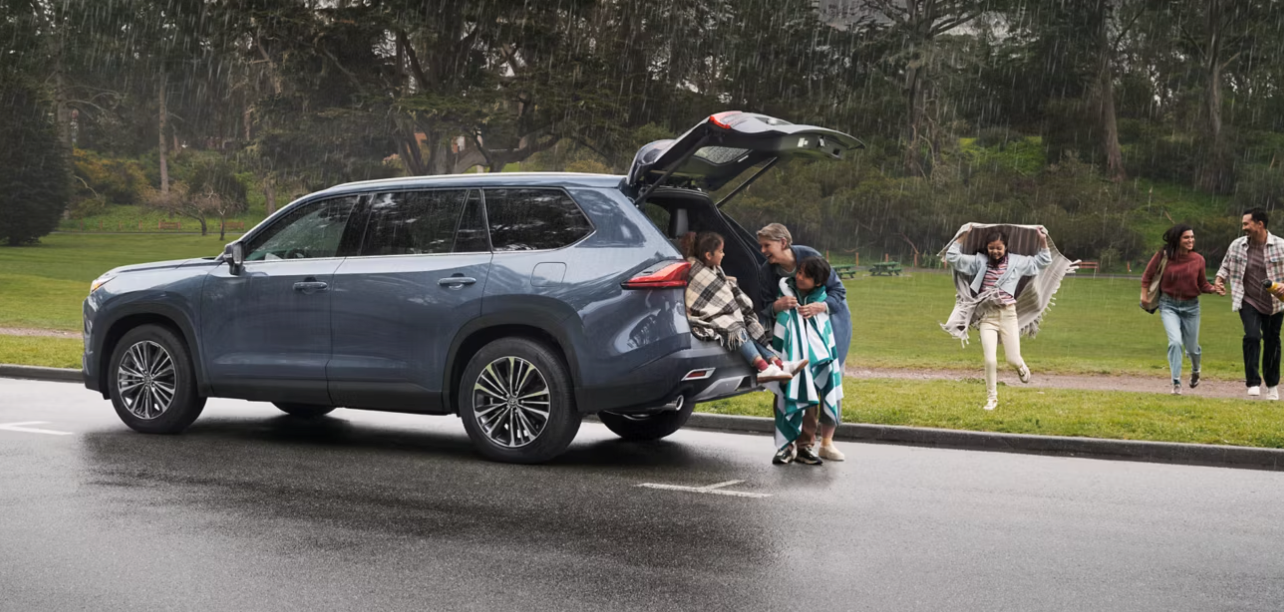
2026 toyota grand highlander exterior
2026 Highlander vs Grand Highlander | Mark Jacobson Toyota

2026 Highlander vs Grand Highlander Overview

If your family is comparing the 2026 Toyota Highlander vs Grand Highlander, the short answer is clear. At Mark Jacobson Toyota, we recommend the Highlander for families that want three-row flexibility in a more manageable SUV, and we recommend the Grand Highlander for households that regularly use the third row, carry more cargo, or take longer family trips. For a Durham family of five that only needs the third row occasionally, Highlander usually makes daily life easier. For a Cary family with car seats, strollers, older kids, and luggage, Grand Highlander is usually the better fit.

The two SUVs overlap in Toyota’s three-row family lineup, but they solve different problems. Highlander offers seating for up to eight, available hybrid efficiency, standard all-wheel drive on gas models for 2026, and a more city-friendly footprint. Grand Highlander adds a larger cabin, a more adult-friendly third row, more cargo room behind all seats, and available Hybrid MAX power for families that want stronger performance and towing capability.

In this guide, we compare size, passenger space, cargo room, gas and hybrid powertrains, MPG, towing, trims, local driving fit, and long-term ownership logic. We also give direct recommendations for Durham, Raleigh, Chapel Hill, Cary, and Apex shoppers who are trying to decide whether the smaller Highlander is enough or the larger Grand Highlander is worth stepping up to.

The 2026 Toyota Highlander and 2026 Toyota Grand Highlander are three-row SUVs designed for different family-space needs. Highlander prioritizes easier daily use and efficient family flexibility. Grand Highlander prioritizes expanded passenger and cargo room for larger households, frequent carpools, and longer family trips.
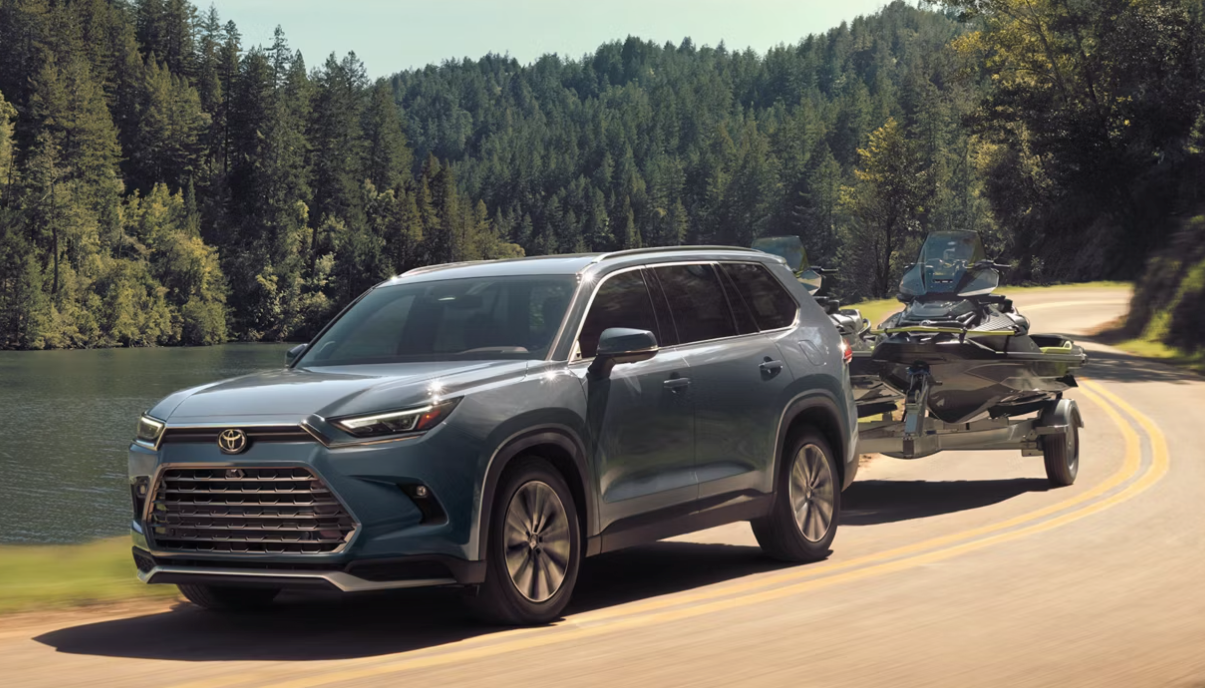
2026 Toyota Highlander vs Grand Highlander

Seating Capacity, Cargo Room, and Overall Size

The real difference between Highlander and Grand Highlander is not whether both have three rows. It is how comfortable and useful those three rows feel when your family uses them every week.

Third-row comfort and passenger space for real family use

Highlander works well for families that want a third row available without moving into the largest possible Toyota SUV. Toyota positions the 2026 Highlander as a versatile three-row SUV, and it remains a strong fit for households that usually carry four or five people but want the option to bring extra passengers when needed. For a Durham family that rotates between school drop-off, grocery runs, youth sports, and weekend plans, that flexibility can be enough.

Grand Highlander is different because its third row is built for more regular use. Toyota lists 33.5 inches of third-row legroom, and that extra room changes the way the SUV feels when older kids, grandparents, or adult passengers ride in back. For a Triangle household with frequent carpools, Grand Highlander gives passengers more breathing room and gives parents fewer compromises when every seat is filled.

The Grand Highlander is the better Toyota SUV if your family uses the third row more than occasionally because its larger cabin and 33.5 inches of third-row legroom make the back row more realistic for growing kids and additional passengers. We recommend Highlander when the third row is backup space. We recommend Grand Highlander when the third row is part of the weekly routine.

Family Space Factor2026 Toyota Highlander2026 Toyota Grand HighlanderBest For
Passenger CapacityUp to 8 passengersUp to 8 passengersBoth support family seating flexibility
Third-Row ComfortBetter for occasional use33.5 inches of third-row legroomGrand Highlander for regular third-row use
Cabin FeelMore compact three-row layoutLarger, more open family cabinGrand Highlander for larger households
Daily FootprintEasier to place and parkLarger body with more roomHighlander for tighter daily routes
Family FlexibilityStrong for smaller families needing backup seatingStronger for families that fill seats oftenDepends on third-row frequency
Ideal Use CaseFamily of four or five with occasional guestsFamily of five or more with regular full-cabin useMatch the SUV to weekly passenger load

Based on current Toyota published specifications.

  • Choose Highlander if your third row is mostly for occasional friends, cousins, or short local trips.
  • Choose Grand Highlander if older kids, grandparents, or carpool passengers use the third row often.
  • Choose Highlander if daily parking and tighter city driving matter more than maximum cabin space.
  • Choose Grand Highlander if passenger comfort matters more than a smaller exterior footprint.
View Highlander Research

Cargo room behind the third row and max cargo flexibility

Cargo space is where many families understand the Grand Highlander immediately. Highlander gives families useful cargo flexibility, especially when the third row is folded, but Grand Highlander provides more room when all seats are in use. Toyota lists Grand Highlander with 20.6 cubic feet of cargo space behind the third row and up to 97.5 cubic feet of maximum cargo volume. That matters because real families rarely travel with every seat folded down.

For Cary parents with two car seats, a stroller, backpacks, and grocery bags, Grand Highlander solves a more practical loading problem. It gives families more room behind passengers instead of asking them to choose between people and gear. Highlander can still be the right choice for families that do not pack heavily or rarely use the third row, but Grand Highlander becomes easier to justify when cargo space is needed even with the cabin full.

We recommend thinking about cargo in two ways. First, ask how much space you need with the third row folded. Second, ask how much room you need when every passenger seat is occupied. The second question is often the one that points families toward Grand Highlander.

Daily maneuverability, parking, and Durham-area usability

Highlander remains appealing because it feels easier to live with around Durham. A smaller footprint helps when parking near restaurants, school lots, grocery stores, downtown areas, and older parking decks. For a Durham family of five that wants extra seating but does not carry a full cabin every day, Highlander often gives the right mix of comfort, utility, and simplicity.

Grand Highlander is easier to justify when the larger size solves a problem every week. For Raleigh families that carpool across town or Chapel Hill households that take longer family trips, the extra space may matter more than tighter parking. What we see in family-SUV shopping is that buyers regret too little space more often than they regret having a slightly larger vehicle, but only when the space is truly being used.

View Grand Highlander Details
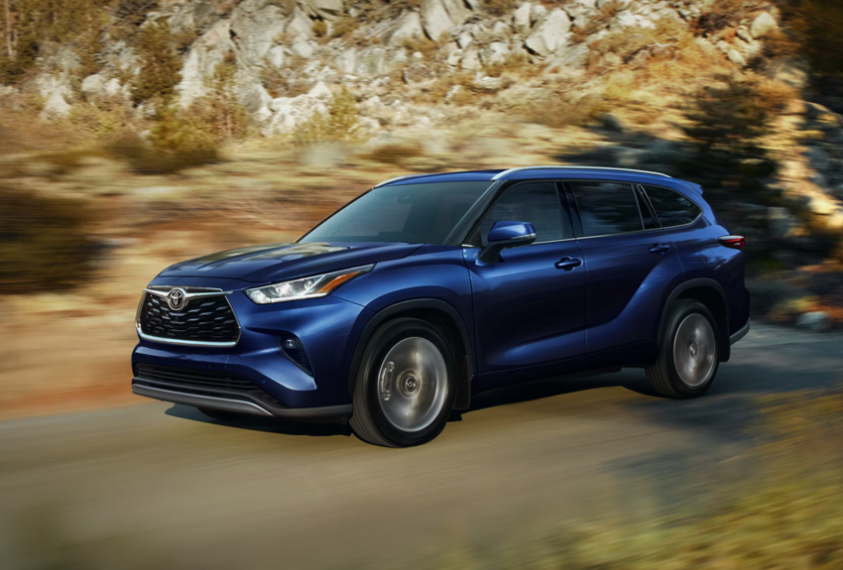
2026 Toyota Highlander vs Grand Highlander

Hybrid Powertrains, MPG, Towing, and Configuration Choices

Highlander is the cleaner choice for families that want simpler three-row capability, while Grand Highlander offers more powertrain range for shoppers comparing gas, hybrid, and Hybrid MAX needs.

Highlander vs Grand Highlander powertrain comparison

The 2026 Highlander lineup gives shoppers a practical choice between turbo gas power and hybrid efficiency. Toyota confirms the gas Highlander uses a 2.4-liter turbocharged four-cylinder engine with 265 horsepower and 310 lb.-ft. of torque, and gas models add standard all-wheel drive for 2026. The Highlander Hybrid is the efficiency play, with up to a 35 MPG combined rating and 243 net combined horsepower. That makes Highlander a strong fit for families that want a traditional three-row Toyota SUV with a straightforward gas or hybrid decision.

Grand Highlander adds more choice because it offers gas, Hybrid, and Hybrid MAX powertrains. The standard Grand Highlander Hybrid focuses on efficiency and family space, while Hybrid MAX is the performance-focused option with 362 net combined horsepower and up to 5,000 pounds of towing capacity. That makes Grand Highlander especially useful for shoppers who want more room and more powertrain flexibility in the same family SUV.

Powertrain Factor2026 Toyota Highlander2026 Toyota Grand HighlanderBest For
Gas Engine2.4L turbo with 265 hp and 310 lb.-ft.Gas option availableHighlander for simpler gas SUV shopping
Hybrid OptionHighlander Hybrid with up to 35 MPG combinedGrand Highlander Hybrid with up to 36 MPG combinedBoth for efficiency-focused families
Performance HybridNo Hybrid MAX versionHybrid MAX with 362 net combined hpGrand Highlander for stronger hybrid performance
All-Wheel DriveStandard AWD on gas models for 2026Available AWD depending on grade and powertrainHighlander gas for built-in AWD simplicity
TowingUp to 5,000 lbs on gas models, up to 3,500 lbs on hybrid modelsUp to 5,000 lbs with Hybrid MAXGrand Highlander Hybrid MAX for stronger hybrid towing
Ideal Use CaseFamilies wanting easier daily size and proven three-row utilityFamilies wanting more space and more configuration rangeMatch powertrain to passenger, cargo, and towing needs

Based on current Toyota published specifications.

The best Toyota three-row SUV powertrain depends on the family job. We recommend Highlander gas for shoppers who want turbo power, standard AWD, and a manageable footprint. We recommend Highlander Hybrid for families focused on MPG. We recommend Grand Highlander Hybrid when space and efficiency matter together, and Grand Highlander Hybrid MAX when a larger family SUV also needs stronger acceleration or higher towing capability.

Which configuration should Durham drivers choose?

For Durham drivers, the right configuration depends less on the badge and more on your actual routine. A daily commuter parent who wants strong MPG and a size that feels easier in parking lots should start with Highlander Hybrid. A family that regularly fills every row should start with Grand Highlander Hybrid. A household that tows, travels with more people, or wants stronger hybrid performance should look closely at Grand Highlander Hybrid MAX.

  • If you commute around Durham and rarely fill all three rows, we recommend Highlander Hybrid because it keeps the family-SUV experience efficient and easier to manage.
  • If you live in Cary and carry car seats, strollers, and sports gear, we recommend Grand Highlander because the larger cargo area will be used often.
  • If you travel from Chapel Hill with older kids and grandparents, we recommend Grand Highlander Hybrid because the third row and cargo space matter more.
  • If you tow a small trailer or want stronger passing power, we recommend Grand Highlander Hybrid MAX because it adds the performance side of the lineup.

For a Raleigh commuter parent, the Highlander Hybrid is usually the cleaner daily choice because it pairs family seating with strong efficiency and a more manageable size. For a Chapel Hill road-trip family, Grand Highlander Hybrid is usually the smarter choice because the larger cabin and cargo space reduce packing stress. The right answer is the SUV that solves your weekly routine, not the one that only looks better on paper.

If you are choosing between Highlander and Grand Highlander, we recommend visiting our Durham showroom and testing the space instead of deciding from specs alone. Sit in the third row, open the liftgate, check cargo room with the seats up, and compare how each SUV feels from the driver’s seat. Our team can walk you through gas, hybrid, and Hybrid MAX choices, explain current vehicle availability, and help you request numbers for the configuration that fits your family. Drivers from Durham, Raleigh, Chapel Hill, Cary, and Apex can call us at 919-493-5599 or start with our Toyota SUV research tools online before visiting. We want the comparison to feel practical, because the right three-row SUV should fit your family without creating a harder daily routine.

Check Toyota SUV AvailabilityGet Pre-Approved for a Toyota SUV

Pricing, Trims, and Family Value for Triangle Shoppers

The smarter value is not always the cheaper SUV. It is the Toyota three-row SUV that your family will not outgrow too quickly or overbuy unnecessarily.

Trim differences, budget fit, and local use-case recommendations

Highlander keeps the family decision cleaner for many buyers because its trims focus on mainstream comfort, hybrid efficiency, and premium family features without forcing shoppers into the largest SUV in the lineup. Families moving up from RAV4 often find Highlander easier to accept because it adds three-row flexibility while still feeling approachable. Grand Highlander, on the other hand, is better for families that already know they need more space and want to choose from a broader mix of gas, hybrid, and Hybrid MAX grades.

For Triangle shoppers, we recommend using real local routines to decide. Durham commuting, Raleigh to RTP traffic, Chapel Hill road trips, Cary school and sports schedules, and Apex weekend travel all reveal different needs. A family that usually carries five people can often choose Highlander confidently. A family that carries passengers and luggage together should move Grand Highlander higher on the list.

Driver ProfileLocal ScenarioRecommended Toyota SUVWhy It Fits
Durham family of fiveNeeds three rows occasionally but wants easier daily parkingHighlanderGood balance of flexibility and manageable size
Cary parents with car seatsNeed stroller and grocery space with passengers aboardGrand HighlanderMore cargo room behind occupied seats
Raleigh commuter parentWants MPG, comfort, and simpler weekday drivingHighlander HybridStrong efficiency with easier daily usability
Chapel Hill road-trip householdTravels with older kids, luggage, and grandparentsGrand Highlander HybridBetter cabin and cargo flexibility for longer trips
Apex family upgrading from RAV4Needs more room but not maximum sizeHighlander XLE or LimitedNatural step up without overbuying space
Triangle household with towing needsWants larger cabin and stronger hybrid performanceGrand Highlander Hybrid MAXBest fit for power, space, and towing logic

Based on current Toyota published specifications.

For families in Durham and nearby communities, Highlander is often the better value when the third row is backup space and daily maneuverability matters. Grand Highlander is often the better value when the third row, cargo area, and road-trip comfort are weekly needs. We recommend deciding by frequency, not by the rare biggest trip of the year.

Value Your Trade for a Toyota SUV

If payment, trade value, or long-term family fit is the biggest question, we can help you compare Highlander and Grand Highlander with real numbers. Our team can review your current vehicle, discuss finance options, and help you decide whether the step up in size is worth it for your household. We work with families from Durham, Raleigh, Chapel Hill, Cary, and Apex every day, and our Mark Says Yes! approach is built around practical guidance instead of pressure. If you are moving from a RAV4, Camry, Sienna, or an older three-row SUV, we can help you compare space, payment, and ownership needs in one visit. Call us at 919-493-5599 or visit us at 4516 Durham-Chapel Hill Blvd so we can help you choose the Toyota SUV that fits your real routine.
2026 Toyota Highlander vs Grand Highlander

Family and Lifestyle Fit: When Highlander Is Enough and When Grand Highlander Is Worth It

Highlander is enough when your family needs flexible seating, while Grand Highlander is worth it when extra room solves a weekly passenger or cargo problem.

We recommend Highlander when your family wants a three-row SUV but does not constantly use all three rows. It is the better fit for households that need a flexible third row for friends, visiting relatives, or occasional carpool duty. For an Apex family upgrading from RAV4, Highlander often feels like the right step because it adds seating without making daily driving feel oversized.

We recommend Grand Highlander when your family has already outgrown smaller three-row flexibility. If you regularly carry older kids, grandparents, sports gear, luggage, or multiple car seats, the larger SUV is not just a luxury. It becomes the vehicle that prevents daily frustration. For Cary parents packing strollers and groceries or a Chapel Hill household planning longer trips, Grand Highlander can become the better ownership decision very quickly.

The cleanest way to decide is to count how often you use the third row and cargo space at the same time. If that happens a few times a year, Highlander is usually enough. If that happens most weeks, Grand Highlander is usually worth it.

Ownership Cost Analysis: MPG, Tires, Service, Insurance, and Long-Term Practicality

The better long-term value depends on whether the SUV keeps fitting your family after the first year of school runs, commuting, road trips, and service visits.

Ownership value is not only about MSRP. It also includes fuel use, tire replacement, service, insurance, parking ease, and the chance that your family outgrows the vehicle too soon. Highlander usually gives the cleaner cost case for families that need flexibility more than maximum space. Its available hybrid efficiency, manageable size, and ToyotaCare support make it a smart fit for commuters and smaller families who still want three rows.

Grand Highlander makes the better cost argument when its extra room prevents a future trade-in that happens too early. If your family constantly fights for space, packs heavily, or uses all three rows, buying too small can cost more in frustration and replacement timing. Grand Highlander Hybrid is especially attractive because it gives families larger-SUV usefulness with strong fuel economy. Hybrid MAX makes sense when stronger power and towing matter enough to justify the added cost.

  • If you want lower overall family-SUV complexity, we recommend Highlander because it is easier to live with every day.
  • If you want more room without jumping to a full-size SUV, we recommend Grand Highlander because it expands family utility meaningfully.
  • If fuel cost is a major concern, we recommend comparing Highlander Hybrid and Grand Highlander Hybrid first.
  • If towing or acceleration matters, we recommend Grand Highlander Hybrid MAX because it gives the stronger performance setup.

Our service team also reminds families that tires, brakes, alignment, and regular inspections matter more as vehicle size, passenger load, and trip frequency increase. Whether you choose Highlander or Grand Highlander, consistent factory-scheduled maintenance helps protect the ownership value you are counting on.

Schedule Toyota SUV Service

Key Takeaways

  • Highlander is the better fit when three-row seating is flexible backup space rather than a constant need.
  • Grand Highlander is better when the third row and cargo area are used together often.
  • Highlander Hybrid reaches up to 35 MPG combined, while Grand Highlander Hybrid reaches up to 36 MPG combined.
  • Grand Highlander Hybrid MAX is the stronger choice for buyers who want more power and towing capability.
  • For Durham commuting, Highlander usually feels easier; for family trips, Grand Highlander usually feels roomier.

2026 Toyota Highlander vs Grand Highlander FAQ for Durham Families

What is the main difference between the 2026 Highlander and Grand Highlander?

The main difference is usable space. Highlander gives families three rows in a more manageable SUV, while Grand Highlander provides a larger cabin, more third-row comfort, and more cargo room for full-family travel. We recommend Highlander when your third row is occasional. We recommend Grand Highlander when your family regularly carries passengers and cargo at the same time, especially for road trips, carpools, and busy Triangle family schedules.

Is the Grand Highlander worth it over the Highlander?

Grand Highlander is worth it when the extra room solves a weekly problem. If your family uses the third row often, carries strollers or sports gear, or takes longer trips with older kids and grandparents, the larger SUV usually justifies itself. If your family usually carries four or five people and only occasionally needs extra seating, Highlander often makes more sense because it is easier to drive, park, and fit into daily Durham routines.

Which Toyota SUV is better for Durham commuting?

For most Durham commuting, we recommend Highlander because it gives families useful three-row flexibility in a more manageable size. It is easier to place in traffic, easier to park, and available as a hybrid for strong fuel efficiency. Grand Highlander can still commute well, but it makes the most sense when your household uses the extra cabin and cargo room often enough to justify the larger footprint every day.

Which one should families with car seats, strollers, or older kids choose?

Families with multiple car seats, strollers, older kids, or frequent third-row passengers should start with Grand Highlander. The larger cabin and more useful cargo area help when the SUV is loaded with both people and gear. We recommend Highlander for lighter family duty, but we recommend Grand Highlander when space needs are already obvious before the test drive. That is usually the clearest sign that the larger Toyota SUV is the better fit.

We are here to help you choose the right Toyota three-row SUV at Mark Jacobson Toyota, 4516 Durham-Chapel Hill Blvd, Durham, NC 27707. Our team works with families from Durham, Raleigh, Chapel Hill, Cary, and Apex who want clear guidance on space, MPG, trims, payments, trade value, and long-term ownership fit. We can compare Highlander and Grand Highlander side by side, discuss ToyotaCare, review Mark Says Yes! options, and help you decide which SUV fits the way your family moves every week. Call us at 919-493-5599, start online, or visit our Durham showroom so we can help you choose confidently.

Posted in:

Related Posts

2027 Toyota C-HR

2027 Toyota C-HR Electric SUV: A Practical Guide for Durham Drivers

Toyota Ownership & Buying Guide • Durham, NC 2027 Toyota C-HR Electric SUV: A Practical Guide for Durham Drivers The 2027 Toyota C-HR is a compact electric SUV with standard all-wheel drive, 338 horsepower, and a Toyota-estimated driving range of up to 287 miles in SE form or 273 miles in XSE form. The numbers are useful, but they don't answer the question most Durham drivers really have: will an EV fit my home, commute, and weekend plans? This guide translates Toyota's official specifications into practical decisions about charging, daily range, rear-seat space, and what changes when you compare a 2026 C-HR with a 2027 model. Definition: A battery-electric vehicle (BEV) runs entirely on electricity stored in a rechargeable battery and has no gasoline engine, so it must be charged from an outlet, a Level 2 charger, or a DC fast charger. The 2027 Toyota C-HR is a five-passenger compact BEV with standard electric all-wheel drive. For drivers in Durham, Chapel Hill, Raleigh, and Research Triangle Park, it suits households that can charge at home or work. C-HR Electric SUV Research Guide 2027 Toyota C-HR Electric SUV: Explore the Guide Battery, Range, and Charging Speed Realistic Range for Durham and RTP Trim Differences and Technology Cargo Space and Practicality 2026 vs 2027 C-HR ToyotaCare and EV Ownership Support Key Takeaways C-HR Electric SUV FAQ Battery, Range, and Charging Speed Every 2027 C-HR uses the same 74.7-kWh lithium-ion battery and a dual-motor setup, with electric motors on front and rear eAxles. Toyota rates total system output at 338 horsepower and estimates 0-60 mph in 4.9 seconds. The wheel size is the main reason the two grades differ on range: the SE's 18-inch wheels help it reach Toyota's 287-mile estimate, while the XSE's 20-inch wheels bring it to 273 miles. Toyota.com also lists estimated efficiency of 117 MPGe for the SE and 112 MPGe for the XSE. The 2027 C-HR has a North American Charging Standard (NACS) port built in, along with an 11-kW onboard AC charger. Toyota estimates a Level 2 charge from 10% to 100% takes about 7 hours on a 240V, 48-amp circuit, and a DC fast charge from 10% to 80% takes around 30 minutes on a station delivering 150 kW or more, under ideal conditions. The C-HR also includes battery preconditioning, which warms or cools the pack before fast charging and can activate automatically when a fast charger is set as the navigation destination with an active Drive Connect trial or subscription. 2027 Toyota C-HR SE vs XSE: Key Specifications Specification C-HR SE C-HR XSE Base MSRP* $37,080 $39,080 Estimated range Up to 287 miles Up to 273 miles Estimated MPGe (combined) 117 112 Battery / drivetrain 74.7 kWh, standard AWD 74.7 kWh, standard AWD Horsepower / 0-60 mph (est.) 338 hp / 4.9 sec. 338 hp / 4.9 sec. Wheels 18-in. black alloy with covers 20-in. gunmetal-finished multi-spoke Curb weight 4,322 lb 4,366 lb Cargo behind rear seat / behind front seats 25.3 / 59.5 cu. ft. 25.3 / 59.5 cu. ft. *Base MSRP excludes delivery, processing, and handling fee, taxes, title, registration, and options. Range and efficiency are Toyota estimates; actual results vary with temperature, speed, terrain, climate control use, and battery age. Realistic Range for Durham and RTP Commuting The easiest way to evaluate an EV is to calculate your real weekly mileage. For example, a hypothetical 24-mile round-trip commute between Durham and Research Triangle Park, five days a week, adds up to 120 miles before errands or weekend outings. That's well within either C-HR grade's published full-charge range in favorable conditions. But don't build your plan around using every last mile: leave a buffer for unexpected trips, adverse weather, detours and battery conditioning. Real-world range will run below the estimate at times. Sustained highway speeds on I-40 or I-85 use more energy than city driving, and cold weather reduces how much usable energy the battery delivers while also adding cabin heating load. Hot, humid summer days add air conditioning demand. Toyota gives the C-HR Eco, Normal, and Snow drive modes and four selectable regenerative braking levels, adjustable with paddle switches on the steering wheel, which can help recover energy in stop-and-go traffic on NC-147 or US-15-501. Longer trips call for a little planning. A drive to the North Carolina coast or the mountains will likely include a fast-charging stop, and that is where preconditioning and a 30-minute 10-to-80% session estimate make a practical difference. Plan stops with a live charging map, since station availability and pricing change often. Home Charging and Public Fast Charging Before picking an EV, figure out where you will charge it most weeks. Toyota includes a dual-voltage charging cable with the C-HR, and a regular 120-volt outlet is an option for limited daily driving. A compatible 240-volt Level 2 setup is much more practical for routine replenishment of a 74.7-kWh battery. If you rent, live in a condo, or park on the street, investigate access and pricing before ordering the vehicle rather than assuming you'll find a public plug every night. 2027 C-HR Charging Options Charging Method Toyota Estimate Where It Fits Level 1 (120V) Toyota does not publish a full-charge time; adds limited miles overnight Backup charging or very short daily driving Level 2 (240V, 48A) About 7 hours from 10% to 100% Home garage, workplace, and destination charging DC fast charging (150 kW or above) About 30 minutes from 10% to 80% Road trips and occasional quick top-ups Estimates under ideal conditions. Charging speed varies with battery temperature, state of charge, station output, and other factors. A 48-amp charger requires an appropriately rated circuit installed by a licensed electrician. Running a 48-amp charger requires a properly rated 240V circuit, so have a licensed electrician assess your panel before you buy equipment. Durham, Wake, and Orange County jurisdictions may require permits. It is also worth asking your utility, such as Duke Energy, about any current EV programs or time-of-use rates, because program terms change. The C-HR has a native NACS charge port. To use a particular public DC fast charger, confirm connector compatibility, billing requirements and current operating status in the charging network or Toyota app. Plug & Charge enrollment and connected-service availability can vary, so ask for a live setup demonstration before relying on automatic billing. Energy costs are easy to estimate. The U.S. Energy Information Administration reported an average North Carolina residential electricity price of 14.95 cents per kWh for August 2026. At Toyota's estimated 117 MPGe, the SE uses roughly 28.8 kWh per 100 miles, or about 4.3 cents per mile at that average rate; the XSE comes in around 4.5 cents. Over 12,000 miles of home charging, that works out to roughly $520 to $540 a year before charging losses. Public fast charging usually costs more per kilowatt-hour than home electricity. North Carolina also charges an additional annual registration fee for battery-electric vehicles, listed by the U.S. Department of Energy at $214.50, and the IRS states that the federal new clean vehicle credit is not available for vehicles acquired after September 30, 2025. Trim Differences and Standard Technology The SE and XSE share the same battery, motors, all-wheel drive system, and safety suite. The XSE adds equipment and styling, while the SE gives you a little more estimated range for $2,000 less in base MSRP. Toyota lists this technology for the 2027 C-HR: A 14-inch Toyota Audio Multimedia touchscreen with wireless Apple CarPlay and Android Auto compatibility An available 9-speaker JBL Premium Audio system with subwoofer Heated front seats and available heated rear seats Dual front Qi wireless chargers and USB-C ports front and rear Available panoramic fixed glass roof with a power sunshade Digital Key capability, which requires a Remote Connect trial or subscription Front and rear ambient lighting with 64 available colors Both 2027 C-HR trims offer Toyota Safety Sense 3.0, with systems designed to support attentive driving. They do not replace a driver, and individual driver-assistance features have operating limits. If a specific feature matters to you such as a surround-view camera, lane-change support or parking assistance check its availability on the exact grade and package rather than assuming every item in the broader equipment list is standard on every C-HR. Cargo Space and Everyday Practicality for a Compact EV The C-HR's compact footprint is part of its appeal in the Triangle. At 177.9 inches long and 73.6 inches wide, it fits easily into downtown Durham parking decks and tight spaces near Duke or UNC. Toyota lists 25.3 cubic feet of cargo space behind the rear seat and 59.5 cubic feet with the 60/40 split rear seats folded, plus a height-adjustable power liftgate. The tradeoff is rear-seat room. Toyota lists 42.1 inches of front legroom and 32.2 inches of rear legroom, so tall adults may find the back seat snug on a long trip. For a single commuter, a couple, or a small family with young children, that is often a fair trade for the easy-parking size. Families who regularly carry adults in back may want to compare it with the larger Toyota bZ. Toyota also lists 8 inches of ground clearance and a Snow drive mode, which can help on the occasional icy Triangle morning, though tires and careful driving matter more than drivetrain alone in winter conditions. 2026 vs 2027 C-HR: Which Should You Buy? Toyota describes the 2027 C-HR as unchanged from the previous model year. So, when comparing a remaining 2026 vehicle with a 2027, check the same trim and equipment first. Next, look at the actual selling price, incentives, build date, warranty start date and ToyotaCare coverage not simply which model year is printed on the window sticker. Toyota lists a shorter complimentary maintenance term for 2027, while the roadside assistance term remains three years for both years. 2026 vs 2027 Toyota C-HR at a Glance Factor 2026 C-HR 2027 C-HR Hardware and range Same battery, motors, AWD, and estimated range Toyota states unchanged from previous model year ToyotaCare scheduled maintenance 2 years or 25,000 miles 1 year or 10,000 miles Roadside Assistance 3 years, unlimited mileage per Toyota's BEV program document 3 years, unlimited mileage per Toyota USA EV component warranty 8 years or 100,000 miles 8 years or 100,000 miles Pricing Varies by remaining unit; contact us SE $37,080; XSE $39,080 base MSRP Model year for resale Older model year Newer model year Sources: Toyota ToyotaCare BEV program document and Toyota USA Newsroom. Program terms can change and may have exclusions. Verify coverage for a specific vehicle before purchase. ToyotaCare and EV-Specific Ownership Support Electric vehicles skip oil changes, but they still need scheduled care such as tire rotations and inspections. Your Toyota Warranty & Maintenance Guide lists the exact items and intervals for the C-HR. Regenerative braking handles much of the everyday slowing, but the friction brakes still need regular inspection. Toyota's 2027 C-HR materials specify ToyotaCare normal factory-scheduled maintenance for one year or 10,000 miles, whichever comes first, and three years of roadside assistance with unlimited mileage. Toyota lists two years or 25,000 miles of scheduled maintenance for the 2026 C-HR, while both model years have three years of roadside assistance. Always review the applicable Warranty & Maintenance Guide for eligibility and exclusions, but there is no reason to frame the 2027 roadside term as unresolved: Toyota's C-HR press release and model FAQ agree on three years. Toyota covers EV drive components, including the traction battery, transaxle, and inverter with converter, for 8 years or 100,000 miles, alongside a 3-year or 36,000-mile basic warranty and 5-year or 60,000-mile powertrain coverage. After ToyotaCare ends, our Toyota service center in Durham can continue the factory maintenance schedule with Genuine Toyota parts. How much charging infrastructure do you actually need? Someone driving 15 to 25 miles most days may find occasional top-ups manageable. Someone commuting 70 or 80 miles daily, driving for work, or frequently taking unplanned interstate trips needs a much more reliable charging routine. Ask an electrician about your electrical panel, parking location and charging circuit before buying hardware. The highest-power charging station isn't necessarily the most useful one; dependable overnight access often matters more than peak speed. What to check before your first DC fast-charge stop Find a station that supports the C-HR's NACS connector, confirm access and payment methods in the charging provider's live app, and build in a second option in case equipment is occupied or offline. Toyota's roughly 30-minute 10%-to-80% charging estimate assumes favorable conditions and sufficient station output. Charging may taper at high battery states of charge, so a stop designed around 80% is often more efficient than waiting for 100%. The SE-versus-XSE choice for real households The $2,000 base-MSRP gap isn't just a styling question. The SE has the longer published range rating and smaller wheels, while the XSE adds appearance and comfort features. Sit in both, check rear visibility, bring the car seat or stroller you'll actually use, and consider replacement tire costs. If you value extra range and a lower starting price, the SE has a straightforward case. If you value the XSE's equipment more, the range difference may be an acceptable tradeoff. Renting, apartments and workplace charging Not every buyer has a dedicated garage. If you depend on a shared apartment charger or workplace equipment, ask who controls access, what fees apply, whether the unit works after hours and what happens when all spaces are occupied. A battery-electric SUV can still suit apartment living, but the inconvenience and cost of public charging should be part of the ownership comparison not an afterthought after delivery. Is the 2027 Toyota C-HR Right for Your Routine? The 2027 Toyota C-HR is a compact BEV with standard AWD, 338 horsepower, and a 74.7-kWh battery, starting at $37,080 (SE) and $39,080 (XSE) before fees. Toyota estimates up to 287 miles of range for the SE and 273 miles for the XSE. The built-in NACS port, 11-kW onboard charger, and roughly 30-minute 10-to-80% DC fast charge estimate support both home and road-trip charging. Toyota says the 2027 is unchanged from the 2026 model, but 2026 models carry 2 years or 25,000 miles of ToyotaCare maintenance versus 1 year or 10,000 miles for 2027. At August 2026 North Carolina electricity prices, home charging costs about 4.3 to 4.5 cents per mile. Cargo space is 25.3 cubic feet behind the rear seat and 59.5 cubic feet with the seats folded. 2027 Toyota C-HR Questions, Answered What is the range of the 2027 Toyota C-HR? Toyota estimates up to 287 miles for the C-HR SE with 18-inch wheels and up to 273 miles for the XSE with 20-inch wheels. Real-world range varies with temperature, highway speed, terrain, climate control use, and battery age. For a typical Durham-to-RTP commute of around 24 miles round trip, either grade leaves a large buffer between charges. Can the 2027 C-HR use Tesla Superchargers? The C-HR has a native NACS charge port. To use a particular public DC fast charger, confirm connector compatibility, billing requirements and current operating status in the charging network or Toyota app. Plug & Charge enrollment and connected-service availability can vary, so ask for a live setup demonstration before relying on automatic billing. What is the difference between the 2026 and 2027 Toyota C-HR? Toyota says the 2027 C-HR is unchanged from the previous model year in hardware and range. The main documented difference is ToyotaCare: 2026 models include scheduled maintenance for 2 years or 25,000 miles, while 2027 models include 1 year or 10,000 miles. Pricing on remaining 2026 units varies, so compare both with our team. How long does it take to charge a Toyota C-HR at home? Toyota estimates about 7 hours to charge from 10% to 100% on a 240V Level 2 charger at 48 amps, using the C-HR's 11-kW onboard charger. A standard 120V outlet works for backup charging but adds limited range overnight. A licensed electrician can tell you whether your home panel supports a 48-amp circuit and whether a permit is required. Specifications and program details are supported by Toyota USA’s 2027 C-HR announcement and Toyota’s official C-HR FAQ. If the C-HR fits your commute, the best next step is to drive one and talk through charging at your home. Visit us at 4516 Durham-Chapel Hill Blvd, Durham, NC 27707, or call our sales team at 919-493-5599. Our sales hours are Monday through Friday from 9:00 AM to 8:00 PM and Saturday from 9:00 AM to 7:00 PM. You can compare our current C-HR inventory, see our Toyota EV SUV overview, and ask our finance team about current Toyota Financial Services offers, subject to credit approval. Schedule a Test Drive Call Our Durham Team Related Toyota Insights & Ownership Guides TOYOTA EV LINEUP 2026 Toyota EV Lineup: bZ vs bZ Woodland vs C-HR Compare Toyota’s electric SUVs if you need more rear-seat room, cargo capacity, or a different approach to daily driving. Read article → ELECTRIFIED OWNERSHIP Toyota Hybrids vs. Toyota EVs: Which Fits Your Drive? Understand the differences among hybrids, plug-in hybrids, and fully electric Toyotas before choosing your next vehicle. Read article → CONNECTED SERVICES Toyota Remote Connect and Digital Key Setup in Durham Learn how to get started with compatible Toyota app features, remote functions, and Digital Key. Read article → THREE-ROW ELECTRIC SUV Toyota Highlander BEV: A Guide for Durham Families Considering a larger electric SUV? Explore Toyota’s three-row Highlander and what it could mean for families in the Triangle. Read article →

tacoma 2027

Toyota Tacoma TRD Off-Road vs. TRD Pro: Durham Buyer's Guide

Toyota Ownership & Buying Guide • Durham, NC i-FORCE vs. i-FORCE MAX Hybrid: What Powers These Off-Road Beasts? Choosing between the 2026 Toyota Tacoma TRD Off-Road and TRD Pro comes down to what you actually do with your truck. Both have serious trail equipment, but the Off-Road starts at $43,915 in the 4WD automatic Double Cab configuration, while the TRD Pro starts at $64,750. The Pro adds standard hybrid power, specialized FOX suspension, and extra hardware for demanding terrain. For many Durham drivers, the less expensive Off-Road already does what they need. Here is how to decide without paying for capability you may rarely use. This guide compares Toyota’s published 2026 Tacoma specifications. Do not assume the same equipment, pricing, or availability for a future model year. Check Toyota USA announcements or ask Mark Jacobson Toyota about the latest officially released Tacoma model-year information. Definition: The Toyota Tacoma TRD Off-Road and TRD Pro are off-road-focused grades of Toyota's midsize pickup. The TRD Off-Road adds a locking rear differential, Multi-Terrain Select, and Crawl Control to the Tacoma, while the TRD Pro adds specialized FOX suspension, a hybrid i-FORCE MAX powertrain, and additional underbody protection. For drivers in Durham, Chapel Hill, Raleigh, and the Triangle, both trims support trail and mountain trips beyond what street-focused grades provide. Toyota Research Guide 2026 Tacoma Trim Comparison: Jump to Key Questions Suspension and Off-Road Hardware Multi-Terrain Select and Crawl Control Powertrain and Towing Differences Interior Technology and Comfort Blue Ridge Trips vs Daily Durham Driving ToyotaCare and Warranty Coverage Key Takeaways Tacoma TRD Off-Road vs TRD Pro FAQ Suspension, Ground Clearance, and Off-Road Hardware Both trucks use an independent double-wishbone front suspension and a coil-spring multi-link rear suspension. But they do not share the same shock absorbers. The TRD Off-Road has Bilstein monotube shocks with piggyback reservoirs, while the TRD Pro steps up to adjustable FOX QS3 internal bypass shocks. That difference matters more than appearance packages if you repeatedly drive rough terrain. The TRD Off-Road is not a basic street truck dressed up with all-terrain tires. Toyota equips it with Bilstein monotube shocks with piggyback reservoirs, an electronically controlled locking rear differential, part-time 4WDemand four-wheel drive with a two-speed transfer case, Multi-Terrain Select, and Crawl Control. Those are substantive upgrades for uneven forest roads and trail obstacles. They make the TRD Off-Road an appealing choice if you use your truck on pavement during the week and explore rougher roads on weekends. The TRD Pro is built to take sustained rough-surface driving further, but its extra cost is not a prerequisite for getting genuine off-road equipment. The TRD Pro is a different level of investment. Toyota equips it with TRD Pro off-road suspension that uses FOX QS3 adjustable internal bypass shocks with rear piggyback reservoirs, along with 1 inch of front lift and 0.5 inch of rear lift. Internal bypass shocks firm up as the suspension compresses deeper into its travel, which helps control big impacts while keeping smaller bumps comfortable, and the QS3 design lets the driver adjust damping. Toyota also makes the Stabilizer Disconnect Mechanism standard on the TRD Pro, so the driver can disconnect the front stabilizer bar for more wheel articulation on uneven ground. Off-Road Hardware: TRD Off-Road vs TRD Pro (2026 Double Cab 4WD) Equipment TRD Off-Road TRD Pro Shocks and lift Bilstein monotube shocks with piggyback reservoirs; no TRD Pro FOX QS3 setup FOX QS3 internal bypass shocks, rear piggyback reservoirs, 1-in. front and 0.5-in. rear lift Stabilizer Disconnect Mechanism Available as part of an option package Standard Locking rear differential Standard Standard Multi-Terrain Select, Crawl Control, Downhill Assist Control Standard Standard Underbody protection Composite front skid plate with transfer case and fuel tank protection Aluminum TRD Pro front skid plate with transfer case and fuel tank protection, reinforced rocker protection Tires and wheels 265/70R17 all-terrain tires, 17-in. TRD Off-Road alloy wheels Goodyear Territory 265/70R18 R/T tires, 18-in. TRD Pro black alloy wheels Running clearance 11.0 in. (8-speed automatic) 11.5 in. Bumpers and recovery points Front driver and passenger recovery points; color-keyed rear bumper High-clearance front bumper, ARB steel rear bumper, front and rear dual recovery points Overall width 77.9 in. 79.9 in. Source: Toyota.com 2026 Tacoma specifications, for Double Cab 5-ft. bed 4WD configurations. Equipment can vary by package and configuration, so confirm the window sticker on any specific truck. Look closely at running clearance. The gap between the two trims is half an inch on Toyota's spec sheet, which is real but smaller than many shoppers expect. Much of the TRD Pro's advantage on rough terrain comes from how the suspension controls movement, the added articulation from the disconnecting stabilizer bar, and the protection underneath, rather than from raw ground clearance alone. Multi-Terrain Select and Crawl Control by Trim Multi-Terrain Select and Crawl Control come standard on both trims, which surprises shoppers who assume the TRD Pro gets all the electronics. Multi-Terrain Select adjusts traction and throttle behavior for surfaces such as mud, sand, or rock, so the truck manages wheelspin differently than it would on pavement. Crawl Control works like low-speed off-road cruise control: in 4WD low range, it manages throttle and braking at a set crawling speed so the driver can focus on steering through rocky or steep sections. Downhill Assist Control helps hold a steady, slow speed on steep descents. Pair those systems with the locking rear differential, which forces both rear wheels to turn together when one lifts or loses grip, and the TRD Off-Road already has the tools that get most drivers through a muddy forest service road or a rutted access road to a trailhead. The TRD Pro uses the same electronic aids; its upgrades are mechanical. Toyota's TRD Pro equipment is aimed at drivers who carry speed over rough ground, crawl through larger rocks, or simply want that hardware without adding aftermarket parts. Powertrain and Towing Differences Powertrain is the second big separator. The TRD Off-Road starts with the i-FORCE 2.4-liter turbocharged four-cylinder and offers the i-FORCE MAX hybrid as an option. The TRD Pro comes only with i-FORCE MAX, paired with an 8-speed automatic transmission. Tacoma TRD Off-Road vs TRD Pro: Power, Efficiency, Payload, and Towing 2026 Configuration (Double Cab, 5-ft. bed, 4WD) Base MSRP* Horsepower / Torque EPA MPG (City/Hwy/Comb.) Max Payload Max Towing** TRD Off-Road, i-FORCE, 6-speed manual $42,815 270 hp / 310 lb-ft 18/23/20 1,525 lb 6,400 lb TRD Off-Road, i-FORCE, 8-speed automatic $43,915 278 hp / 317 lb-ft 19/23/21 1,610 lb 6,300 lb TRD Off-Road, i-FORCE MAX hybrid $47,635 326 hp / 465 lb-ft 22/24/23 1,705 lb 6,000 lb TRD Pro, i-FORCE MAX hybrid $64,750 326 hp / 465 lb-ft 22/24/23 1,680 lb 6,000 lb *Base MSRP excludes delivery, processing, and handling fee, taxes, title, registration, options, and dealer-installed accessories. **Towing ratings apply when properly equipped. Source: Toyota.com 2026 Tacoma specifications. Contact us for current pricing and availability. A few things stand out. First, the TRD Off-Road with i-FORCE MAX matches the TRD Pro's 326 horsepower and 465 lb-ft of torque for about $17,000 less in base MSRP, so you can get the stronger hybrid powertrain without stepping up to the TRD Pro's suspension and armor. Second, the hybrid's low-end torque arrives at just 1,700 rpm, which helps when crawling uphill or merging onto I-40 with a loaded bed. Third, the highest tow rating in this group belongs to the manual TRD Off-Road at 6,400 pounds, not the TRD Pro. Towing numbers deserve a careful read. Toyota lists maximum tongue weight at 640 pounds for these configurations, and everything you put in the cab and bed counts against payload. A camper that looks fine on paper based on its dry weight can push a midsize truck past its limits once water, gear, and passengers are added. Weigh your loaded trailer and confirm the exact rating for the truck you are buying. The i-FORCE MAX also changes long-term coverage. Toyota lists a hybrid battery warranty of 10 years or 150,000 miles and a hybrid system warranty of 8 years or 100,000 miles on i-FORCE MAX Tacomas, in addition to the standard powertrain coverage. Interior Technology and Everyday Comfort Inside, the trims start farther apart than the exterior suggests. A TRD Off-Road with standard equipment uses an 8-inch Toyota Audio Multimedia touchscreen with wireless Apple CarPlay and Android Auto, a 12.3-inch digital gauge cluster, fabric-trimmed seats, and automatic climate control. Toyota offers TRD Off-Road Upgrade and Premium packages that add features such as heated seats, JBL audio, the 14-inch touchscreen, a moonroof, and Digital Key capability, depending on the package and configuration. The TRD Pro includes much of that as standard. Toyota lists TRD Pro IsoDynamic Performance seats, which Toyota designed to help keep occupants more settled on rough terrain, with heated and ventilated front seats. It also comes with the 14-inch touchscreen with a 10-speaker JBL system, a moonroof, a digital rearview mirror, dual-zone automatic climate control, and a 2,400-watt, 120V bed-mounted power supply that can run tools or campsite equipment. Both trims come with Toyota Safety Sense 3.0, which includes the Pre-Collision System with Pedestrian Detection, Lane Departure Alert with Steering Assist, Lane Tracing Assist, Dynamic Radar Cruise Control, Road Sign Assist, and Automatic High Beams. Some features, such as Full-Speed Range Dynamic Radar Cruise Control and Proactive Driving Assist, depend on the transmission. These systems support an attentive driver; they do not replace one. Which Trim Fits Weekend Blue Ridge Trips vs Daily Durham Driving Most Tacoma owners in the Triangle split their time between commuting and occasional adventure, so the right trim depends on where that balance falls for you. The scenarios below are hypothetical examples, not profiles of actual customers. Ownership Scenario Better Fit Why Daily commute on I-40 or NC-147, occasional gravel roads TRD Off-Road (automatic) Locking differential and low range at a lower price; standard width is easier in Durham parking decks Weekend trips to national forest roads and campgrounds with a loaded bed TRD Off-Road with i-FORCE MAX 465 lb-ft of torque, 1,705-lb payload, and better EPA-rated efficiency for long highway drives Regular technical trails, rocky ascents, or off-road parks TRD Pro FOX QS3 bypass shocks, standard Stabilizer Disconnect Mechanism, aluminum skid plate, and R/T tires Towing a small camper or boat to Jordan Lake or Falls Lake TRD Off-Road (configuration-dependent) Higher max towing ratings on i-FORCE configurations; verify payload and tongue weight for your trailer Driver who enjoys shifting a manual transmission TRD Off-Road 6-speed manual Toyota offers the iMT manual on the TRD Off-Road with the i-FORCE engine For most Durham drivers whose off-road use means gravel forest roads, campground access, and occasional muddy trails, the TRD Off-Road delivers the decisive traction hardware, a locking rear differential, low range, Multi-Terrain Select, and Crawl Control, for roughly $17,000 to $22,000 less than the TRD Pro in base MSRP. The TRD Pro makes more sense when you regularly drive rough, technical terrain at speed or over large obstacles, where its FOX bypass shocks, standard stabilizer disconnect, and heavier underbody protection provide capability the TRD Off-Road would need aftermarket parts to match. If you want the hybrid's torque and efficiency without the TRD Pro's price, the TRD Off-Road with i-FORCE MAX sits in the middle of that decision. Daily livability matters too. The TRD Pro is 2 inches wider and about 1.2 inches longer overall than the TRD Off-Road, which can make tight downtown garages and narrow parking spaces a little more demanding. Its rated combined fuel economy is better than the gas TRD Off-Road automatic, 23 MPG versus 21 MPG, because of the hybrid powertrain, but the TRD Off-Road i-FORCE MAX matches that rating as well. If you want to compare both on the same day, our sales team can help you check our current Tacoma inventory and set up back-to-back test drives on roads you actually use. ToyotaCare and Warranty Coverage Both trims carry the same factory warranty structure. Toyota.com lists a basic warranty of 3 years or 36,000 miles, powertrain coverage of 5 years or 60,000 miles, and corrosion perforation coverage of 5 years with unlimited miles. As noted earlier, i-FORCE MAX models add hybrid battery coverage of 10 years or 150,000 miles and hybrid system coverage of 8 years or 100,000 miles. For 2026 vehicles, Toyota’s model-year-specific ToyotaCare program brochure lists no-cost normal factory-scheduled maintenance for two years or 25,000 miles, whichever comes first. Some current Toyota.com vehicle pages use a shorter general program banner; the model-year-specific document is the clearer reference for a 2026 truck. Roadside assistance and eligibility are subject to the applicable ToyotaCare terms. Ask our team to review the coverage document for the exact VIN before purchase rather than relying on a generic website banner. Off-road driving also shapes maintenance. Toyota's maintenance guidance includes more frequent inspections for vehicles driven on dirt, mud, or rough roads, and trail use can call for extra attention to tires, alignment, underbody components, and air filters. When it is time, our Toyota service center in Durham can inspect your truck using Genuine Toyota parts and Toyota diagnostic equipment. Key Takeaways The 2026 Tacoma TRD Off-Road starts at $43,915 (automatic Double Cab 4WD), while the TRD Pro starts at $64,750, both before fees. Both trims include a locking rear differential, Multi-Terrain Select, Crawl Control, and Downhill Assist Control. The TRD Pro adds FOX QS3 internal bypass shocks with a lift, a standard Stabilizer Disconnect Mechanism, an aluminum skid plate, and R/T tires. The TRD Off-Road can be ordered with the same 326-hp, 465 lb-ft i-FORCE MAX hybrid as the TRD Pro for about $17,000 less in base MSRP. Maximum towing in this comparison ranges from 6,000 to 6,400 pounds when properly equipped, with the TRD Pro at 6,000 pounds. Toyota USA had not released complete 2027 Tacoma specifications, so confirm model-year details with our team. Frequently Asked Questions Is the Tacoma TRD Pro worth the extra cost over the TRD Off-Road? It depends on how you use the truck. The TRD Pro's FOX QS3 bypass shocks, standard Stabilizer Disconnect Mechanism, heavier armor, and standard premium interior add real capability and comfort on rough terrain. If your off-road driving is mostly gravel roads and campground access, the TRD Off-Road already includes the locking rear differential, low range, Multi-Terrain Select, and Crawl Control at a much lower price. Does the Tacoma TRD Off-Road come with the i-FORCE MAX hybrid? Yes, Toyota offers the i-FORCE MAX hybrid on the 2026 TRD Off-Road. It produces 326 horsepower and 465 lb-ft of torque, matching the TRD Pro, with EPA-estimated fuel economy of 22/24/23 MPG. Toyota lists a base MSRP of $47,635 for the TRD Off-Road i-FORCE MAX Double Cab 5-foot bed, before fees. We can help you compare it directly with the gas TRD Off-Road and the TRD Pro. Which Tacoma off-road trim tows more? In Toyota's 2026 specifications for Double Cab 5-foot bed 4WD trucks, the TRD Off-Road with the i-FORCE engine and manual transmission is rated up to 6,400 pounds, the automatic up to 6,300 pounds, and the i-FORCE MAX versions, including the TRD Pro, up to 6,000 pounds when properly equipped. Always check loaded trailer weight, tongue weight, and payload for your exact truck. Is there a 2027 Toyota Tacoma TRD Pro yet? This guide compares Toyota’s published 2026 Tacoma specifications. Do not assume the same equipment, pricing, or availability for a future model year. Check Toyota USA announcements or ask Mark Jacobson Toyota about the latest officially released Tacoma model-year information. The best way to settle TRD Off-Road versus TRD Pro is to drive both and talk through how you will really use the truck. Visit us at 4516 Durham-Chapel Hill Blvd, Durham, NC 27707, or call our sales team at 919-493-5599 during our sales hours, Monday through Friday from 9:00 AM to 8:00 PM and Saturday from 9:00 AM to 7:00 PM. You can review our Tacoma i-FORCE MAX research page before you come in, and our finance team can walk through current Toyota Financial Services options, subject to credit approval. Schedule a Test Drive Call Our Durham Team Related Toyota Insights & Ownership Guides Truck Comparison 2026 Toyota Tacoma vs Tundra: Which Truck Is Right for You in Durham? Compare midsize and full-size Toyota trucks for towing, payload, cabin space, and daily Triangle driving. Read More → Competitive Comparison Toyota Tacoma vs Ford Ranger: Which Truck Wins? See how the Tacoma stacks up against one of its closest midsize rivals before you settle on a trim. Read More → Off-Road Setup Toyota Land Cruiser Off-Road Tips Near Durham Get practical trail-preparation ideas for Toyota off-roaders heading out from the Triangle. Read More → Body-on-Frame SUV 2026 Toyota 4Runner Trims From SR5 to Platinum in Durham Considering an SUV instead of a pickup? Review the 4Runner lineup and its off-road grades. Read More →

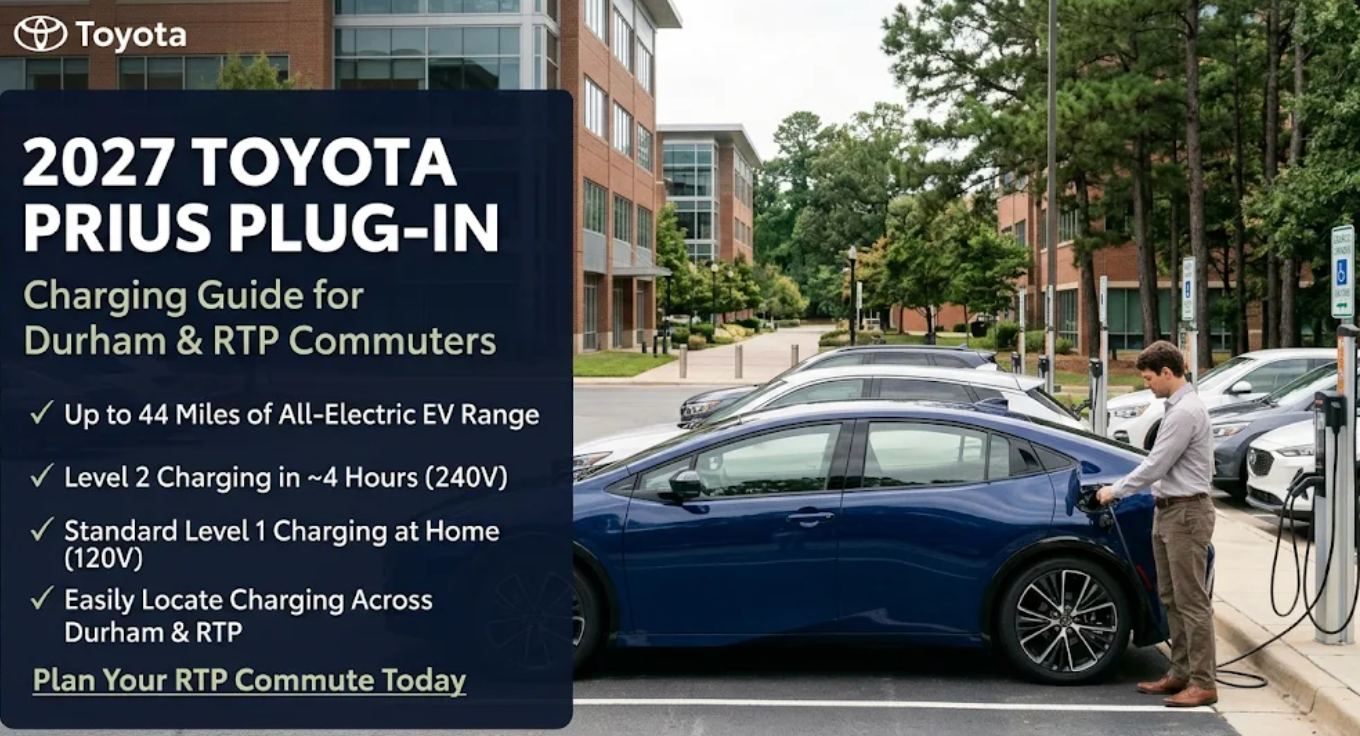
See how 2027 Toyota Prius Plug-in Hybrid charging and electric range work for Durham and RTP commuters, including home and public charging options.

2027 Toyota Prius Plug-in Hybrid Charging RTP Guide

Toyota Ownership & Buying Guide • Durham, NC Why the Prius Plug-in Hybrid is the Perfect Commuter Vehicle for the Triangle Area The 2027 Toyota Prius Plug-in Hybrid can cover many Durham-to-RTP round trips on electricity alone, because Toyota lists an EPA-estimated all-electric range of up to 44 miles on the SE grade and up to 39 miles on the XSE, Nightshade, and XSE Premium grades. Toyota estimates a full charge takes about 11 hours on a standard 120V household outlet and about 4 hours on a 240V Level 2 charger under ideal conditions. When the battery runs low, the hybrid system takes over automatically, so an empty battery does not leave you stranded the way it could in a battery-electric vehicle. That combination is why the plug-in Prius keeps coming up for Triangle commuters who are curious about electric driving but not ready to depend on public chargers. Here at Mark Jacobson Toyota, we wrote this guide for drivers who want the practical side of ownership: how far the battery really goes on a weekday, what a home charging setup involves, where public charging fits around Durham and Research Triangle Park, and whether the plug actually saves money compared with the regular Prius hybrid. We use Toyota's published figures for the 2027 model year, current North Carolina energy prices, and clearly labeled assumptions so you can swap in your own commute. Definition: A plug-in hybrid electric vehicle (PHEV) pairs a gasoline engine with a larger battery that can be recharged from an outlet, allowing a limited distance of all-electric driving before it operates as a conventional hybrid. The 2027 Toyota Prius Plug-in Hybrid uses a 13.6-kWh lithium-ion battery and a 2.0-liter engine. For commuters across Durham, Chapel Hill, Raleigh, and Research Triangle Park, it allows many daily trips on electricity without depending on public charging. Toyota Research Guide 2027 Prius Plug-in Hybrid Charging: Find Your Answer Powertrain and Electric-Only Range Realistic Electric Range for RTP Commuting Home Charging Setup and Charge Times Public Charging Near Durham and RTP Fuel Savings vs the Standard Prius Hybrid ToyotaCare and Battery Coverage Key Takeaways Prius Plug-in Hybrid Charging FAQ Plug-in Hybrid Powertrain and Electric-Only Range The 2027 Prius Plug-in Hybrid uses Toyota's fifth-generation hybrid system with a 2.0-liter four-cylinder engine and two motor-generators. Toyota rates the combined system at 220 net horsepower, with an EPA-estimated 0-60 mph time of 6.6 seconds, and the car is front-wheel drive with an electronically controlled continuously variable transmission. The traction battery is a 13.6-kWh lithium-ion pack, and Toyota lists only 120V and 240V charging times for it, which tells you how this car is meant to be used: plug in at home or at work, and let the gas engine handle the long trips. A standard hybrid recharges its small battery through braking and the engine, and you never plug it in. The plug-in version stores enough energy to drive dozens of miles with the engine off, then shifts into hybrid operation on its own once the usable charge is spent. For 2027, Toyota added dual-zone automatic climate control so the driver and front passenger can set separate temperatures, plus a new Inked exterior color. The core hardware, including the battery capacity and system output, carries over. That matters if you are comparing a 2027 against a remaining 2026 unit, a point we come back to in the ToyotaCare section. 2027 Prius Plug-in Hybrid Grades: Price, Electric Range, and Efficiency Grade Base MSRP* EPA-Est. Electric Range EPA-Est. MPGe Hybrid Mode MPG (City/Hwy/Comb.) SE $33,980 Up to 44 miles 128 55/46/51 XSE $37,230 Up to 39 miles 114 50/43/47 Nightshade $38,000 Up to 39 miles 114 50/43/47 XSE Premium $40,675 Up to 39 miles Confirm with our team Confirm with our team *Base MSRP excludes Toyota's $1,295 delivery, processing, and handling fee, taxes, title, registration, and dealer-installed options. Figures from Toyota.com The SE's longer electric range comes mostly from its smaller wheels and lighter curb weight. Toyota lists the SE at 3,461 pounds and the XSE at 3,516 pounds, and the SE also carries a lower drag figure. If maximum electric miles are your main goal, the SE is the efficiency choice. If you want the larger feature set on the XSE grades, you give up roughly five miles of rated electric range. Realistic All-Electric Range for RTP Commuting There is no single "typical" RTP commute, so here is a worked example you can adjust. Assume a driver who lives near our dealership on Durham-Chapel Hill Boulevard and works in Research Triangle Park, about 12 miles each way, for a 24-mile round trip. Five commuting days a week for 48 weeks comes to about 5,760 commuting miles per year. With a full overnight charge, that daily round trip sits comfortably inside the SE's 44-mile EPA estimate and the XSE's 39-mile estimate, which leaves a cushion for a lunch errand or a stop on the way home. Now stretch the example. A Chapel Hill driver heading to the far side of RTP, or a Durham driver commuting to downtown Raleigh, can easily exceed 40 miles round trip. In that case the car simply uses its electric range first and then finishes the drive as a hybrid. You still benefit from the electric miles; you just do not complete the whole day without gas. A few conditions can shorten electric range in everyday use: Sustained highway speeds on I-40 or NC-147 use more energy per mile than stop-and-go surface streets. Heavy use of climate control during a humid Triangle summer or a cold January morning draws on the same battery. Cold temperatures generally reduce how much usable energy a lithium-ion battery delivers. Extra passengers and cargo add weight. Treat the EPA number as a planning figure, not a promise. If your round trip is well under the rated range, most weekday driving can happen on electricity with regular overnight charging; if it is well above, the gap between the plug-in and a regular hybrid narrows. Home Charging Setup and Charge Times Regular access to an outlet is what makes this Prius different from a standard hybrid. Toyota confirms that a dual-voltage charging cable is supplied with the 2027 Prius Plug-in Hybrid. You can charge from a suitable 120-volt household outlet, or use compatible 240-volt Level 2 equipment for a faster refill. Have a licensed electrician evaluate an outlet or circuit if you are unsure about its condition or capacity; do not assume an extension cord or an aging garage outlet is safe for continuous charging. Prius Plug-in Hybrid Charging Options at a Glance Charging Method Typical Location Toyota-Estimated Time to Full Best Fit Level 1 (120V) Standard household outlet, ideally on a dedicated circuit About 11 hours Overnight charging when you park from early evening to morning Level 2 (240V) Home wall-mounted equipment, workplaces, public parking decks About 4 hours Shorter overnight windows, two daily trips, or topping up at work DC fast charging Highway fast-charging sites Not listed by Toyota for this model Plan on Level 1 or Level 2; use hybrid mode on road trips Charge times are Toyota estimates under ideal conditions and can vary with temperature, battery state, and the electrical supply. Confirm the charge port type and any adapter needs on a specific vehicle with our team before buying charging equipment. In practice, Level 1 charging works well if you are home from about 7 p.m. to 6 a.m. That 11-hour window matches Toyota's estimate for a full charge from a depleted battery, and most nights you will start with some charge already in the pack. Level 2 makes more sense if your household parks late and leaves early, if two drivers share the car, or if you want to recharge between a morning commute and an evening trip. A few planning steps before you install anything: Have a licensed electrician check whether your garage outlet is on a circuit shared with freezers, power tools, or other heavy loads. Ask about permits, since Durham, Wake, and Orange County jurisdictions may require one for new 240V circuits. Check with your electric utility, such as Duke Energy, about any current EV charging programs or time-of-use rates, because program terms change. Renters and condo owners should confirm parking-space access to an outlet before relying on home charging. The cost side is simple to estimate. The U.S. Energy Information Administration reported an average North Carolina residential electricity price of 14.95 cents per kilowatt-hour for August 2026. Using the SE's EPA rating of 128 MPGe, which works out to roughly 26.3 kWh per 100 miles, electric driving costs about 3.9 cents per mile at that average rate. Your utility bill, rate plan, and charging losses will move that number up or down. Public Charging Options Near Durham and RTP Public charging is a convenience for a plug-in hybrid, not a requirement. If a public station is occupied or out of service, you simply drive on as a hybrid. At a compatible Level 2 station, a multi-hour parking stop can restore a useful portion of the battery. But availability, parking rules, and fees vary by location. Check the station’s current connector, access requirements, and operating status before making charging part of your day. Unlike a battery-electric vehicle, this Prius can continue in hybrid mode if there is no available charger. The most reliable way to find current stations is a live map rather than a printed list, since locations, pricing, and access rules change often. Good options include: The U.S. Department of Energy's Alternative Fuels Data Center station locator, which lets you filter by Level 2 and connector type. Charging network apps and community maps that show real-time availability and user check-ins. The Toyota app, which can help locate charging and, with the right Connected Services trial or subscription, show charge status. Check whether a station bills by the hour, the kilowatt-hour, or the session. An hourly rate can make a slow public session cost more per mile than charging at home. Fuel Savings and Ownership Cost vs the Standard Prius Hybrid This is where we want to be careful, because the plug-in does not automatically save money over the regular Prius. The standard 2027 Prius LE is rated at an EPA-estimated 59/50/55 MPG with a base MSRP of $28,755, while the Prius Plug-in Hybrid SE starts at $33,980. North Carolina gasoline was also relatively inexpensive at the end of October 2026, with AAA reporting a statewide average of about $3.43 per gallon for regular on October 29. Estimated Annual Energy Cost: 12,000 Miles in North Carolina Scenario (12,000 miles per year) Cost per Mile Estimated Annual Energy Cost Prius Plug-in Hybrid SE, 100% electric miles About 3.9 cents About $472 Prius Plug-in Hybrid SE, 60% electric and 40% hybrid miles About 5.0 cents (blended) About $606 2027 Prius LE hybrid (55 MPG combined) About 6.2 cents About $748 Older vehicle averaging 30 MPG About 11.4 cents About $1,371 Assumptions: 14.95 cents per kWh (EIA North Carolina residential average, August 2026), $3.43 per gallon (AAA North Carolina average, October 2026), EPA ratings of 128 MPGe and 51 MPG for the SE, and 55 MPG for the Prius LE. Estimates exclude maintenance, insurance, taxes, and fees and are for comparison only. The table shows a pattern that surprises some shoppers. For a driver replacing an older 30 MPG car, either Prius cuts energy spending sharply. Between the two Priuses, the gap is much smaller, roughly $140 to $280 per year in these scenarios. North Carolina also charges an additional annual registration fee for plug-in hybrids, listed by the U.S. Department of Energy's Alternative Fuels Data Center at $107.25, which offsets part of that difference. The federal new clean vehicle tax credit is also not available for vehicles acquired after September 30, 2025, according to the IRS, so it should not be part of a 2027 purchase calculation. For RTP commuters with home charging, the 2027 Prius Plug-in Hybrid makes the most sense when the value of driving most weekday miles on electricity, plus its 220 horsepower and quieter electric operation, matters more to you than the lowest purchase price. If your priority is the lowest total cost and you cannot charge reliably at home, the standard Prius hybrid is likely the better financial fit because it delivers similar efficiency without the higher MSRP or the plug-in registration fee. Either way, comparing current pricing, incentives, and financing on both models side by side gives you a clearer answer than fuel math alone. A short way to decide: Lean toward the Plug-in Hybrid if you can charge at home or work, your round trip is under about 35 to 40 miles, and you value electric driving and stronger acceleration. Lean toward the standard Prius if you park on the street without an outlet, drive long highway distances daily, or want the lowest upfront price. Consider AWD needs too. Toyota offers the standard Prius with available all-wheel drive on several grades, while the Plug-in Hybrid is front-wheel drive. ToyotaCare and Plug-in Hybrid Battery Coverage The 2027 Prius Plug-in Hybrid comes with ToyotaCare normal factory-scheduled maintenance for one year or 10,000 miles, whichever comes first. Toyota’s model-year-specific program literature states that 2026 and earlier Toyota vehicles generally received two years or 25,000 miles under the previous terms. If you compare a 2027 car against a remaining 2026, check both model years’ actual coverage; the difference may affect your first two years of routine service planning. Toyota’s model-year-2027 ToyotaCare brochure describes three years of roadside assistance with unlimited mileage for Prius and PHEV models, while Toyota’s July 2026 Prius Plug-in Hybrid announcement describes two years. That mismatch should not be presented as settled coverage. Before buying, request the current VIN-specific ToyotaCare and roadside-assistance terms from Mark Jacobson Toyota and keep a copy with the purchase documents. The battery coverage is strong. Toyota.com lists these 2027 warranty terms for the Prius Plug-in Hybrid: Hybrid battery warranty: 10 years or 150,000 miles Hybrid system warranty: 8 years or 100,000 miles Basic warranty: 3 years or 36,000 miles Powertrain warranty: 5 years or 60,000 miles Connected Services matter for a plug-in too. Toyota lists a 5-year trial for Remote Connect, Safety Connect, and Service Connect on the 2027 model, which supports features such as remote climate control and vehicle status in the Toyota app. Trials end, and continued use requires a subscription after the trial period. After ToyotaCare ends, our Toyota service team in Durham can follow the same factory maintenance schedule with Genuine Toyota parts. Key Takeaways The 2027 Prius Plug-in Hybrid offers EPA-estimated electric range of up to 44 miles on the SE and up to 39 miles on the XSE, Nightshade, and XSE Premium. Toyota estimates about 11 hours to charge on a 120V outlet and about 4 hours on 240V Level 2, so many owners only need overnight home charging. At August 2026 North Carolina electricity prices, electric driving in the SE costs roughly 3.9 cents per mile before charging losses and rate differences. Savings over the standard Prius hybrid are modest in North Carolina, so the plug-in makes the most sense for drivers who can charge at home and value electric driving. MY2027 ToyotaCare covers scheduled maintenance for 1 year or 10,000 miles, compared with 2 years or 25,000 miles on 2026 and earlier models. The hybrid battery is covered for 10 years or 150,000 miles under Toyota's 2027 warranty terms. Frequently Asked Questions How long does it take to charge a 2027 Toyota Prius Plug-in Hybrid? Toyota estimates about 11 hours for a full charge on a standard 120V household outlet and about 4 hours on a 240V Level 2 charger under ideal conditions. Toyota does not list DC fast charging for this model. Most owners plug in overnight at home, and if the battery runs out during the day, the car continues as a hybrid using gasoline. Starting with a partial charge shortens the time. Can I use the Prius Plug-in Hybrid without ever charging it? Yes, the car operates as a regular hybrid when the battery is depleted, and Toyota rates the SE at 51 MPG combined in hybrid mode. However, you would be paying for a larger battery you are not using. If you cannot charge at home or work, we suggest comparing the standard Prius, which has a lower MSRP and similar hybrid efficiency, before deciding. Is 44 miles of electric range enough for an RTP commute? For many drivers it is. A 24-mile round trip between central Durham and RTP fits within the SE's EPA-estimated 44 miles with room to spare, assuming a full overnight charge. Longer commutes, highway speeds, extreme heat or cold, and heavy climate control use reduce real-world range. Beyond that point the car switches to hybrid operation automatically, so you never have to stop to charge. Does the 2027 Prius Plug-in Hybrid qualify for a federal tax credit? According to the IRS, the new clean vehicle credit is not available for vehicles acquired after September 30, 2025, so a 2027 Prius Plug-in Hybrid purchased today does not qualify for it. Utility programs and manufacturer offers can change, so ask our team about current Toyota offers and any local programs. This is general information, not tax advice; please consult a tax professional for your situation. The best next step is to compare your actual round-trip distance and charging access with a standard Prius. Mark Jacobson Toyota is at 4516 Durham-Chapel Hill Blvd, Durham, NC 27707. Call 919-493-5599 or explore available vehicles before you visit. Schedule a Test Drive Call Our Durham Team Related Toyota Insights & Ownership Guides Hybrid Comparison 2026 Toyota Prius vs Prius Plug-in Hybrid: Which Saves You More in Durham? Compare the regular Prius and the plug-in version side by side for Durham driving, efficiency, and everyday ownership. Read More → Electrified Ownership Toyota Hybrids vs. Toyota EVs: Choosing the Right Option for You See how hybrids, plug-in hybrids, and battery-electric Toyotas differ in charging, range, and daily routines. Read More → RTP Commute Guide 2026 Toyota Camry Hybrid MPG and Commute Guide for RTP Drivers Compare how a hybrid sedan handles Research Triangle Park commuting if you would rather skip the plug entirely. Read More → Plug-in Hybrid Lifestyle RAV4 Prime Spring Getaway Guide Near Durham See how a Toyota plug-in hybrid SUV fits weekend trips around the Triangle when you need more cargo room than a Prius. Read More →